
Multi-Framework Gap Analysis: Best Practices
A practical guide to consolidating ISO, SOC and NIST requirements into a unified control set that cuts audit time, lowers cost, and targets high-risk remediation.

Managing compliance across multiple frameworks like ISO 27001, SOC 2, and NIST 800-53 doesn’t have to be overwhelming. A multi-framework gap analysis helps you identify overlapping controls, reduce redundancies, and close compliance gaps efficiently.
Key takeaways:
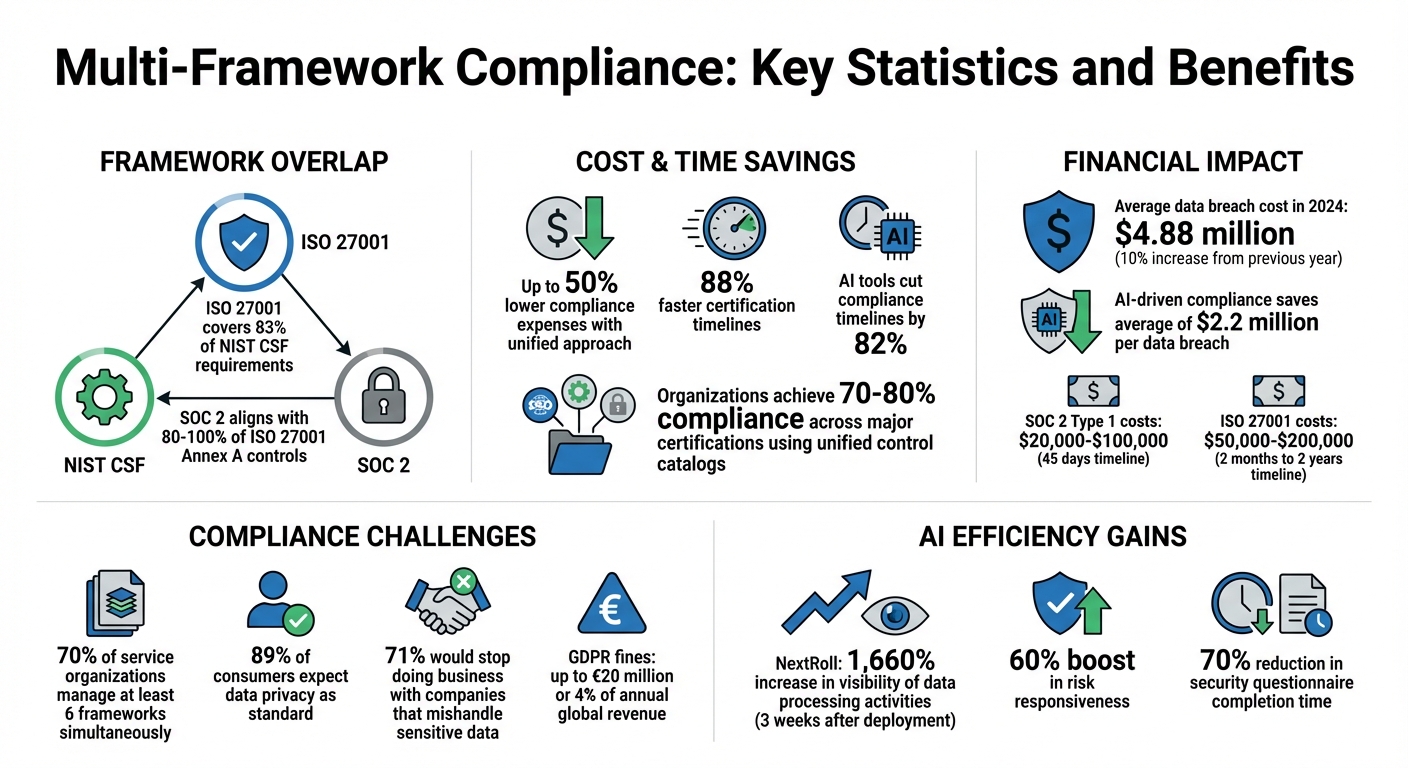
- Overlap saves time: ISO 27001 covers 83% of NIST CSF requirements, and SOC 2 aligns with 80%-100% of ISO 27001 Annex A controls.
- Unified compliance reduces costs: Organizations addressing multiple frameworks simultaneously can significantly cut compliance expenses and shorten certification timelines.
- Challenges to watch for: Resource misallocation, redundant evidence collection, and conflicting requirements are common pitfalls.
To succeed:
- Document your current compliance status: Use tools like a Statement of Applicability (SoA) or NIST Current Profile.
- Map controls across frameworks: Identify shared requirements to streamline efforts.
- Set SMART goals: Focus on specific, measurable, and time-bound compliance objectives.
- Prioritize based on risk: Address high-risk gaps first and leverage overlapping controls.
- Automate with AI tools: Platforms like ISMS Copilot can cut compliance timelines by 82% and reduce manual work.
Multi-Framework Compliance: Key Statistics and Benefits
How to Conduct Gap Assessment in ISO 27001
sbb-itb-4566332
Assessing Your Current Compliance Status
To build a strong compliance foundation, start by documenting your current compliance status. This ensures you’re not duplicating efforts or overlooking critical requirements.
Documenting Your Current State
Begin by defining your scope. List all relevant areas, processes, and assets, including hardware, software, networks, databases, and human resources. Don’t forget to account for statutory, regulatory, and contractual obligations.
A key part of this documentation is the Statement of Applicability (SoA). This document outlines applicable controls, their implementation status (e.g., Implemented, In Progress, or No), and any justified exclusions. As iso-docs.com explains:
"The Statement of Applicability acts as a bridge between your risk assessment and risk treatment measures identified by ISO 27001 consultants or subject matter experts."
If you’re using a NIST-based framework, create a Current Profile that identifies which category and subcategory outcomes you’ve already achieved. This profile acts as your baseline for risk assessments and helps clarify your starting point before setting improvement goals.
For ISO 27001 compliance, mandatory documentation includes the ISMS scope, information security policy, SoA, asset inventory, access control policy, risk assessment and treatment reports, monitoring results, and internal audit records. Managing this documentation across multiple frameworks can get tricky. To simplify:
- Use standardized templates for consistency.
- Automate evidence collection to capture detailed information.
- Involve stakeholders from IT, HR, Legal, and Finance to ensure a comprehensive approach.
- Update documentation annually or after significant changes.
Once your documentation is complete, you can start aligning your controls with the requirements of each framework.
Mapping Controls to Framework Requirements
The next step is mapping your documented controls to the specific requirements of your chosen frameworks. This process often highlights overlaps that can simplify compliance across multiple frameworks.
Organize your controls into three main types: technical (e.g., encryption, firewalls), administrative (e.g., policies, training), and physical (e.g., facility access). Use the NIST Cybersecurity Framework (CSF) functions - Identify, Protect, Detect, Respond, Recover, and the newer Govern function - as a foundation to align controls from standards like ISO 27001 or NIST SP 800-53.
An asset-based approach is critical here. Keep a live inventory of all your information assets, assess their vulnerabilities, and determine which framework requirements apply. As iso-docs.com puts it:
"You can't protect what you don't know you have."
To ensure thorough mapping, assemble a cross-functional team from IT, operations, legal, and incident management. Together, define risk criteria - such as using a 5x5 impact-likelihood matrix - and assign ownership for each risk and control.
With the global average cost of a data breach reaching $4.88 million in 2024 (a 10% increase from the previous year), accurate control mapping is more crucial than ever. Use standards like ISO 27005 or NIST SP 800-30 as guides during this process. For federal compliance, NIST SP 800-53 offers detailed requirements, while modern Governance, Risk, and Compliance platforms can centralize policy management and automate tracking.
Setting Target Compliance Goals
Using your documented state and mapped controls as a foundation, it's time to define clear compliance goals. These goals should guide your efforts across various frameworks and help ensure efficient, focused action.
Creating SMART Compliance Goals
Your compliance goals should follow the SMART criteria: Specific, Measurable, Achievable, Relevant, and Time-bound. Avoid vague objectives like "improve security", especially when managing multiple frameworks. Instead, aim for precise outcomes, such as: "Achieve SOC 2 Type 1 readiness and address key ISO 27001 Annex A gaps within 90 days for our European SaaS product line."
To monitor progress, use dashboards that track control implementation and evidence collection. Given the complexity of managing multiple frameworks, cross-framework compliance automation can be a game changer.
Keep goals achievable by aligning them with your organization's current maturity level. For example, SOC 2 Type 1 certification can often be completed in as little as 45 days, with costs ranging from $20,000 to $100,000. Meanwhile, ISO 27001 certification can take anywhere from two months to two years and cost between $50,000 and $200,000. Michelle Strickler, Lead Product & Compliance Experience Strategist at Strike Graph, emphasizes the importance of understanding ISO requirements:
"The biggest challenge I see with ISO is not reading the actual ISO 27001 document and missing the program needs to be maintained".
If your team is stretched thin, starting with SOC 2's more flexible, risk-based framework might be more practical than ISO 27001's structured ISMS requirements.
Ensure goals are relevant by aligning them with your business needs. Stephen Ferrell, Chief Strategy Officer at Strike Graph, offers this advice:
"If you are a US company with US-centric customers, SOC is probably going to be your pick. If you are a more global organization, ISO 27001 is a better bet".
This alignment is critical, especially when considering that 89% of consumers expect data privacy as a standard, and 71% would stop doing business with companies that mishandle sensitive data.
Finally, set time-bound milestones. These should align with audit windows and critical business deadlines. If pursuing multiple certifications, stagger them strategically. Organizations using automated GRC platforms often report faster compliance timelines because automation helps overlap preparation efforts by identifying common controls across frameworks.
Once your SMART goals are in place, the next step is to prioritize requirements for maximum compliance efficiency.
Prioritizing Framework Requirements
When prioritizing framework requirements, focus on three main factors: regulatory urgency, business impact, and resource efficiency.
Start with regulatory urgency. Statutory and contractual obligations must come first to avoid penalties. For example, non-compliance with GDPR-adjacent frameworks can result in fines up to €20 million or 4% of annual global revenue, whichever is higher. Similarly, U.S. federal contractors must adhere to NIST SP 800-53, while healthcare organizations often prioritize HITRUST. Defense contractors face mandatory CMMC requirements.
Next, consider business impact by using a risk matrix to evaluate threat likelihood and potential damage. The NIST Cybersecurity Framework recommends comparing your Current Profile to a Target Profile to identify gaps. From there, create a prioritized action plan that reflects mission needs, costs, and risks. Focus on activities critical to service delivery and those that protect high-value assets.
Finally, optimize for resource efficiency by leveraging control overlap. Framework "crosswalks" allow you to implement a single control that meets multiple requirements, reducing duplicate work and improving ROI. For instance, an access control policy compliant with ISO 27002 standards may also satisfy COBIT and HIPAA requirements.
To streamline prioritization, follow a simple approach: address high-risk regulatory requirements first, tackle high-impact business needs next, and then implement controls that satisfy multiple frameworks. Regularly review your priorities, especially after security incidents, major infrastructure changes, or updates to regulatory standards, rather than waiting for annual audits.
Identifying and Addressing Gaps
Once you've set your compliance goals and priorities, the next step is to identify the gaps between where you are now and where you need to be. This means comparing your Current Profile (the controls and practices you already have in place) to your Target Profile (the standards you aim to meet). The difference between these two profiles highlights your compliance gaps.
Using your documented controls and mapped requirements, identifying these gaps ensures that your efforts are focused on the areas that need improvement most. Clearly defining these gaps lays the groundwork for a targeted and effective remediation strategy.
Organizing Gaps by Framework and Domain
Gaps generally fall into three categories: missing controls, inadequate controls, and insufficient evidence.
To streamline the process, leverage a Unified Control Matrix (UCM) to map shared requirements across multiple frameworks. This approach consolidates overlapping requirements, making it easier to address multiple gaps with a single remediation effort. For example, the UCM can link SOC 2 Trust Services Criteria to ISO 27001 Annex A controls. This way, one action can resolve compliance issues across several frameworks. Micah Spieler, Chief Product Manager at Strike Graph, underscores this advantage:
"By joining frameworks together at the control level, we're able to provide our customers with a platform to essentially design their own control environment... the controls operate as the glue".
Once you've categorized gaps by type and domain, prioritize them based on three factors: risk severity (how likely the gap is to lead to data exposure), audit criticality (the chance it could trigger a formal audit observation), and implementation effort. For example, Rocketlane, a software company, adopted the Sprinto GRC platform in 2024 to manage compliance across multiple frameworks. By automating gap detection and evidence collection, they saved two weeks of manual work while maintaining compliance with five different frameworks simultaneously.
Using Analysis Tools for Root Cause Identification
Understanding the root cause of a gap is essential for effective remediation.
The Fishbone Diagram (or Ishikawa Diagram) is a visual tool that helps organize potential causes into categories like Methods, Materials, Machines, People, and Environment. This tool is especially useful for tackling complex compliance failures with multiple contributing factors. For instance, inadequate encryption controls might stem from outdated infrastructure or insufficient employee training.
For a simpler approach, the 5 Whys Technique involves repeatedly asking "why" a gap exists until you uncover its root cause. For example, if you lack audit-ready documentation, asking "why" multiple times might reveal the absence of a centralized repository for storing evidence.
To focus your efforts, use a Pareto Chart to identify the 20% of causes responsible for 80% of compliance failures. In many cases, the majority of issues can be traced back to just a small number of root causes.
Clara, a financial services platform, used proactive compliance tools to strengthen its security posture. This initiative boosted their risk responsiveness by 60% and reduced the time spent completing security questionnaires by 70% compared to their previous manual process.
When working across multiple frameworks, don't forget to account for Complementary User Entity Controls (CUECs) and Complementary Subservice Organization Controls (CSOCs). In SOC 2 reporting, CUECs are responsibilities that fall on the customer, while CSOCs are the vendor's responsibility. Organizations can streamline this by using a SOC 2 Copilot to automate control implementation. Both must be reviewed to ensure there are no weak links in the overall security chain.
These analyses will guide the development of a unified remediation plan in the next phase.
Building and Executing Action Plans
Once you've pinpointed gaps and their root causes, the next step is to craft a single, cohesive remediation plan. This plan should tackle overlapping framework requirements and prioritize actions based on the severity of risks and their potential impact. Addressing high-risk gaps first ensures your efforts are both effective and efficient.
Your remediation plan should include three essential components: a Risk Treatment Plan (RTP) outlining specific steps to mitigate each risk, a Statement of Applicability (SoA) detailing which controls are included or excluded and why, and a control mapping that aligns various standards to a unified set of practical controls. This approach not only avoids redundant work but also ensures alignment across frameworks, paving the way for accountability and measurable progress.
Creating a Unified Remediation Plan
To categorize and manage remediation actions, apply the 4Ts framework - Treat, Avoid, Transfer, Accept. Here's how it works:
- Treat risks by implementing measures like multi-factor authentication (MFA) across systems.
- Avoid risks entirely by discontinuing high-risk practices, such as unnecessary data collection.
- Transfer risks through options like cyber insurance.
- Accept low-level risks when the cost of mitigation outweighs the potential impact.
Focus on critical controls - MFA, logging, backup, and encryption - that align with frameworks like SOC 2, ISO 27001, and NIST CSF. NMS Consulting suggests a 90-day roadmap to jumpstart progress: scope systems, address high-risk gaps, and establish governance routines within three months using an AI ISO 27001 implementation assistant to prepare for audits. This timeline keeps teams motivated and reassures stakeholders with visible progress.
To streamline efforts, use mapping references to align multiple framework requirements with one implementation. For instance, NIST highlights the adaptability of its framework:
"The Framework is not designed to replace existing processes; an organization can use its current process and overlay it onto the Framework to determine gaps in its current cybersecurity risk approach and develop a roadmap to improvement."
Ensure your cross-functional team is on the same page. Maintain a centralized repository for policies, procedures, and risk registers , often managed through an ISO 27001 toolkit, to promote consistency across frameworks.
Once your unified plan is ready, the next step is assigning clear responsibilities and setting firm deadlines.
Assigning Responsibilities and Timelines
Every identified risk must have a specific owner to ensure nothing slips through the cracks. A RACI matrix (Responsible, Accountable, Consulted, Informed) can help clarify who handles what, especially for complex areas like supply chain risk management. These roles should be documented in policies and even reflected in job descriptions.
Leadership plays a critical role in overseeing cybersecurity initiatives. Senior management must approve policies, allocate resources, and review strategies regularly. The CISO should also review and update strategies at least once a year to ensure they remain relevant and actionable.
Break large projects into smaller, manageable tasks with clear milestones and an audit schedule. This schedule should include specific dates, processes, and responsibilities. Regular review cycles - quarterly or after major events - are essential for keeping executives informed and tracking progress. For SOC 2 Type 2 compliance, plan for 3 to 6 months of remediation and evidence collection, followed by a 3 to 12-month operational period.
Best practices for success:
| Component | Best Practice |
|---|---|
| Responsibilities | Use a RACI matrix; include roles in job descriptions; appoint a dedicated Information Security Officer |
| Timelines | Set clear milestones; prioritize by risk level; establish quarterly review cycles |
| Accountability | Require senior management approval; review resource allocation periodically |
| Monitoring | Measure control effectiveness over time using KPIs |
Plan for regular reviews of your remediation plan, triggered by annual cycles, significant security incidents, or major system changes. To maintain compliance, integrate cybersecurity responsibilities into hiring, onboarding, and offboarding processes. Regularly assess team performance against established goals to ensure alignment with your objectives.
The stakes are high. For example, non-compliance with the EU AI Act can result in fines of up to €40 million or 7% of annual global revenue. Additionally, weak risk assessments can leave up to 70% of vulnerabilities unaddressed. By assigning clear roles and setting realistic timelines, you create a structure that ensures your remediation plan is both actionable and effective.
Using AI Tools for Multi-Framework Compliance
Handling multi-framework compliance manually can be a real headache - it's slow, prone to mistakes, and eats up valuable time. That’s where AI-powered tools step in, automating tasks like control mapping, evidence collection, and documentation. This can cut process time by as much as 82% and save businesses an average of $2.2 million per data breach. Considering that the average data breach in 2024 is projected to cost $4.88 million - a 10% jump from the previous year - the financial benefits of AI-driven compliance are hard to ignore.
These efficiency and cost savings highlight how AI is reshaping the compliance landscape with best practices that streamline operations.
How AI Improves Compliance Efficiency
AI tools take compliance to the next level by automating some of the most tedious tasks, like gap analysis. Instead of manually comparing requirements, AI platforms can quickly identify overlapping controls across frameworks such as ISO 27001, SOC 2, and NIST 800-53. This automated control mapping allows you to implement solutions like multi-factor authentication once and have them meet the requirements of multiple standards at the same time.
Another big win is evidence reuse. AI reviews policies, logs, and risk assessments to suggest the best cross-mapping strategies. This cuts out repetitive work and ensures your compliance efforts stay consistent. Tim Blair, Senior Manager at Vanta, sums it up well:
"Leveraging cross-mapping provides another lens to analyze risk... the delta between frameworks can identify a legitimate need for additional controls to combat risk - this is the biggest benefit".
AI also supports continuous monitoring, running automated tests hourly to catch configuration drift or new gaps in real-time. This replaces outdated manual snapshots with ongoing oversight, keeping your compliance up-to-date. Companies using these tools can achieve certifications in half the time it would take with traditional manual methods - reducing timelines from months to just weeks.
| Feature | Manual Gap Analysis | AI-Powered Gap Analysis |
|---|---|---|
| Mapping Speed | Hours/Days per framework | Seconds/Minutes via automation |
| Evidence Handling | Manual tagging and reformatting | Automated reuse across standards |
| Accuracy | High chance of human error | High precision with AI intelligence |
| Guidance | Static spreadsheets | Dynamic, step-by-step workflows |
| Monitoring | One-time snapshots | Real-time tracking |
ISMS Copilot Features and Benefits
ISMS Copilot is purpose-built for multi-framework compliance, supporting 20+ standards like ISO 27001, SOC 2, and NIST 800-53. Unlike general AI tools like ChatGPT or Claude, it uses Retrieval-Augmented Generation (RAG) to pull from a curated library of field-tested compliance knowledge and consulting projects. This means the guidance you get is practical and specific - not generic advice pulled from the internet.
The platform’s cross-framework control mapping makes it easy to align controls across multiple standards, ensuring consistency in managing different frameworks. You can upload files like PDFs, DOCXs, and spreadsheets - even lengthy 20+ page reports - and the tool will perform automated gap analysis against specific framework requirements. It also generates audit-ready policies, procedures, and risk assessments in minutes, giving you a solid starting point to refine instead of starting from scratch.
For complex compliance tasks, ISMS Copilot One breaks down intricate workflows into clear, actionable steps with tailored guidance. It uses dedicated Workspaces to keep different projects or audits separate, so there’s no risk of mixing up policies or files between frameworks. Privacy is a top priority - the platform doesn’t use user data to train its AI models and ensures GDPR-compliant practices, including EU data residency in Frankfurt.
1,000+ organizations rely on ISMS Copilot to manage their compliance programs, and the platform boasts a perfect 5.0/5 rating from 20 expert testimonials. As founder Tristan Roth puts it:
"We're not here to replace your expertise - we're here to amplify it".
With pricing starting at just $20 per month for individual consultants and a free tier available to explore features, ISMS Copilot makes AI-powered compliance accessible for teams of all sizes. This tool is a key part of tackling the challenges of multi-framework compliance with confidence and efficiency.
Continuous Monitoring and Updates
Achieving certification is just the starting point - maintaining compliance across multiple frameworks requires constant vigilance. As NIST SP 800-137 explains, continuous monitoring provides "visibility into organizational assets, awareness of threats and vulnerabilities, and visibility into the effectiveness of deployed security controls". This approach shifts the focus from static, one-time assessments to near real-time oversight, which is essential when managing standards like ISO 27001, SOC 2, and NIST 800-53 simultaneously.
Compliance frameworks are not static - they evolve over time. For instance, on August 27, 2025, NIST released SP 800-53A Release 5.2.0, introducing new assessment procedures such as SA-15, SA-24, and SI-02. Similarly, ISO/IEC 27001 recently incorporated a Climate Change Amendment into all management systems standards under Annex SL. These updates can reveal gaps in controls that were previously aligned, requiring organizations to adapt quickly.
Setting Up Review Cycles
To ensure compliance over the long term, continuous oversight must be prioritized.
Establish a consistent schedule for reviewing your compliance status. While annual reviews are a baseline, quarterly cycles are more effective for organizations juggling multiple frameworks. After conducting gap analyses or risk assessments, update your Statement of Applicability (SoA) promptly to reflect any changes.
A 90-day governance cycle is a practical approach. Every quarter, perform control testing, vendor risk evaluations, and incident response drills. This aligns with modern standards like PCI DSS v4.0.1, which emphasize ongoing control verification over one-off assessments. Include cross-functional teams - such as IT, HR, and legal - in these reviews to ensure controls remain accurate and applicable across all frameworks.
| Review Activity | Recommended Frequency | Key Objective |
|---|---|---|
| Management Review | At least annually | Evaluate ISMS effectiveness and relevance |
| Control Testing | Quarterly | Confirm safeguards are functioning as intended |
| SoA Update | Annually or after changes | Document inclusion/exclusion of controls |
| Risk Assessment | Regularly/Continuous | Identify emerging threats and vulnerabilities |
Adapting to Framework Changes
Staying ahead of framework updates is crucial. Subscribe to notifications from standards bodies like NIST, ISO, and the Cloud Security Alliance. When major updates occur - such as the transition from ISO/IEC 27001:2013 to ISO/IEC 27001:2022 - organizations must follow specific guidelines like IAF MD26:2023 to maintain accreditation. Missing these deadlines can jeopardize certifications.
Real-time monitoring tools can simplify this process by keeping you informed about changes and enabling swift, cost-effective adjustments. Using a cross-framework ISMS assistant can further streamline these updates while ensuring data privacy. As noted in NIST SP 800-37 Rev. 2, "the RMF also promotes near real-time risk management and ongoing information system and common control authorization through the implementation of continuous monitoring processes".
Invest in AI-powered policy assistants that automatically update policies and procedures. For organizations managing AI systems, frameworks like NIST's AI Risk Management Framework require specialized oversight, including monitoring for bias and assessing model robustness. Assign specific roles to track updates and implement adjustments, ensuring accountability throughout transitions.
Conclusion
As outlined, adopting a structured, risk-focused, and AI-driven approach can revolutionize how organizations handle compliance. Managing compliance across multiple frameworks no longer has to mean drowning in manual tasks. By using a unified control catalog and shared mapping, businesses can achieve 70–80% compliance across major certifications, significantly reducing redundant efforts. This "collect once, reuse everywhere" approach is a game-changer, cutting down the audit fatigue that comes from treating each framework as a standalone challenge.
This method also enables more precise remediation efforts. By prioritizing high-risk gaps that impact critical systems and sensitive data, teams can focus their resources where they matter most. As Rob Pierce, Senior Cybersecurity and Compliance Manager at Linford & Co., emphasizes:
"The key? Streamlining your cybersecurity compliance so one audit supports multiple certifications".
AI tools play a pivotal role in speeding up this process. For instance, ISMS Copilot supports 20+ frameworks, including ISO 27001, SOC 2, and NIST 800-53, helping organizations accelerate compliance work and reduce consultant dependency. A striking example comes from NextRoll, which saw a 1,660% increase in visibility of its data processing activities just three weeks after deploying an AI-native platform in 2024.
The shift from annual "audit panic attacks" to continuous, automated oversight isn't just a convenience - it's a necessity. With nearly 70% of service organizations juggling at least six frameworks simultaneously, staying agile amid evolving regulations and maintaining year-round audit readiness are what separate industry leaders from those struggling to keep up.
FAQs
How does performing a gap analysis across multiple frameworks improve compliance efforts?
Conducting a gap analysis across multiple frameworks gives you a consolidated view of how your current security practices measure up against standards like ISO 27001, SOC 2, NIST CSF, or PCI-DSS. By spotting overlapping requirements, you can zero in on the unique gaps that need attention. This eliminates redundant tasks, such as repeatedly collecting the same evidence or rewriting policies for different frameworks. The result? Less time spent, lower costs, and a smoother path to meeting multiple compliance standards.
Tools powered by AI, such as ISMS Copilot, take this process to the next level. These tools automate control mapping for 20+ frameworks, pinpoint specific gaps, and generate audit-ready documentation. By streamlining workflows and offering actionable insights, they help you build a prioritized compliance roadmap. This not only speeds up readiness but also reduces risks, simplifies audits, and cuts down the effort needed to achieve multi-framework compliance.
What are the advantages of using AI tools like ISMS Copilot for managing compliance?
AI tools like ISMS Copilot simplify the often-daunting task of compliance by transforming dense regulatory requirements into manageable, actionable steps. Tailored for security frameworks such as ISO 27001, SOC 2, and NIST 800-53, this tool offers customized guidance, ready-to-use templates, and detailed checklists. The result? Significant time savings and reduced effort compared to combing through lengthy documents manually.
One standout feature is its ability to automatically map and align controls across different frameworks. This creates a unified control set, cutting down on duplicate work and highlighting overlapping requirements. The benefits are clear: faster gap analyses, more precise reports, and quicker audit preparation. Additionally, by automating evidence collection and keeping up with the latest standards, ISMS Copilot helps organizations focus on addressing gaps and achieving compliance more effectively.
What’s the best way to prioritize compliance goals across multiple security frameworks?
To manage compliance goals across multiple frameworks effectively, start by building a unified baseline. This involves consolidating overlapping controls from the standards you need to address, such as ISO 27001, SOC 2, NIST 800-53, or GDPR. By identifying shared requirements, you can streamline efforts, saving both time and resources. Once your baseline is in place, conduct a gap analysis for each framework to spot non-compliant areas. Assign a risk-based priority - high, medium, or low - to these gaps, focusing first on those with the highest risks, tightest legal deadlines, or most significant business impact.
When ranking these gaps, consider three key factors: business risk, external pressures (like audit deadlines or customer demands), and the effort required to resolve them. A straightforward scoring system can help you visualize which issues to address first for the greatest compliance benefit. Tools like ISMS Copilot can simplify this process by automating tasks like control mapping, scoring, and suggesting remediation steps, cutting down on manual work.
Keep your compliance plan adaptable. Update your baseline as new frameworks emerge or existing standards evolve. Reassess gaps regularly and adjust priorities accordingly. To maintain alignment with stakeholders, share clear timelines (e.g., January 15, 2026) and realistic cost estimates (e.g., $12,500 for a remediation project). This method ensures you tackle the most pressing compliance needs efficiently while staying organized across multiple frameworks.
Related Blog Posts
Related Posts
How AI Enhances Multi-Framework Compliance
AI unifies control mapping, automates evidence collection, and provides real-time monitoring to cut audit prep time and reduce compliance errors.
How Real-Time Alerts Reduce ISO 27001 Non-Compliance Risks
Real-time alerts detect threats fast, cut breach costs and audit failures, and keep ISO 27001 logs tamper-proof for continuous compliance.
AI Accuracy in Security: Specialized vs Generic
Specialized AI beats generic models for security compliance—higher accuracy, fewer hallucinations, and audit-ready documentation for ISO 27001 and GRC.