
Multi-Framework Compliance: AI's Role in Reports
AI turns multi-framework compliance from months of manual work into continuous, reusable, auditor-ready reporting.

Managing compliance across multiple frameworks is tough, but following multi-framework compliance best practices and using AI is simplifying the process. Here's the key takeaway: AI tools can reduce audit prep time by up to 90%, cut staffing needs by over 50%, and help organizations reuse up to 75% of controls across frameworks like ISO 27001, SOC 2, and NIST 800-53.
Why does this matter?
- Compliance often requires mapping thousands of control pairs, which can take hundreds of hours.
- AI automates evidence collection, control mapping, and report drafting, saving time and reducing errors.
- Organizations using AI report fewer audit findings and faster certifications.
For example, a company in 2025 completed three audits in under 8 months using AI, saving $500,000 compared to traditional methods. AI tools like ISMS Copilot provide framework-specific outputs, automate repetitive tasks, and ensure reports meet auditor expectations.
Bottom line: AI is transforming compliance from a manual, time-consuming process into a streamlined workflow, enabling continuous readiness and significant cost savings.
Automating Compliance Monitoring using AI, SIEM & GRC Tools | Advanced Audit System Architecture
sbb-itb-4566332
How AI Improves Multi-Framework Compliance Reporting
AI has turned compliance reporting into a streamlined, automated process. Instead of spending countless hours manually aligning policies with various frameworks, AI steps in to handle tasks like evidence collection, control mapping, and drafting reports. The payoff? Faster audits, fewer mistakes, and more time for teams to focus on strategic goals rather than tedious spreadsheets. Let’s dive into how AI achieves this by automating evidence collection, mapping controls across frameworks, and drafting tailored reports.
Automating Evidence Collection Across Frameworks
AI integrates directly with your existing tools through API connections to platforms like AWS, Azure, GCP, Okta, and HR systems. This allows it to automatically gather security configurations, access logs, and employee records - skipping the need for manual downloads. This approach supports a "collect once, use many" strategy, where a single piece of evidence (like an access review or password policy) can satisfy multiple controls across frameworks like SOC 2, ISO 27001, and HIPAA simultaneously.
Taking it a step further, Continuous Control Monitoring (CCM) enables automated testing on an hourly basis, replacing outdated point-in-time snapshots. For organizations using unified control libraries, this means they can reuse evidence for 80–90% of overlapping controls. For example, in May 2025, Arbor Education used Secureframe to manage compliance across ISO 27001, ISO 9001, PCI DSS, and GDPR. By centralizing evidence collection and control mapping, they slashed audit preparation time by 66%, cutting it down from six weeks to just two weeks.
Cross-Framework Control Mapping and Reconciliation
Mapping controls across frameworks is another area where AI shines. By using tools like Sentence-BERT (SBERT), AI can compare requirements, calculate similarity scores, and classify relationships as "equal" (identical), "intersect" (related but not identical), or "no relationship." This drastically reduces the time-consuming manual mapping process.
"Modern AI tools can analyze control requirements across frameworks and automatically generate a mapping of common controls... You'll free up your compliance team to focus on analysis, not spreadsheets." - Rob Pierce, Partner, Linford & Co
AI goes beyond speed by improving accuracy. It uses contextual analysis to understand nuanced terms - for instance, recognizing that "Inventory" under "Asset Management" refers specifically to hardware, not software licenses. Combining SBERT's speed with Large Language Models (LLMs) for deeper reasoning ensures mappings are precise and auditor-ready. Once mapped, this data feeds into framework-specific narratives, making the reporting process seamless and efficient.
Automated Drafting of Framework-Specific Reports
AI doesn’t stop at collecting evidence - it also writes reports. Through modular policy generation, AI tailors the same control to fit the language and format required by different frameworks. For example, a single password policy can be adapted to meet the requirements of ISO 27001 Annex A and SOC 2 CC6.2, all from one source document. This "control-as-code" approach transforms raw compliance data into polished, framework-specific narratives, producing complete System Security Plans (SSPs) or auditor-ready evidence packages in minutes.
Each piece of evidence is tagged with metadata (like its source, collection date, and framework relevance), ensuring the platform knows exactly what to include in each report. This method reduces audit preparation time by 50–75%, cutting staffing needs from over 200 hours to just 50–80 hours per audit.
Customizing Audit Reports for Specific Frameworks
After AI gathers evidence and maps controls, the next step involves creating reports tailored to specific frameworks. Each standard comes with its own set of requirements, formats, and terminology. For example, ISO 27001 auditors need risk assessments and a Statement of Applicability, while SOC 2 auditors look for evidence that controls have been consistently operational. NIST 800-53, on the other hand, demands detailed technical precision, especially for federal contractors. By leveraging Retrieval-Augmented Generation (RAG) and specialized compliance datasets, AI generates reports that align perfectly with each framework’s structure and language. This foundation allows for the detailed customization process described below.
Tailoring Reports for ISO 27001
Using the unified control mapping as a base, AI generates ISO 27001-specific reports like the Statement of Applicability (SoA) and risk assessments. These reports are central to ISO 27001 compliance. AI evaluates your existing controls and automatically creates an SoA, linking implemented controls to Annex A requirements. For risk assessments, AI drafts potential risk scenarios, assigns likelihood and impact scores, and suggests appropriate treatment plans. These documents are formatted to meet ISO 27001:2022 standards. Tools like ISMS Copilot, which use RAG, ensure that the output is aligned with the latest ISO 27001:2022 requirements, removing the complexity of translating your security measures into ISO-compliant language.
Customizing SOC 2 and NIST 800-53 Reports
AI also adapts its automated processes to produce accurate SOC 2 and NIST 800-53 reports. For SOC 2, the focus is on the Trust Services Criteria (TSC), which include security, availability, processing integrity, confidentiality, and privacy. AI generates examples of policies and links evidence - such as MFA logs or access reviews - to relevant criteria like CC6.1.
For NIST 800-53, the emphasis shifts to the technical and operational controls required by federal contractors. AI modifies foundational controls, such as password management, to meet NIST’s specific requirements. For instance, AI aligns controls with standards like PR.AC-1 for identity management, ensuring compliance with NIST’s detailed expectations.
Adapting Reports for NIS 2 and DORA
Frameworks like NIS 2 (Network and Information Security Directive) and DORA (Digital Operational Resilience Act) introduce additional requirements for cybersecurity and operational resilience. AI tools are evolving to address these frameworks by analyzing their specific mandates. For instance, NIS 2 emphasizes incident reporting timelines, while DORA focuses on third-party risk management. AI identifies gaps by comparing these new requirements to existing compliance efforts, such as ISO 27001 or GDPR. Often, this analysis reveals that much of the necessary groundwork - up to 80% - is already in place. AI then drafts the remaining policies and evidence packages, helping organizations meet these new standards without starting from scratch.
Benefits of AI in Multi-Framework Compliance Automation
Manual vs AI-Driven Compliance Reporting: Time and Cost Savings
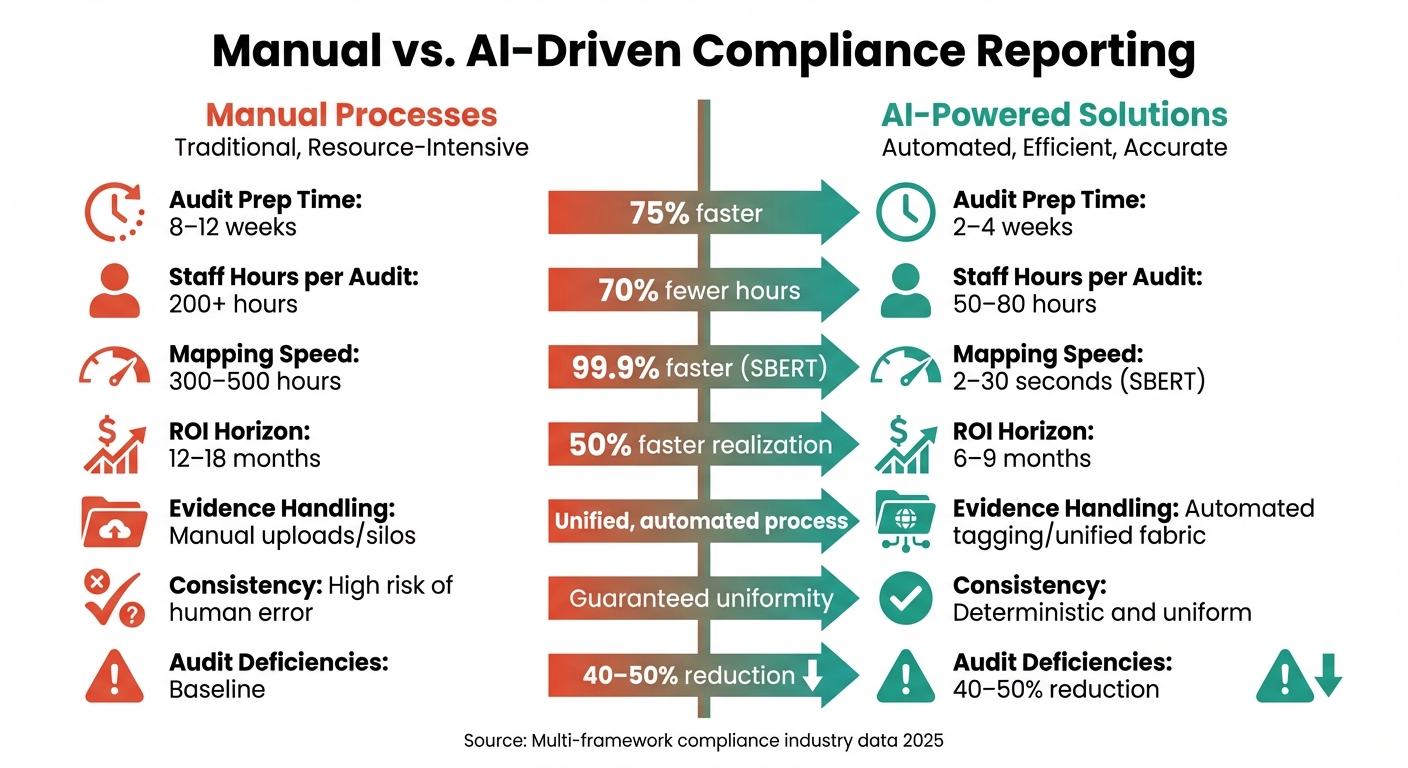
AI-driven automation has completely reshaped how organizations approach multi-framework compliance. What used to be a time-consuming and fragmented process is now streamlined into something far more efficient and manageable. One of the most immediate benefits? Time savings. Using an AI ISO 27001 implementation assistant can accelerate this process significantly. Tasks like manual mapping, which traditionally required countless hours of expert labor, are completed by AI in mere seconds. This efficiency extends to audit preparation as well - companies using AI-based tools report cutting prep time from 8–12 weeks down to just 2–4 weeks. Even the staff hours required per audit drop significantly, from over 200 hours to a range of 50–80 hours.
AI also brings a new level of accuracy and consistency to compliance reporting. Unlike manual processes, which are prone to human errors, fatigue, and inconsistent documentation, AI delivers uniform outputs that auditors find far more reliable. In fact, organizations adopting AI-driven compliance solutions often see a 40–50% reduction in audit findings. This level of precision not only reduces errors but also sets the stage for handling growing regulatory demands without added stress.
"Automation doesn't replace people. It gives them better tools to do their job without drowning in busywork." - Rob Pierce, Partner, Linford & Co.
Another standout benefit is scalability. As regulatory requirements grow more complex, AI supports a "collect once, reuse everywhere" approach. For example, a single piece of evidence - like multi-factor authentication (MFA) logs - can be automatically tagged for multiple frameworks such as SOC 2 CC6.1, ISO 27001 A.9.4.2, and NIST 800-53 IA-2 at the same time. When a new framework is introduced, AI identifies which requirements are new (typically around 20%) and recognizes that most (about 80%) are already covered by existing compliance efforts. This eliminates the need to hire additional staff as compliance demands increase, while also improving the quality and relevance of audit reports for frameworks like ISO 27001 and SOC 2.
Comparison: Manual vs. AI-Driven Reporting
The advantages of AI-driven compliance are clear when compared to traditional manual processes, as illustrated below:
| Metric | Manual Processes | AI-Powered Solutions |
|---|---|---|
| Audit Prep Time | 8–12 weeks | 2–4 weeks |
| Staff Hours per Audit | 200+ hours | 50–80 hours |
| Mapping Speed | 300–500 hours | 2–30 seconds (SBERT) |
| ROI Horizon | 12–18 months | 6–9 months |
| Evidence Handling | Manual uploads/silos | Automated tagging/unified fabric |
| Consistency | High risk of human error | Deterministic and uniform |
| Audit Deficiencies (Manual) | Baseline | 40–50% reduction |
One of the biggest shifts AI enables is moving from reactive audits to continuous compliance. Instead of scrambling for quarterly or annual snapshots, AI provides real-time dashboards that display compliance status across all frameworks. This proactive approach identifies potential issues before auditors even step in, turning compliance into an ongoing operational strength rather than a periodic headache. These transformative benefits set the stage for practical applications, which will be explored in the next section.
ISMS Copilot: Practical Use Cases for AI in Compliance Reporting
The promise of AI in compliance is clear, but how does it actually help in day-to-day tasks? ISMS Copilot bridges this gap with tools tailored for managing multiple frameworks. Unlike general AI platforms that might miss the intricacies of security standards, ISMS Copilot is purpose-built to support 20+ frameworks, including ISO 27001, SOC 2, NIST 800-53, GDPR, DORA, NIS 2, and the EU AI Act. Let’s explore how its features simplify compliance across these frameworks.
Multi-Framework Support and Cross-Mapping
One standout feature of ISMS Copilot is its ability to map requirements across frameworks seamlessly. Let’s say a federal contractor needs to align NIST 800-53 controls with existing ISO 27001 documentation or explain SOC 2 Trust Criteria - ISMS Copilot ensures precise alignment without manual input. A single piece of evidence can be tagged to meet multiple requirements, saving time and effort.
The platform uses RAG (retrieval-augmented generation) and a proprietary compliance library to deliver accurate, framework-specific mappings grounded in real standard text. Trusted by 1,000+ organizations to generate auditor-ready outputs.
Simplifying Policy Writing and Risk Assessments
Drafting policies can be a time-consuming task, but ISMS Copilot speeds up the process by generating framework-specific policies, such as Acceptable Use or SOC 2 policies, in minutes. It also provides tailored outlines and analyses for risk assessments, ensuring alignment with standards like ISO 27001.
Additionally, the platform enables gap analysis by allowing users to upload PDFs, DOCX, or XLS files to verify compliance. Its Workspaces feature keeps files, policies, and conversation histories separate - an essential tool for consultancies juggling multiple client projects.
"Our AI doesn't search the whole internet. It only uses our own library of real-world compliance knowledge. When you ask a question, you get a straight, reliable answer." – ISMS Copilot
This approach highlights how AI can revolutionize multi-framework compliance reporting, making it more efficient and reliable.
Comparison: ISMS Copilot vs. General AI Tools
ISMS Copilot sets itself apart from general AI platforms with its specialized focus on compliance tasks:
| Feature | ISMS Copilot | General AI (ChatGPT/Claude/DeepSeek) |
|---|---|---|
| Compliance Specialization | Built specifically for compliance frameworks | Designed for general use |
| Framework Knowledge | Extensive and up-to-date (20+ standards) | Limited or outdated knowledge |
| Document Analysis | Tailored for gap analysis in compliance | General text processing |
| Audit Preparation | Produces auditor-ready outputs | Unstructured and less specific |
| Data Privacy | Compliance-grade, no data used for training | Varies; often used for training models |
| Knowledge Source | Curated from real-world consulting data | Sourced from general internet data |
While tools like ChatGPT are great for broad tasks, they lack the depth and precision needed for compliance work. ISMS Copilot fills this void with features like framework-specific guidance, multi-language support (English, German, Spanish, and French), and enterprise-level security, including EU data residency in Frankfurt. For compliance professionals, these capabilities translate into quicker results, fewer errors, and outputs that auditors can accept with minimal revisions - delivering both efficiency and accuracy as outlined earlier.
Governance and Controls for AI-Generated Compliance Reports
AI can churn out compliance reports at impressive speeds, but the real test lies in making those reports audit-ready. The challenge isn't just about generating content - it's about backing every claim with solid proof. As CustomGPT.ai puts it, "Audits don't fail because writing is messy, they fail because proof is".
The key to success starts with evidence-first drafting. Every assertion in an AI-generated report needs to link directly to a supporting piece of evidence, like a policy document, system log, screenshot, or risk register entry. If claims lack proper support, they should be flagged as 'needs evidence' automatically. For instance, when Alphabet's Gemini chatbot made a single factual error during its debut livestream, it led to a staggering $100 billion loss in market value. That’s how high the stakes can be.
Human oversight serves as the final safeguard. Before submission, a qualified reviewer must ensure every claim is backed by current evidence and that production data is kept separate from staging data. Companies that integrate this human verification step report a 40–50% drop in audit findings. Think of this process as a mandatory checkpoint, not an optional step.
But the work doesn’t stop there. Maintaining report integrity requires ongoing oversight. Embedding auditability into CI/CD pipelines allows for real-time tracking of model performance, data drift, and compliance gaps. Tools like Prometheus and Grafana can help visualize system metrics and catch anomalies before they escalate into audit failures. This proactive approach has helped organizations reduce compliance incidents by 30% and improve operational efficiency by 25%.
Another critical point: steer clear of absolute language unless you have the evidence to back it up. Automated safeguards should flag terms like "we always", "fully", or "guaranteed". It’s equally important to establish minimum criteria for every statement - a stable evidence reference, timestamp, owner attestation, and control mapping are all non-negotiable. Running dual SOC 2 and ISO 42001 programs separately, rather than under a unified framework, often leads to a 60% certification failure rate. A single governance charter and unified risk register can eliminate duplicate work and close control gaps, cutting certification overhead by 40–50% in typical three- to six-month implementations.
Conclusion
Managing compliance across multiple frameworks doesn’t have to feel overwhelming. Tools like ISMS Copilot are changing the game by turning what used to be a months-long process into a smooth, ongoing workflow. For example, AI-driven continuous compliance mapping can cut audit prep time by a staggering 90% - shrinking it from 80–120 hours to less than 10 hours.
A key benefit here is the "collect once, reuse everywhere" strategy. By leveraging AI-powered compliance tools, organizations can typically reuse 75% of their controls across different frameworks. This approach slashes audit timelines from 18 months to less than 8 months and saves hundreds of thousands of dollars in consulting fees. It’s a shift that transforms teams from scrambling to meet deadlines into maintaining steady, year-round readiness.
"One audit shouldn't mean triple the effort. Do it once. Do it well. Reuse. Repeat." - Rob Pierce, Partner, Linford & Co
What makes specialized tools like ISMS Copilot stand out is their precision. Unlike general-purpose AI like ChatGPT or Claude, ISMS Copilot uses Retrieval-Augmented Generation (RAG) and curated datasets covering 20+ frameworks to provide auditor-ready, framework-specific guidance.
Here’s the takeaway: AI doesn’t replace compliance professionals - it enhances their capabilities. Organizations that embrace AI-driven compliance often see a 40–50% drop in audit findings. This isn’t just about saving time and money; it’s about improving audit readiness across the board. The real question isn’t whether to adopt AI for multi-framework compliance - it’s how soon you can integrate it to stay ahead of evolving regulations.
FAQs
What data sources can AI pull evidence from automatically?
AI streamlines the process of collecting evidence by pulling data from a variety of sources such as logs, screenshots, reports, policies, and procedures stored across cloud platforms, internal systems, and document repositories. It can also analyze audit reports, control mappings, and vendor questionnaires, aligning the gathered information with frameworks like ISO 27001, SOC 2, and NIST 800-53. This automation not only cuts down on manual work but also reduces the risk of errors and ensures that compliance evidence is always current for audits and assessments.
How do I validate AI-generated control mappings for auditors?
To ensure the accuracy of AI-generated control mappings, tools like ISMS Copilot can be incredibly helpful. These tools offer cross-framework mapping features that enhance consistency and precision. It's essential to review the AI-generated mappings by closely examining the reasoning behind each control association, as provided by the AI's analysis. Incorporating spot checks and manual reviews is another critical step to confirm that the mappings align with the requirements of the relevant frameworks. By following these practices, you can ensure the mappings are precise, audit-ready, and meet the necessary standards.
What governance is needed to keep AI-written reports audit-ready?
To ensure AI-generated reports are always ready for audits, start by creating clear guidelines for how AI is used - covering everything from its development to deployment and documentation. These policies help maintain transparency and accountability throughout the process.
Automated controls are another key piece of the puzzle. Tools like traceability systems, evidence management, and routine reviews can verify that everything stays compliant. These measures not only help catch potential issues, like outdated evidence or mistakes, but also ensure that the AI operates as intended.
Additionally, keeping a close eye on AI outputs through continuous monitoring and validation can help you spot and fix problems early. Advanced practices like Policy-as-Code and Audit-as-Code further simplify compliance by automating checks, making it easier to uphold the integrity of audits.
Related Blog Posts
Related Posts
He ran client audits on a raw Anthropic key. Then a client asked where their evidence went.
An EU consultant can run an entire audit practice on a frontier model key and never once ask where client evidence actually goes. The moment a client's security team asks, the answer is an A.5.14 finding waiting to happen. Here is the honest fix: EU processing aliases, zero retention, and a receipt on every response.
How AI Enhances Multi-Framework Compliance
AI unifies control mapping, automates evidence collection, and provides real-time monitoring to cut audit prep time and reduce compliance errors.
How Real-Time Alerts Reduce ISO 27001 Non-Compliance Risks
Real-time alerts detect threats fast, cut breach costs and audit failures, and keep ISO 27001 logs tamper-proof for continuous compliance.