 ISMS Copilot
Reglamento de IA de la UE vs. ISO 27001: Comparación de Gobernanza de Datos
Combina las normas de sesgo, transparencia y calidad de datos del Reglamento de IA de la UE con el SGSI de ISO 27001 para construir una gobernanza de datos de IA integrada y auditables.

El Reglamento de IA de la UE y la ISO 27001 abordan la gobernanza de datos de manera diferente, pero pueden trabajar juntos para gestionar los sistemas de IA de manera efectiva.
- Reglamento de IA de la UE: Una regulación obligatoria (vigente desde agosto de 2024) que se centra en los riesgos de los sistemas de IA, la detección de sesgos y la calidad de los datos. Obligaciones como la representatividad de los conjuntos de datos y la mitigación de sesgos se aplican, especialmente para sistemas de alto riesgo.
- ISO 27001: Un estándar internacional voluntario que garantiza la seguridad de los datos a través de un Sistema de Gestión de Seguridad de la Información (SGSI). Destaca la confidencialidad, integridad y disponibilidad de todos los activos de datos, no solo de los específicos de IA.
Diferencia clave:
El Reglamento de IA de la UE aborda la gobernanza legal y ética de la IA, mientras que la ISO 27001 se centra en la seguridad de los entornos de datos. Juntos, proporcionan un enfoque estructurado para el cumplimiento y la seguridad de los sistemas de IA.
Comparación rápida:
| Característica | Reglamento de IA de la UE | ISO 27001 |
|---|---|---|
| Estado legal | Obligatorio | Voluntario |
| Enfoque | Riesgos de IA, sesgos, seguridad | Seguridad de datos (CIA) |
| Alcance | Conjuntos de datos específicos de IA | Todos los datos organizacionales |
| Mitigación de sesgos | Requerida | No abordada |
| Aplicación | Multas de hasta €35M o 7% | Certificación opcional |
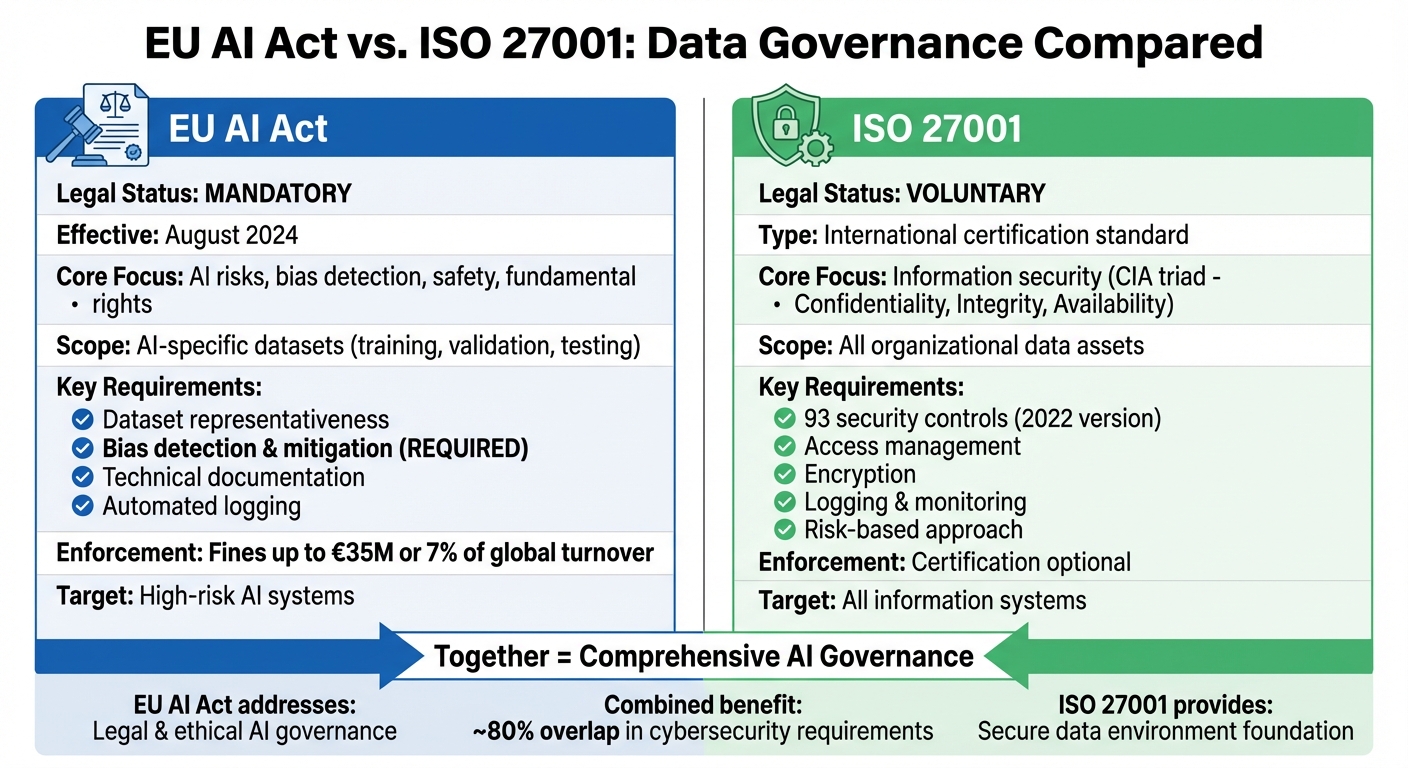
Reglamento de IA de la UE vs ISO 27001: Diferencias clave en la gobernanza de datos
Explicación del Reglamento de IA de la UE: Navegando el cumplimiento en 2025 - Data Leaders Unscripted
Reglamento de IA de la UE: Gobernanza de datos para sistemas de IA de alto riesgo
El Reglamento de IA de la UE adopta un enfoque personalizado para regular los sistemas de IA, con normas más estrictas para aplicaciones de alto riesgo. El Artículo 10, que entrará en vigor el 2 de agosto de 2026, detalla obligaciones específicas para estos sistemas, y el incumplimiento conlleva sanciones.
Requisitos para sistemas de IA de alto riesgo
Según el Artículo 10, los conjuntos de datos utilizados para el entrenamiento, validación y pruebas deben cumplir con estándares rigurosos. Deben ser relevantes, representativos, libres de errores en la medida de lo posible y completos para su propósito previsto. Estos conjuntos de datos deben reflejar con precisión las poblaciones y entornos donde operará el sistema de IA, asegurando que se consideren todos los contextos aplicables.
Abordar el sesgo es un requisito crítico. Los proveedores deben evaluar los conjuntos de datos en busca de sesgos que puedan comprometer la salud, la seguridad o los derechos fundamentales. Se deben implementar medidas para detectar, prevenir y mitigar estos sesgos. Esto es especialmente crucial en casos donde las salidas de la IA podrían influir en futuras entradas, potencialmente creando bucles de retroalimentación que refuercen patrones discriminatorios. Para minimizar riesgos, las organizaciones deben adoptar salvaguardas como la seudonimización y garantizar que los datos se eliminen después de realizar correcciones.
La documentación es otro aspecto clave. Los proveedores deben rastrear meticulosamente el ciclo de vida de sus datos, cubriendo desde decisiones de diseño y fuentes de datos hasta procesos como el etiquetado, limpieza y enriquecimiento. Se les exige identificar lagunas en los datos, documentar suposiciones y confirmar la idoneidad del conjunto de datos para su uso previsto. Para sistemas que no involucran el entrenamiento de modelos, estos estándares se aplican únicamente a los conjuntos de datos de prueba.
Marcos de gobernanza y aplicación
Para garantizar el cumplimiento de estas normas de gobernanza de datos, el Reglamento de IA de la UE establece mecanismos de aplicación formales. A diferencia de las directrices voluntarias, el Reglamento impone obligaciones vinculantes a cualquier organización que introduzca sistemas de IA de alto riesgo en el mercado de la UE. La supervisión se gestiona tanto a nivel de la Unión —por entidades como la Oficina de IA y el Consejo Europeo de Inteligencia Artificial— como a nivel nacional, a través de las Autoridades Nacionales Competentes designadas. Estas autoridades tienen la facultad de solicitar documentación técnica, evaluar sistemas y aplicar medidas correctivas por incumplimiento.
Las organizaciones deben implementar marcos de gobernanza estructurados que cubran todas las etapas de sus pipelines de datos. Esto incluye protocolos estandarizados para la preparación de datos, auditorías regulares de sesgos y planes de monitoreo post-comercialización para evaluar el rendimiento del sistema después de su implementación. Prácticas como el raspado no dirigido de imágenes faciales de internet para construir bases de datos de reconocimiento facial están explícitamente prohibidas según el Reglamento. Con plazos de aplicación cercanos, tratar el Artículo 10 como una simple lista de verificación podría acarrear consecuencias graves.
ISO 27001: Gobernanza y controles de seguridad de datos
La ISO 27001 desempeña un papel clave junto al Reglamento de IA de la UE al centrarse en la protección de datos. Su fundamento se basa en la tríada de la CIA: confidencialidad (garantizar que solo usuarios autorizados accedan a los datos), integridad (mantener la precisión y completitud de los datos) y disponibilidad (hacer que los datos estén accesibles cuando se necesiten). Este marco neutral en tecnología se aplica universalmente, ya sea para proteger registros de clientes, datos financieros o conjuntos de datos para el entrenamiento de IA. Al enfocarse en prácticas robustas de seguridad de datos, la ISO 27001 proporciona una base sólida para gestionar flujos de trabajo de datos específicos de IA.
Requisitos clave de gobernanza de datos
La actualización de 2022 de la ISO 27001 organiza sus 93 controles de seguridad en cuatro categorías principales: Organizacional, Personas, Física y Tecnológica. Estos controles cubren áreas críticas como el acceso, el cifrado, el monitoreo y los riesgos de terceros. Algunos aspectos destacados incluyen:
- Gestión de acceso (Anexo A.9): Garantiza que solo personas autorizadas puedan ver, modificar o eliminar datos.
- Criptografía (Anexo A.10): Protege datos sensibles mediante cifrado, tanto en reposo como durante la transmisión.
- Registro y monitoreo (Anexo A.12): Rastrea el acceso y las acciones mediante registros de auditoría.
- Seguridad de proveedores (Anexo A.15): Mitiga riesgos asociados con proveedores externos que manejan datos.
A diferencia del Reglamento de IA de la UE, que prescribe reglas específicas para sistemas de IA de alto riesgo, la ISO 27001 enfatiza un enfoque basado en riesgos. Las organizaciones identifican amenazas potenciales para sus datos y aplican controles adaptados. Una encuesta de Gartner de 2024 reveló que las empresas que utilizan plataformas de cumplimiento automatizadas redujeron sus ciclos de auditoría en un 39%. Este cambio hacia un "cumplimiento vivo", como lo describe Mark Sharron de ISMS.online, se centra en la recolección de evidencia en tiempo real en lugar de documentación estática. Estos controles no solo mejoran la seguridad de los datos, sino que también agilizan su integración en sistemas de IA.
Aplicabilidad a pipelines de datos de IA
El marco de la ISO 27001 es naturalmente adecuado para sistemas de IA. Sus controles de gestión de activos (Anexo A.8) exigen a las organizaciones inventariar sus activos de información, clasificarlos por sensibilidad y definir procedimientos adecuados de manejo. En entornos de IA, esto incluye catalogar conjuntos de datos de entrenamiento, conjuntos de validación y pesos de modelos junto con activos de datos tradicionales.
Tareas específicas de preparación de datos —como la limpieza, el etiquetado y el enriquecimiento— caen bajo "Manejo de activos" (A.8.2.3). Las transferencias seguras de conjuntos de datos entre entornos están guiadas por controles como "Transferencia de medios físicos" (A.8.3.3) y medidas de Seguridad de comunicaciones. Mientras tanto, los controles de "Seguridad de operaciones" (Anexo A.12) y "Desarrollo de sistemas" (Anexo A.14) garantizan el procesamiento seguro de datos, una gestión efectiva de cambios y la integridad general de los pipelines de IA.
Como explica Pansy de Sprinto:
"La ISO 27001 protege el sistema, y la ISO 42001 gobierna las decisiones".
Esta distinción es crucial. Mientras que la ISO 27001 se centra en la seguridad del pipeline de datos, marcos como el Reglamento de IA de la UE abordan preocupaciones más amplias, como la equidad y la explicabilidad en las salidas de la IA. Juntos, forman un enfoque complementario para gestionar sistemas de IA de manera efectiva.
sbb-itb-4566332
Comparación entre el Reglamento de IA de la UE y la ISO 27001: Gobernanza de datos
Esta sección profundiza en cómo el Reglamento de IA de la UE y la ISO 27001 abordan la gobernanza de datos a lo largo del ciclo de vida de la IA, destacando sus diferencias y superposiciones.
Comparación de características
El Reglamento de IA de la UE y la ISO 27001 siguen caminos distintos en cuanto a la gobernanza de datos. El Reglamento de IA de la UE es una regulación obligatoria, y el incumplimiento de prácticas prohibidas puede acarrear multas de hasta €35,000,000 o el 7% del volumen de negocios anual global. Por otro lado, la ISO 27001 es un estándar de certificación voluntario que las organizaciones adoptan para demostrar su compromiso con la seguridad. Sin embargo, no hay consecuencias legales por no implementarlo.
El Reglamento de IA de la UE prioriza la seguridad, los derechos fundamentales y la prevención de sesgos, especialmente para sistemas de IA de alto riesgo. La ISO 27001, en cambio, se centra en proteger todos los activos de información a través de la tríada de la CIA: confidencialidad, integridad y disponibilidad. Mientras que el Reglamento de IA de la UE enfatiza la importancia de conjuntos de datos de entrenamiento libres de errores y representativos, la ISO 27001 se preocupa más por la seguridad del entorno general de datos.
| Característica | Reglamento de IA de la UE (IA de alto riesgo) | ISO 27001 |
|---|---|---|
| Estado legal | Obligatorio | Voluntario |
| Enfoque principal | Seguridad, derechos fundamentales, sesgo | Seguridad de la información (CIA) |
| Cobertura de datos | Conjuntos de entrenamiento, validación y pruebas | Todos los activos de información |
| Requisito de sesgo | Detección y mitigación obligatorias | No abordado explícitamente |
| Controles de seguridad | Robustez de la IA y ciberseguridad | 93 controles (versión 2022) |
| Documentación | Documentación técnica y evaluación de conformidad | Manual del SGSI, Declaración de aplicabilidad |
El siguiente paso es ver cómo estos marcos se alinean con las etapas del ciclo de vida de los datos de IA.
Etapas del ciclo de vida de los datos de IA
Cuando se mapean al ciclo de vida de los datos de IA, las diferencias entre el Reglamento de IA de la UE y la ISO 27001 se vuelven aún más evidentes. Por ejemplo, el Artículo 10 del Reglamento de IA de la UE exige transparencia clara sobre el origen y propósito de los datos durante la fase de recolección. La ISO 27001 aborda esto a través de los controles de inventario de activos y relaciones con proveedores. Sin embargo, la ISO 27001 no aborda la mitigación de sesgos, lo que obliga a las organizaciones a crear flujos de trabajo separados para la gobernanza de IA.
| Etapa del ciclo de vida | Obligaciones del Reglamento de IA de la UE (Art. 10) | Controles de ISO 27001 (Anexo A) |
|---|---|---|
| Recolección | Origen de los datos, propósito original de la recolección | Inventario de activos, relaciones con proveedores |
| Etiquetado/Preparación | Anotación, etiquetado, limpieza, agregación | Clasificación de la información, enmascaramiento de datos |
| Entrenamiento/Validación | Evaluación de representatividad, identificación de lagunas de datos | Entorno de desarrollo seguro, gestión de cambios |
| Mitigación de sesgos | Detección y corrección de discriminación prohibida | No aplicable (requiere gobernanza de IA separada) |
| Retención | Eliminación de datos especiales después de corregir sesgos | Retención y eliminación de activos de información |
Superposiciones y diferencias
Aunque ambos marcos comparten algunos puntos en común, cumplen propósitos distintos. Por ejemplo, ambos requieren registros y controles de acceso, pero sus objetivos difieren. El Reglamento de IA de la UE exige "registros generados automáticamente" para rastrear las decisiones de la IA hasta sus fuentes de datos (Artículo 12), mientras que la ISO 27001 utiliza el registro para el monitoreo de seguridad y la respuesta a incidentes. Las organizaciones con implementaciones de SGSI bien establecidas ya pueden cumplir hasta el 80% de los requisitos de ciberseguridad del Reglamento de IA de la UE, lo que ofrece una ventaja inicial.
La principal distinción radica en calidad de datos versus seguridad de datos. El Reglamento de IA de la UE permite el procesamiento de datos personales sensibles —como raza, religión y salud— para la detección de sesgos. En cambio, la ISO 27001 aplica controles más generales para proteger estos datos. Como explica acertadamente Gnanendra Reddy, auditor líder de ISO/IEC 27001:
"El Reglamento de IA de la UE es el reglamento, e ISO/IEC 42001 es el sistema operativo que hace que el cumplimiento sea repetible y auditable".
Construcción de un modelo integrado de gobernanza de datos
El Reglamento de IA de la UE define el "qué", mientras que la ISO 27001 proporciona el "cómo" al establecer un marco operativo sólido. Juntos, crean una base perfecta para mapear requisitos y simplificar la implementación.
Mapeo de requisitos del Reglamento de IA de la UE a controles de ISO 27001
Para establecer un proceso claro y trazable, las organizaciones pueden alinear los requisitos del Reglamento de IA de la UE con los controles de la ISO 27001. Por ejemplo, la obligación del Artículo 10 de documentar el origen y propósito de recolección de datos (Artículo 10[2b]) se empareja con los controles de Gestión de Activos (A.8) en la ISO 27001, que ya enfatizan el inventario de activos de información. De manera similar, los requisitos de preparación, etiquetado y limpieza de datos se alinean con la Seguridad de Operaciones (A.12), asegurando que el procesamiento y transformación de datos estén bien regulados.
| Requisito del Reglamento de IA de la UE (Art. 10) | Dominio de control relevante de ISO 27001 | Acción operativa |
|---|---|---|
| Recopilación de datos y origen (2b) | Gestión de activos (A.8) | Catalogar fuentes de datos y documentar su propósito. |
| Preparación/etiquetado de datos (2c) | Seguridad de operaciones (A.12) | Usar métodos controlados para anotación y limpieza. |
| Detección y mitigación de sesgos (2f, 2g) | Evaluación de riesgos (A.12.6 / A.14.2) | Realizar pruebas técnicas y documentar pasos de mitigación. |
| Documentación técnica (Art. 11) | Documentación (A.5 / A.18) | Mantener registros de diseño y tarjetas de modelos controlados por versiones. |
| Registros y conservación (Art. 12) | Registro y monitoreo (A.12.4) | Definir políticas de retención de registros basadas en riesgos y controles de acceso. |
Al crear una matriz de requisitos a pruebas que vincule los artículos del Reglamento de IA de la UE con los controles de la ISO 27001 y las pruebas asociadas, el cumplimiento se convierte en un proceso estructurado y rastreable. Por ejemplo, los requisitos de registro suelen implicar períodos de retención que van desde 180 hasta 365 días, alineándose con ambos marcos.
Una vez establecidas estas alineaciones, el enfoque se traslada a integrar estos controles en los flujos de trabajo diarios.
Implementación de la gobernanza de datos de IA
Combinar estos marcos transforma el cumplimiento de una simple lista de verificación en un sistema operativo cohesivo. Al basarse en el marco existente del SGSI y aprovechar el ciclo PDCA (Planificar-Hacer-Verificar-Actuar), puedes integrar controles específicos de IA sin empezar desde cero. Esto podría incluir:
- Ampliar los procesos de gestión de proveedores para cubrir proveedores de datos de entrenamiento de IA.
- Implementar monitoreo continuo para detectar deriva del modelo.
- Programar revisiones periódicas para identificar y abordar sesgos.
El modelo de "Tres Líneas de Defensa" funciona bien para la gobernanza de IA. En este esquema, los equipos operativos gestionan riesgos durante el desarrollo (primera línea), los equipos de riesgo y legal brindan supervisión (segunda línea), y la auditoría interna realiza verificaciones independientes (tercera línea). Un inventario centralizado de modelos se vuelve esencial para rastrear metadatos, como tipos de datos, algoritmos y contextos de implementación. Esto es especialmente crítico, ya que un estudio de 2024 de 624 casos de uso de IA reveló que el 30% de los modelos fueron desarrollados por terceros, y algunas organizaciones no pudieron identificar los algoritmos utilizados.
Mantener un archivo unificado de conformidad es otro paso clave. Este archivo mapea cada requisito del sistema de IA a las políticas, pruebas y resultados de monitoreo correspondientes, asegurando que la documentación de cumplimiento esté centralizada y sea fácilmente accesible para revisiones regulatorias.
Uso de ISMS Copilot para cumplimiento integrado
ISMS Copilot simplifica el proceso de integración al actuar como un asistente potenciado por IA que conecta los requisitos legales con los controles de la ISO 27001. Mapea automáticamente los requisitos de gobernanza de datos del Artículo 10 del Reglamento de IA de la UE a los controles de la ISO 27001, eliminando la necesidad de cruzar referencias manualmente. La plataforma también ayuda a redactar documentos críticos —como políticas del ciclo de vida de los datos, registros de riesgos y archivos de conformidad— mientras vincula cada obligación con la evidencia correspondiente.
Al automatizar el seguimiento de evidencia y aprovechar el ciclo PDCA, ISMS Copilot convierte las auditorías en tareas sencillas de recuperación. También integra la gobernanza de datos de IA en operaciones comerciales repetibles. Las organizaciones pueden usar la herramienta para definir sus roles según el Reglamento de IA de la UE (por ejemplo, como proveedores, implementadores o ambos), implementar registros con alcance y automatizar la documentación de detección de sesgos para cumplir con el Artículo 10, asegurando que los datos personales de categorías especiales se procesen y eliminen de manera adecuada.
Con soporte para más de 20 marcos, incluyendo ISO 27001, ISO 42001 y el Reglamento de IA de la UE, ISMS Copilot permite a las organizaciones gestionar un modelo de cumplimiento unificado en lugar de lidiar con sistemas fragmentados. Esto es especialmente importante dado que, aunque el 96% de las empresas ya utilizan IA, solo el 5% tiene marcos formales de gobernanza de IA implementados.
Conclusión
El Reglamento de IA de la UE y la ISO 27001 no son rivales —trabajan en armonía—. El Reglamento de IA define lo que las organizaciones deben hacer para garantizar que los sistemas de IA sean seguros, transparentes y respetuosos con los derechos fundamentales. Mientras tanto, la ISO 27001 proporciona un Sistema de Gestión de Seguridad de la Información (SGSI) estructurado para ayudar a operacionalizar esos requisitos de manera efectiva.
La creciente adopción de estos marcos subraya la urgencia de una gobernanza integrada. Al combinar las fortalezas de ambos, las organizaciones pueden abordar riesgos tradicionales de seguridad de la información —como brechas de datos y acceso no autorizado— junto con problemas específicos de IA, como el sesgo de los modelos y la transparencia en la toma de decisiones.
La integración no se trata solo de marcar casillas para el cumplimiento; es un movimiento estratégico. Mapear los requisitos del Reglamento de IA de la UE a los controles de la ISO 27001 e integrarlos en los ciclos existentes de Planificar-Hacer-Verificar-Actuar crea un sistema unificado. Este enfoque no solo simplifica las auditorías, sino que también posiciona a las empresas para cumplir con regulaciones futuras, ya que los esfuerzos de estandarización global alinean cada vez más los requisitos de la UE con los marcos de la ISO/IEC.
Puntos clave para recordar
Una estrategia unificada de cumplimiento ofrece beneficios tangibles. Así es como comenzar:
Aprovecha tu SGSI existente.
Expande tus controles de ISO 27001 para abordar desafíos específicos de IA, como la detección de sesgos y la calidad de los conjuntos de datos. Con un solapamiento estimado del 80% entre la ISO 27001 y otros marcos como SOC 2, estos sistemas se complementan de manera natural.
Centraliza tu inventario de IA.
Mantén documentación detallada para cada sistema de IA, incluyendo tipos de datos, algoritmos, contextos de implementación y si actúas como proveedor o implementador.
Automatiza la alineación de marcos.
Herramientas como ISMS Copilot pueden agilizar el cumplimiento al mapear automáticamente los requisitos del Artículo 10 del Reglamento de IA de la UE a los controles de la ISO 27001. Estas herramientas también redactan archivos de conformidad y rastrean evidencia en múltiples marcos, ahorrando tiempo y reduciendo errores a medida que las obligaciones del Reglamento de IA de la UE entran en vigor.
Deja atrás los métodos de gobernanza obsoletos.
Las políticas basadas en papel sin revisiones continuas ni métricas suelen fallar en las auditorías. En su lugar, integra la gobernanza de IA en las operaciones diarias mediante monitoreo continuo, revisiones periódicas de sesgos y registros con alcance (generalmente de 180 a 365 días) que se alineen con ambos marcos.
Las organizaciones que triunfan bajo el Reglamento de IA de la UE irán más allá del cumplimiento básico. Integrarán los requisitos legales con las mejores prácticas operativas, utilizando la ISO 27001 como base para una gobernanza de IA escalable y auditable. Con las herramientas y la mentalidad adecuadas, el cumplimiento se transforma de un obstáculo regulatorio en una ventaja competitiva.
Preguntas frecuentes
¿Cómo colaboran el Reglamento de IA de la UE y la ISO 27001 para gestionar sistemas de IA de manera efectiva?
El Reglamento de IA de la UE establece un marco legal para la IA, enfatizando clasificaciones basadas en riesgos, transparencia, responsabilidad y requisitos de gobernanza de datos (como los descritos en el Artículo 10). Estas medidas buscan garantizar que los sistemas de IA permanezcan auditables y confiables. Mientras tanto, la ISO 27001 proporciona un enfoque estructurado a través de un Sistema de Gestión de Seguridad de la Información (SGSI) para proteger la confidencialidad, integridad y disponibilidad de los datos mediante evaluaciones de riesgos, controles y mejoras continuas.
Al integrar un SGSI alineado con la ISO 27001, las organizaciones pueden mapear procesos clave —como la gestión de riesgos y los controles de acceso— directamente a los requisitos del Reglamento de IA de la UE. Esta alineación ayuda a cumplir con las expectativas del Reglamento en cuanto al manejo de datos, monitoreo y registro. En esencia, el Reglamento de IA especifica el qué debe lograrse, mientras que la ISO 27001 ofrece una guía sobre el cómo lograrlo. Herramientas como ISMS Copilot pueden agilizar este proceso al conectar los controles de la ISO 27001 con cláusulas específicas del Reglamento de IA, proporcionando políticas, plantillas y evidencia de auditoría para abordar ambos estándares de manera eficiente.
¿Cuál es la diferencia entre cumplimiento obligatorio y voluntario en la gobernanza de datos?
El cumplimiento obligatorio, como el Reglamento de IA de la UE, obliga a las organizaciones a seguir reglas estrictas y legalmente vinculantes en torno a la gobernanza de datos. Esto significa que deben establecer procedimientos de gestión de riesgos, garantizar la calidad de los datos y mantener registros exhaustivos. No cumplir con estos requisitos puede acarrear multas cuantiosas o incluso la pérdida de acceso a ciertos mercados.
Por otro lado, el cumplimiento voluntario —como la ISO 27001— ofrece un enfoque diferente. Aunque no es legalmente obligatorio, implica adoptar las mejores prácticas a través de un Sistema de Gestión de Seguridad de la Información (SGSI). Las organizaciones suelen optar por este camino para mejorar su reputación, fortalecer las medidas de seguridad y obtener certificaciones. Sin embargo, no hay consecuencias legales por no implementarlo.
Las principales diferencias radican en la aplicación legal frente a la participación opcional, las sanciones regulatorias frente a las ventajas reputacionales, y los mandatos estrictos frente a marcos adaptables y personalizables.
¿Cómo pueden las organizaciones incorporar requisitos específicos de IA en sus marcos de ISO 27001?
Para incorporar necesidades específicas de IA en un marco de ISO 27001, comienza ampliando tu proceso de evaluación de riesgos para incluir desafíos relacionados con IA, como deriva del modelo, sesgo en los datos y acceso no autorizado a modelos. Conecta estos riesgos con los controles aplicables de la ISO 27001, como gestión de cambios, gestión de acceso privilegiado y relaciones con proveedores. Este enfoque garantiza que los riesgos de IA se aborden dentro de la estructura existente de tu Sistema de Gestión de Seguridad de la Información (SGSI).
Además, alinea tus políticas con el Reglamento de IA de la UE, centrándote en sus requisitos de gobernanza de datos. Integra prácticas como verificaciones de calidad de datos, seguimiento de procedencia y límites de retención en tus procedimientos del SGSI. Estas actualizaciones pueden formalizarse como políticas de "Gobernanza de Datos de IA", complementando tus controles actuales para la clasificación y manejo de datos.
Para una estrategia más organizada, podrías considerar superponer la ISO/IEC 42001 (el estándar de Sistema de Gestión de IA) sobre la ISO 27001. Esto crea un marco cohesivo para gestionar tanto la IA como la seguridad de la información. Herramientas como ISMS Copilot pueden facilitar este proceso al automatizar el mapeo de riesgos, proporcionar plantillas y agilizar la documentación, permitiéndote cumplir con los estándares de IA y seguridad de la información de manera más efectiva.
Entradas relacionadas del blog
Artículos relacionados
Ejecutaba auditorías de clientes con una clave de Anthropic directa. Entonces un cliente preguntó adónde iban sus evidencias.
Un consultor de la UE puede dirigir una práctica de auditoría entera con una clave de un modelo 'frontier' y no preguntarse ni una sola vez adónde van realmente las evidencias del cliente. En cuanto el equipo de seguridad del cliente lo pregunta, la respuesta es un hallazgo de A.5.14 esperando a ocurrir. Esta es la solución honesta: alias de procesamiento en la UE, retención cero y un recibo en cada respuesta.
Cómo la IA mejora el cumplimiento multimarco
La IA unifica el mapeo de controles, automatiza la recolección de evidencias y proporciona monitoreo en tiempo real para reducir el tiempo de preparación de auditorías y minimizar errores de cumplimiento.
Cómo las alertas en tiempo real reducen los riesgos de incumplimiento de ISO 27001
Las alertas en tiempo real detectan amenazas rápidamente, reducen costos por brechas y fallos en auditorías, y mantienen los registros de ISO 27001 a prueba de manipulaciones para una conformidad continua.