 ISMS Copilot
Best Practices for Multi-Framework Policy Integration
Compare spreadsheets, templates, and AI tools for streamlining multi-framework compliance and control mapping.

Best Practices for Multi-Framework Policy Integration
Managing compliance across multiple frameworks is tough, but it can be simplified. With 70% of organizations needing to meet six or more standards like ISO 27001, SOC 2, and NIS2, the workload can quickly overwhelm teams. Manual spreadsheets, pre-built templates, and AI tools are three common approaches to handling this complexity - each with its own pros and cons.
Key Takeaways:
- Manual spreadsheets are cheap but time-consuming and error-prone, making them impractical for managing multiple frameworks.
- Pre-built templates save time but require customization and can lead to duplicated efforts without proper integration.
- AI-powered tools like ISMS Copilot automate control mapping, document creation, and evidence management, cutting compliance time by up to 80%.
Quick Comparison:
| Criteria | Manual Spreadsheets | Pre-Built Templates | AI-Powered Tools |
|---|---|---|---|
| Efficiency | Low | Moderate | High |
| Accuracy | Low | Moderate | High |
| Framework Coverage | Limited | Framework-specific | Extensive |
| Automation | None | Low | High |
| Audit Readiness | Periodic | Periodic | Continuous |
| Cost | Free (labor-intensive) | Low to Moderate | Subscription-based |
The bottom line: For scalable compliance, AI tools are the most efficient and accurate option, especially as regulatory demands grow. Start with a core framework like ISO 27001, and let automation handle the heavy lifting.
::: @figure 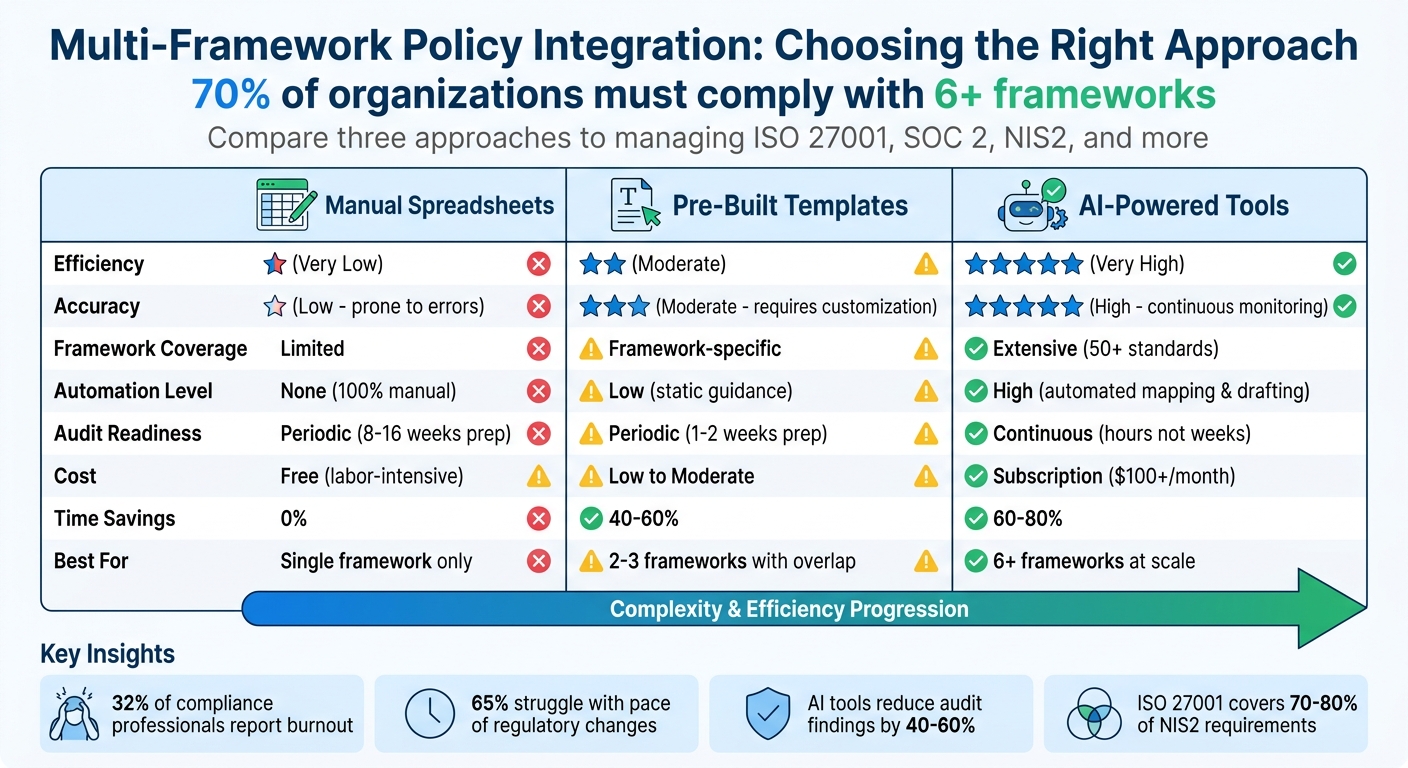 {Multi-Framework Compliance Approaches Comparison: Manual vs Templates vs AI Tools}
:::
Governance Structure: A Strategy for Compliance with Multiple Security Frameworks (Part 1 of 4)
::: @iframe https://www.youtube.com/embed/Se_4oHzNFwc :::
1. Manual Spreadsheets
Manual spreadsheets are often the starting point for compliance teams managing multi-framework policies. They’re appealing because they don’t require an initial investment, but the tradeoff is the significant time and effort they demand. This method quickly becomes impractical when dealing with more than one or two frameworks.
Efficiency
Spreadsheets are notoriously time-consuming for multi-framework compliance. Tasks like consolidating risk registers or organizing evidence across multiple tabs can take hours [2]. As organizations adopt additional standards, what begins as a manageable tool for ISO 27001 can spiral out of control. Adding requirements for SOC 2, NIS 2, or DORA often turns a simple workbook into a chaotic, unmanageable document [6].
Accuracy
Accuracy is another major challenge with spreadsheets. Manually mapping security controls across frameworks leaves plenty of room for error [6]. For instance, switching between ISO 27001’s "controls", SOC 2’s "criteria", and NIS 2’s "security measures" increases the likelihood of mistakes. Emily Bonnie, Senior Content Marketing Manager at Secureframe, emphasizes:
"Crosswalking security controls manually with documents and spreadsheets is at best inefficient; at worst inaccurate and prone to error" [6].
The constant need to adjust to different terminologies and numbering schemes makes it easy to miss requirements or duplicate efforts [1].
Framework Coverage
Spreadsheets simply don’t scale well when managing multiple frameworks. With nearly 70% of service organizations needing to comply with six or more frameworks [6][2], manual methods often fall behind. Spreadsheets also create "siloed" data, making it tough to get a unified view of compliance. For example, IT might manage an ISO 27001 spreadsheet, Legal might handle GDPR, and the compliance team might oversee SOC 2 - leaving these datasets disconnected and hard to reconcile [2].
Automation Level
Spreadsheets lack any form of automation. Every update, every control mapping, and every adjustment must be done manually. Unlike automated platforms that can generate audit trails or flag issues, spreadsheets rely entirely on human effort [2][6]. This repetitive workload often leads to "audit fatigue", where compliance teams burn out from performing the same tasks over and over [6]. These inefficiencies highlight the need for more streamlined, automated solutions, such as pre-built templates or dedicated compliance tools.
2. Pre-Built Templates
Pre-built templates offer a practical middle ground between the manual effort of spreadsheets and the convenience of fully automated platforms. They provide structured frameworks that can save time when creating compliance documentation. However, they do have limitations, particularly when managing multiple standards simultaneously.
These templates simplify policy creation by offering ready-made structures tailored to various frameworks, addressing some of the challenges associated with manual spreadsheets.
Efficiency
Templates come with pre-structured policies aligned to specific frameworks, helping organizations get a head start [2]. For example, an access control policy template might already include all the required sections. However, as Oussama Louhaidia, Cybersecurity Founder and Expert at GetCybr, points out:
"Most MSPs... treat each framework as a separate project: separate policy sets, separate evidence libraries, separate review cycles. It triples the workload" [5].
The key to overcoming this challenge is policy normalization. Instead of maintaining separate documents for each framework, organizations can create a single access control policy that references multiple control numbers - for instance, ISO 27001, SOC 2, and NIST. This approach can lead to cost savings of 40–60% compared to handling each framework as an independent project [4]. While this method boosts efficiency, it also requires careful accuracy checks.
Accuracy
Although templates are generally aligned with established standards, they still need to be reviewed and verified, especially when dealing with newer regulations like NIS2 or DORA. Cross-checking the template content against official regulatory texts ensures compliance with the latest requirements [1]. Christie Rae, Content Marketing Specialist at ISMS.online, emphasizes:
"Pre-built templates are a quick win, but not a set-and-forget exercise" [2].
Templates should be customized to suit your organization's industry, size, and risk profile. Without policy normalization, framework-specific templates can lead to duplication of effort during audits due to inconsistent terminology for the same controls [5]. Accuracy is essential, but ensuring comprehensive coverage across frameworks is equally important.
Framework Coverage
Modern templates typically support major standards like ISO 27001, SOC 2, NIST CSF, GDPR, DORA, and NIS2 [7][8]. For example, meeting ISO 27001 Annex A requirements can cover 65–75% of SOC 2 Trust Services Criteria [5]. This overlap allows organizations to use one primary framework as a foundation and layer additional requirements as needed. A useful strategy is to maintain a control matrix, where each row represents a control and each column maps it to multiple frameworks. For instance, a single monthly access review log might align with SOC 2 CC6.2, ISO 27001 A.5.18, and NIST CSF PR.AC-4 simultaneously [5].
Automation Level
While templates provide a structured starting point, they don't automate the compliance process. Manual effort is still required for customization, updates to reflect organizational changes, and evidence mapping. Unlike automated platforms that can send reminders for policy reviews or automatically gather evidence, templates rely on ongoing human involvement to stay current [2].
3. AI-Powered Tools (e.g., ISMS Copilot)
AI-powered tools are stepping in to address the challenges of manual methods and static templates in compliance management. Unlike templates that demand heavy customization or spreadsheets requiring constant updates, these platforms use artificial intelligence to automate processes like control mapping, document generation, and maintaining consistency across various standards. A standout example is ISMS Copilot, which focuses on streamlining multi-framework compliance.
Efficiency
AI tools significantly reduce the repetitive tasks that bog down traditional compliance efforts. For instance, rather than manually cross-referencing control numbers between frameworks, you can use natural language commands to instantly map controls. Picture this: you ask the AI to "map ISO 27001 to NIST 800-53", and within seconds - literally 5 to 15 - you receive a comprehensive response. These tools also produce first drafts of essential documents like Statements of Applicability, audit plans, and framework-specific policies [9].
Managing compliance for multiple frameworks can be expensive. However, programs built on a common control approach - enabled by AI - cost only 1.4 to 1.6 times more than a single framework, compared to triple the cost when handled as separate projects [5]. Oussama Louhaidia, a cybersecurity expert at GetCybr, highlights this efficiency:
"The MSPs who thrive... build a common control framework once, map it to everything, and reuse evidence across every audit the client will ever face" [5].
This streamlined approach not only saves time but also enhances accuracy in compliance mapping.
Accuracy
AI tools rely on Dynamic Framework Knowledge Injection (DFKI) to ensure their responses are grounded in verified, authoritative data rather than generic information [9]. This approach reduces the risk of errors, such as referencing non-existent controls or outdated requirements. For example, ISMS Copilot supports knowledge injection for 14 compliance frameworks, with updates carefully reviewed by GRC engineers against official regulatory texts [9].
AI tools can also identify inconsistencies, like conflicting notification timelines between NIS2 and GDPR, or highlight missing controls [10][3]. Organizations using automated compliance platforms have reported achieving compliance up to 80% faster than with traditional methods [3]. As the ISMS Copilot Help Center puts it:
"Think of ISMS Copilot as an expert team member who accelerates research, documentation, and analysis - but your GRC team still drives the compliance program" [8].
For newer regulations like DORA or NIS2, it’s crucial to double-check AI-generated outputs against official texts, as these tools perform best with well-established standards like ISO 27001 [1].
Framework Coverage
AI-powered platforms offer support for a wide array of frameworks, including ISO 27001, SOC 2, NIST CSF 2.0, NIST 800-53 Rev 5, GDPR, DORA, NIS2, the Cyber Resilience Act, ISO 42001, ISO 27701, ISO 27035, PCI DSS, HIPAA, CIS Controls, and Cyber Essentials [1]. For example, ISO 27001 is estimated to cover 70–80% of the requirements outlined in the newer NIS2 directive [11].
This centralized knowledge base simplifies compliance by providing a single interface for managing multiple regulations. It also reduces reliance on consultants, who often charge $200–$300 per hour [3]. By eliminating duplicate policy sets, this unified approach boosts the efficiency of compliance efforts.
Automation Level
AI tools excel in automating tasks that traditional methods struggle with. Automated control mapping replaces tedious manual cross-referencing, while AI-generated drafts can reduce the time needed to create policies from days to just hours. Uploading documentation in formats like PDF, DOCX, or XLS triggers automatic gap analysis [9], and multi-framework tagging allows evidence to be reused across audits, following a "map once, reuse everywhere" model [5].
These tools also simplify ongoing maintenance. Quarterly AI checks detect contradictions or expired review dates before audits [10]. Real-time regulatory tracking highlights how changes impact existing controls, ensuring you’re always up to date. Platforms like ISMS Copilot offer a cost-effective alternative to traditional consulting engagements: ISMS Copilot has a free plan, and paid plans start at $24 per month (see current pricing).
Advantages and Disadvantages
Looking at the different methods for multi-framework compliance, it's clear that each comes with its own set of strengths and challenges. Here's a closer look at what each approach offers and where it falls short.
Manual spreadsheets are highly customizable, but they can quickly spiral into "spreadsheet nightmares." This includes disconnected risk registers, formula errors, and a mad rush to gather evidence at the last minute. On top of that, audit preparation with manual processes can stretch from 1–2 weeks (if automated) to a grueling 8–16 weeks [12].
Pre-built templates are a great starting point for documentation, offering quick setup and accuracy for standard clauses. However, they aren't a "set-and-forget" solution. Customization is often required, which can lead to accumulating technical debt. Oussama Louhaidia explains it well:
"Every policy you write in framework-specific language is debt you'll pay at every subsequent audit" [5].
AI-powered tools, on the other hand, bring unmatched efficiency and automation. They can cut evidence collection efforts by 60% to 80% and reduce audit findings by 40% to 60% compared to manual methods [12]. While AI excels at reducing the cognitive load - allowing teams to manage 3 to 5 frameworks per person instead of just 1 or 2 manually - it still needs human oversight, especially for newer regulations like DORA or NIS2, where AI's capabilities may not yet be fully developed [1].
The growing complexity of compliance is evident in the numbers: 65% of organizations say the pace of regulatory changes makes compliance tougher, and 32% of professionals report burnout due to rising workloads [2]. With nearly 70% of service organizations needing to comply with at least six frameworks, the "map once, reuse everywhere" strategy has become essential [2][5].
Summary Comparison:
| Criterion | Manual Spreadsheets | Pre-Built Templates | AI-Powered Tools |
|---|---|---|---|
| Efficiency | Very Low; high administrative overhead [12] | Moderate; faster than starting from scratch [2] | Very High; 60–80% time savings [12] |
| Accuracy | Low; prone to human error and version control issues [1][12] | High for standard clauses; depends on customization [2] | High; continuous monitoring with real-time alerts [2][12] |
| Framework Coverage | Limited by manual mapping capabilities [5] | Framework-specific; can create silos [5] | Extensive; unified control mapping across 50+ frameworks [1] |
| Automation Level | None; entirely manual [5] | Low; static guidance only [2] | High; automated mapping, drafting, and evidence collection [12] |
| Audit Readiness | Periodic "boom-and-bust" cycles [12] | Periodic | Continuous [12] |
| Cost | Free (labor-intensive) | Low to moderate | Subscription-based |
This breakdown highlights the trade-offs between customization, efficiency, and scalability across these methods. Each organization will need to weigh these factors based on their specific compliance needs and resources.
Conclusion
This analysis makes one thing clear: there isn’t a one-size-fits-all method for compliance. However, integrating strategies smartly can lead to scalable solutions. Organizations that embrace integrated compliance approaches often see 40–60% cost savings compared to managing separate implementation projects [4].
Relying on manual spreadsheets gets overwhelming as frameworks multiply, while pre-built templates, though quick to deploy, can create "template debt" during audits. Enter AI-powered tools like ISMS Copilot, which simplify compliance by automating mapping across 50+ standards. These tools ease the mental load of managing multiple frameworks, streamline evidence collection, and slash audit prep time from days to just hours [1][5].
Integrated tools are reshaping compliance management, addressing the challenges professionals face today. With 32% of professionals experiencing burnout and 65% struggling to keep up with regulatory changes, the right tools aren’t optional - they’re necessary [2]. ISMS Copilot, often called "the ChatGPT of ISO 27001", offers a unified strategy for managing compliance across frameworks.
To stay ahead, focus on anchoring your policies with ISO 27001 and standardize your documentation. Let AI handle repetitive tasks like mapping and documentation. As Oussama Louhaidia aptly states:
"Using spreadsheets... at three clients, it's impossible. A GRC platform isn't a nice-to-have... it's the difference between a scalable practice and one that breaks under its own weight" [5].
Don’t wait for your compliance processes to hit a breaking point - modernize them now.
FAQs
::: faq
How do I pick a “core” framework to start with?
To select a "core" framework, start by evaluating your organization's primary regulatory or standards requirements, such as GDPR, NIS 2, or ISO 27001. Choose the framework that best aligns with your business operations, legal responsibilities, or client expectations. This framework will act as the cornerstone of your compliance efforts. Once it's in place, you can repurpose and map evidence across other standards like SOC 2 or NIST, making the process more streamlined and efficient. :::
::: faq
What’s the best way to reuse one set of evidence across audits?
Automating control mapping and reusing evidence can save time and reduce headaches. Start by creating a unified control framework that aligns with multiple standards. Then, leverage tools that allow for seamless evidence sharing. For example, platforms like ISMS Copilot make it easier to manage compliance across frameworks like ISO 27001, SOC 2, and NIS2. This approach ensures consistency while keeping the process efficient. :::
::: faq
How do I validate AI-generated control mappings for newer rules like NIS2 or DORA?
To ensure AI-generated control mappings align with frameworks like NIS2 or DORA, it's crucial to cross-reference them against the specific requirements of these frameworks. Regular reviews are necessary to identify any gaps or overlaps in the mappings and to make updates as the frameworks change over time. While tools like ISMS Copilot can automate parts of this process, manual validation is still key to ensuring both accuracy and compliance. :::
Related Posts
NIS2 does not bind your company. Your national law does.
Directive (EU) 2022/2555 addresses Member States, not undertakings. The fines, the reporting clocks and the authority you answer to are written in national law, and those laws arrived on twenty-seven different calendars.
The internal audit that never finds anything
ISO 19011 changed edition in May 2026. The failure mode it exists to prevent did not: the internal audit that has, by drift, stopped disagreeing with management.
Under NIS2, "important" is not a lighter security tier
Teams read the important label as NIS2-lite and scope their controls down. The security measures in Article 21 are the same either way; the tier changes supervision, some enforcement tools, and the floor on the national fine maximum.