 ISMS Copilot
The hardest call in compliance is what you don't need
ISMS Copilot now sizes its advice to your organisation by default. When it reviews your plan, it looks for what is more than you need as hard as for what is missing.

The hardest call in compliance is what a company doesn't need.
Adding a control is easy. Each addition sounds reasonable on its own: a security committee, a weekly board to approve every deployment, dozens of policies reviewed every quarter. Nobody gets blamed for one more control. But a small team ends up with an ISMS nobody runs, so it lives on paper. The policies say one thing, the team does another, and the people who should own security spend their time feeding the process instead.
I have made this call for years, first as an ISMS manager and then with clients. As a certified ISO/IEC 27001 Lead Auditor, I know what a requirement asks for, and also what it does not ask for. Lately I make the call with Claude x ISMS Copilot on hard cases, and I decide. The best moments in those sessions were never the long lists. They were the reviews that cut a plan down to what the requirement and the risk really need.
So since 14 November 2026, this is the default in ISMS Copilot.
A made-up plan, a real answer
Here is an example. A 12-person B2B SaaS company handles names, emails and project content, with customers in the EU. It is starting ISO 27001, and its AI drafted a year-one plan. The plan looked serious and complete. I asked ISMS Copilot to review it.
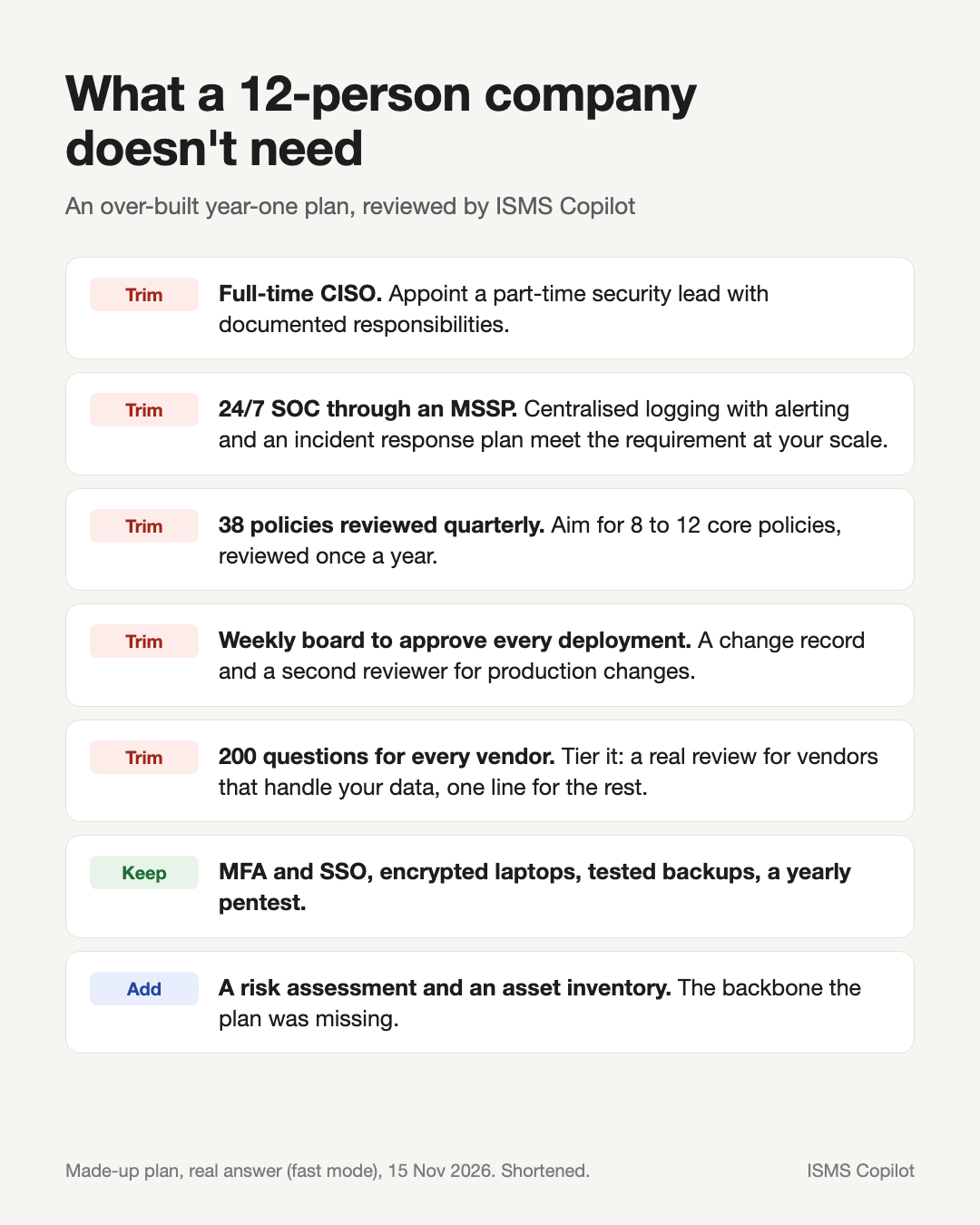
A made-up plan, a real ISMS Copilot answer, Fast mode, 15 November 2026, shortened.
What it trimmed, and what it proposed instead:
- A full-time CISO. Appoint a part-time security lead with documented responsibilities.
- A 24/7 SOC through an MSSP. Centralised logging with alerting, plus an incident response plan, meet the requirement at that scale.
- 38 policies reviewed quarterly. 8 to 12 core policies, reviewed once a year.
- A weekly change board approving every deployment. A change record and a second reviewer for production changes.
- DLP on all endpoints. Not justified by that data yet. Revisit it when larger enterprise customers come.
- A 200-question questionnaire for every vendor, the coffee supplier included. Tier it: a real review for vendors that handle your data, one line for the rest.
What it kept: MFA and SSO, encrypted laptops, tested backups, a yearly pentest, yearly training plus onboarding.
And what it added, because the plan was missing it: a risk assessment and treatment plan, an asset inventory, a Statement of Applicability, and an incident response procedure tied to the GDPR 72-hour breach duty.
This is the part I care about. The review did not only make the plan smaller. It found the backbone that was missing, and it removed what this company would not run. Each cut came with a reason, and the team can still say no to any of them.
What ISMS Copilot now does by default
It sizes what it recommends to your organisation: your headcount, the data you handle and how sensitive it is, your sector and legal obligations, your stage. It takes this from your company profile, your workspace project instructions and what you tell it in the conversation.
When it does not know your size and the size would change the answer, it says in one line what size it assumed. If your sector or your data suggests regulation, it leans to the fuller control.
It prefers the smallest adequate control: one that meets the requirement, treats the identified risk, and that your organisation will actually run. It does not add process, tooling, roles, documents, approvals or review cycles that neither the requirement nor the risk calls for, unless you ask for the fuller version.
Small size is not an excuse to skip things. When it is not sure a requirement applies, it keeps it and says why. It names a size exemption only where the framework or the law provides one, and it names the basis.
It keeps the depth of its guidance. The explanation stays as complete as before; only what it recommends gets smaller.
And when you give it a plan, a design or a document to review, it looks for what is more than you need as hard as for what is missing, even when you did not ask. It says why each item can go. It adds a new item only when a requirement or an identified risk calls for it.
You decide what stays.
How to use it
Give it your size, your sector and your data. The company profile and the workspace project instructions are the best place, because every answer in that workspace then starts from them. A line in the chat works too.
Ask it to review your plan. Paste the plan, the policy list or the design, in the app or from the AI you already work with, for example Claude x ISMS Copilot or ChatGPT x ISMS Copilot. Your AI drafts, ISMS Copilot reviews and challenges, you decide.
Ask for the fuller version when you want it. Sometimes a large customer, a contract or your own risk appetite asks for more than the smallest adequate control. Say so, and it drafts the fuller version. Proportionate is the default, not a limit.
Where it works today
It is live in ISMS Copilot answers in Fast and Think: in the web app, in Slack, and in the answers your AI gets when you connect it to your ISMS Copilot account, for example Claude x ISMS Copilot or ChatGPT x ISMS Copilot. Beyond follows later.
More on the behaviour is on the proportionate compliance page. You can try it on your next plan. If it cuts something you need, or keeps something you don't, write to me at contact@ismscopilot.com.
Tristan Roth, founder, ISMS Copilot
Related Posts
Cyber Resilience Act answers now cite the article
The CRA's Article 14 reporting duty has applied since 11 September 2026. Chat now answers Cyber Resilience Act questions with references to the article and point of Regulation (EU) 2024/2847.
Claude is the harness. ISMS Copilot is the GRC specialist.
We are not trying to replace the agent you already use. Keep Claude Code, Cursor, Codex, OpenCode, or Grok for the work. When the task turns into compliance, your agent consults a specialist over MCP and has it check the work before it is final.
Run Beyond from the editor you already work in
Fast and Think already followed you into Claude Code and Cursor. The multi-document checking mode lived in the browser. It does not have to.