
5 bonnes pratiques d'IA pour le cadre NIST
Cinq pratiques basées sur l'IA pour le NIST AI RMF : automatiser la gouvernance, cartographier et inventorier les risques, mesurer les performances des modèles, gérer les audits et aligner les cadres.

Le NIST AI Risk Management Framework (AI RMF 1.0), lancé en janvier 2023, offre une approche structurée pour aborder les risques uniques des systèmes d'IA - comme la dérive des données, l'opacité des modèles et les biais. Il repose sur quatre fonctions principales : Gouverner, Cartographier, Mesurer et Gérer, qui aident les organisations à identifier, surveiller et atténuer efficacement les risques liés à l'IA.
Voici cinq pratiques basées sur l'IA pour simplifier la mise en œuvre du cadre NIST :
- Automatiser la création de politiques de gouvernance : Utiliser des outils d'IA pour rédiger des politiques, suivre les preuves et gérer le contrôle des versions pour la conformité.
- Cartographier et inventorier les risques : Exploiter l'IA pour classer les systèmes, documenter les risques et maintenir un inventaire à jour des actifs d'IA.
- Mesurer les performances : Mettre en place des tests et une surveillance pilotés par l'IA pour suivre les métriques, détecter des problèmes comme la dérive des données et garantir une fiabilité continue.
- Gérer les risques et les audits : Automatiser la détection des risques, prioriser les réponses et maintenir une documentation prête pour les audits.
- Automatiser l'alignement inter-cadres : Utiliser des outils d'IA pour aligner le NIST AI RMF avec d'autres normes comme ISO 27001 et SOC 2 pour une conformité plus rapide.
Ces approches réduisent l'effort manuel, améliorent la précision et soutiennent une conformité continue, transformant la gestion des risques liés à l'IA en un processus rationalisé.
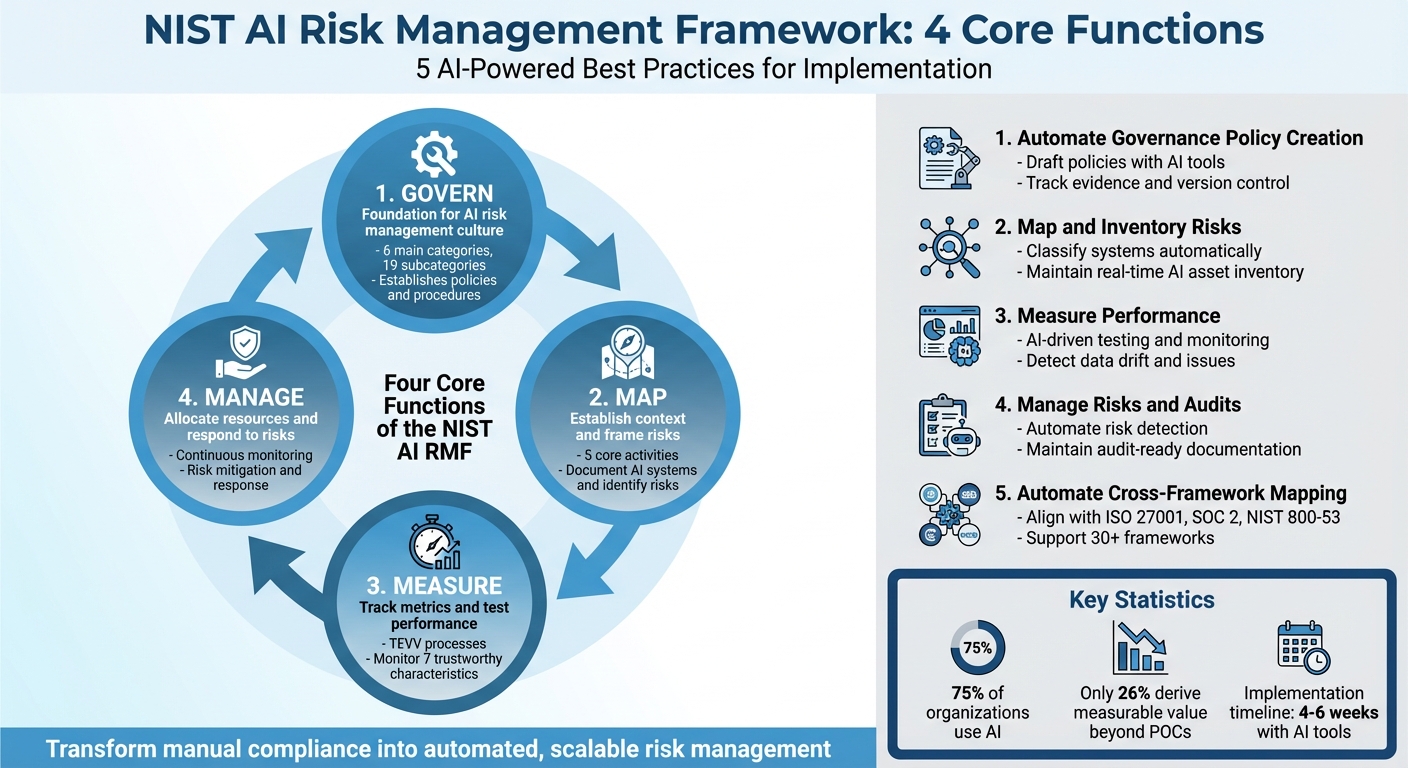
NIST AI Risk Management Framework : 4 fonctions principales et processus de mise en œuvre
1. Automatiser la génération de politiques de gouvernance avec l'IA
Alignement avec les fonctions principales du NIST
La fonction Gouverner joue un rôle central dans le NIST AI Risk Management Framework (AI RMF), servant de base aux fonctions Cartographier, Mesurer et Gérer. Elle comprend six catégories principales et 19 sous-catégories, toutes visant à promouvoir une culture de gestion des risques au sein des organisations. Les outils basés sur l'IA peuvent simplifier la création de la documentation essentielle de gouvernance, couvrant des tâches comme la cartographie des exigences légales et réglementaires (Gouverner 1.1), l'établissement de politiques claires de gestion des risques (Gouverner 1.4) et le maintien d'inventaires précis des systèmes d'IA (Gouverner 1.6).
"La gouvernance est conçue pour être une fonction transversale afin d'informer et d'être intégrée dans les trois autres fonctions." - NIST AI RMF 1.0
Cette approche fondamentale permet aux outils d'IA de rationaliser efficacement ces tâches de gouvernance.
Utilisation de l'IA pour l'automatisation et l'efficacité
Les outils d'IA apportent évolutivité et efficacité aux processus de gouvernance qui étaient autrefois manuels et chronophages. Le NIST AI RMF Playbook - disponible en formats CSV, JSON et Excel - fournit des sous-catégories structurées qui servent de prompts détaillés pour la création de politiques pilotée par l'IA. Par exemple, des outils comme ISMS Copilot peuvent utiliser ces entrées structurées pour rédiger des politiques de gouvernance conformes aux normes NIST tout en garantissant une précision réglementaire.
Les organisations ont déjà démontré leur succès en intégrant l'IA dans leurs flux de travail de gouvernance. En cartographiant les contrôles du NIST AI RMF et en automatisant le suivi des preuves, elles ont pu mettre en œuvre des solutions d'IA conformes et alignées sur leurs activités en quelques semaines seulement. Cette approche rationalisée réduit la complexité, rendant la conformité plus accessible.
Mise en œuvre actionnable pour la conformité
Pour tirer parti de ces efficacités, les organisations peuvent utiliser l'IA pour automatiser la création de politiques de gouvernance alignées sur les normes NIST. Commencez par intégrer les actions suggérées dans le NIST AI RMF Playbook dans des outils de rédaction assistée par IA pour générer des politiques détaillées. Pour des tâches comme les évaluations des risques tiers (Gouverner 6.1), l'IA peut analyser automatiquement les logiciels et politiques de données des fournisseurs, abordant des préoccupations telles que la propriété intellectuelle et les risques liés à la chaîne d'approvisionnement.
De plus, le contrôle des versions automatisé peut aider à répondre aux exigences de Testing, Evaluation, Verification, and Validation (TEVV). L'IA garantit la cohérence de tous les documents de gouvernance tout en les adaptant au profil de risque de votre organisation. Cette approche transforme les projets d'IA, passant d'expérimentations incertaines à des solutions commerciales fiables, évolutives et conformes, intégrant confiance et transparence à chaque étape du cycle de développement.
2. Cartographier et inventorier les risques avec l'IA
Alignement avec les fonctions principales du NIST
La fonction Cartographier est un pilier essentiel pour comprendre les risques liés à l'IA, posant les bases des fonctions Mesurer et Gérer. Sans ce contexte fondamental, la gestion efficace des risques devient un défi. La fonction Cartographier se divise en cinq activités principales où l'IA peut apporter de l'efficacité : documenter le contexte des systèmes d'IA (Cartographier 1), catégoriser les systèmes par type de tâche (Cartographier 2), analyser leurs capacités (Cartographier 3), identifier les risques spécifiques dans les composants (Cartographier 4) et évaluer les impacts potentiels (Cartographier 5).
"La fonction Cartographier établit le contexte pour encadrer les risques liés à un système d'IA." – NIST AI RMF 1.0
Cette fonction est étroitement liée à Gouverner 1.6, qui appelle à l'utilisation d'outils automatisés pour inventorier les systèmes d'IA et allouer des ressources en fonction des priorités de risque. Elle prend également en compte la nature sociotechnique de l'IA. Combinées, ces initiatives rendent l'identification et la cartographie des risques plus efficaces et continues.
Utilisation de l'IA pour l'automatisation et l'efficacité
L'IA peut simplifier et améliorer la catégorisation et l'identification des risques. Par exemple, elle peut classer les systèmes - comme les systèmes de recommandation, de génération ou de classification (Cartographier 2.1) - pour identifier les risques de manière plus précise. Des outils automatisés peuvent également analyser les composants tiers pour évaluer les risques technologiques et juridiques (Cartographier 4.1). Des outils comme ISMS Copilot sont particulièrement utiles pour maintenir un inventaire dynamique des systèmes d'IA, y compris les intégrations externes, tout en documentant les limitations des systèmes et la nécessité d'une supervision humaine (Cartographier 2.2). L'analyse de données joue un rôle clé dans l'analyse des données historiques et des rapports d'incidents, aidant à estimer la probabilité et la gravité des dommages potentiels. Cette automatisation transforme une tâche autrefois manuelle et chronophage en un processus rationalisé et continu. En cartographiant en permanence les risques, les organisations peuvent mieux aligner leurs efforts de gouvernance avec une compréhension claire du paysage des risques.
Mise en œuvre actionnable pour la conformité
Pour mettre en pratique ces stratégies, commencez par utiliser des outils de découverte basés sur l'IA pour documenter les tâches, les méthodes et les limitations de vos systèmes d'IA (Cartographier 2.1-2.2). Construisez un inventaire en temps réel qui permet des requêtes de haut niveau comme : "Combien d'utilisateurs sont affectés ?" ou "Quand ce modèle a-t-il été mis à jour pour la dernière fois ?". Cet inventaire doit capturer des détails critiques tels que la documentation du système, les dictionnaires de données, le code source, les dates de rafraîchissement des modèles et les noms des parties prenantes clés. Des outils de scan automatisés peuvent ensuite cartographier en continu les risques sur tous les composants, y compris les logiciels et données tiers, garantissant qu'ils répondent aux seuils de risque de votre organisation. L'analyse de données peut en outre évaluer l'ampleur des risques en fonction des incidents passés. Comme les systèmes d'IA évoluent avec le temps, ce processus de cartographie doit rester dynamique, s'adaptant aux changements de contexte, de capacités et de risques tout au long du cycle de vie de l'IA.
3. Mesurer les performances avec des métriques et tests pilotés par l'IA
Alignement avec les fonctions principales du NIST
La fonction Mesurer joue un rôle critique dans les tests de performance en exploitant des métriques spécifiques identifiées lors de la phase Cartographier. Ces métriques guident les décisions liées à la gestion des risques et à la conformité. Les données collectées alimentent la fonction Gérer, déclenchant des actions comme le recalibrage des modèles, l'atténuation des impacts potentiels, voire la mise hors service de systèmes ne répondant plus aux normes. Le cadre garantit que la mesure n'est pas une tâche ponctuelle mais un processus continu intégré tout au long du cycle de vie de l'IA.
"La mesure fournit une base traçable pour éclairer les décisions de gestion. Les options peuvent inclure le recalibrage, l'atténuation des impacts ou la suppression du système du processus de conception, de développement, de production ou d'utilisation." – Noyau du NIST AI RMF
Utilisation de l'IA pour l'automatisation et l'efficacité
Les outils pilotés par l'IA simplifient et rationalisent les processus de TEVV (Testing, Evaluation, Verification, and Validation), réduisant le travail manuel tout en garantissant des méthodes de test cohérentes et évolutives. Ces outils permettent aux organisations de surveiller les métriques clés avant le déploiement et pendant l'exploitation, en surveillant les problèmes tels que la dérive - lorsque les performances ou la fiabilité d'un système d'IA se dégradent en raison de données changeantes. La surveillance en temps réel devient particulièrement vitale dans les applications critiques pour la sécurité, permettant des réponses rapides aux défaillances. Par exemple, des outils comme ISMS Copilot aident à garantir le niveau de transparence et de responsabilité requis par les auditeurs. Une pratique clé consiste à maintenir une séparation claire entre les équipes développant les modèles d'IA et celles chargées de leur vérification et validation. Cette séparation favorise l'objectivité et soutient des stratégies de conformité actionnables.
Mise en œuvre actionnable pour la conformité
En partant de l'inventaire des risques établi précédemment, les organisations doivent se concentrer sur la sélection de métriques qui traitent des risques les plus pressants identifiés lors de la phase de cartographie. Ces métriques doivent s'aligner sur les sept caractéristiques de confiance de NIST : valides et fiables, sûrs, sécurisés et résilients, responsables et transparents, explicables et interprétables, renforçant la confidentialité, et équitables. La surveillance en temps réel et les boucles de rétroaction sont essentielles pour identifier les problèmes de performance ou de dérive des risques, tandis que les retours des utilisateurs peuvent affiner davantage les évaluations en cours. Documenter tous les processus de test, y compris les risques difficiles à quantifier, est tout aussi important. Pour garantir l'impartialité, impliquez des évaluateurs indépendants qui n'ont pas participé au processus de développement. Enfin, les métriques doivent prendre en compte les aspects sociotechniques de l'IA, en considérant comment différents groupes peuvent être affectés - même s'ils ne sont pas des utilisateurs directs.
4. Gérer les risques et les audits avec l'IA
Alignement avec les fonctions principales du NIST
La fonction Gérer est la pièce finale du cadre NIST AI RMF, où les organisations traitent activement les risques identifiés lors des phases précédentes de Cartographier et Mesurer. Gérer les risques n'est pas une tâche ponctuelle - elle nécessite une attention constante et une allocation cohérente des ressources, comme défini par les directives de gouvernance. Cette fonction sert de pont, reliant les étapes initiales d'identification et d'évaluation des risques au contrôle opérationnel pratique.
"La fonction GÉRER implique l'allocation des ressources de risque aux risques cartographiés et mesurés de manière régulière et telle que définie par la fonction GOUVERNER." – NIST AI RMF 1.0
Au cœur de la gestion efficace des risques se trouvent des décisions critiques : poursuivre le déploiement, atténuer les dommages potentiels, ou interrompre les opérations si les risques dépassent les niveaux acceptables. Comme l'explique le NIST : "Dans les cas où un système d'IA présente des niveaux de risque négatifs inacceptables... le développement et le déploiement doivent cesser de manière sûre jusqu'à ce que les risques puissent être suffisamment gérés."
Utilisation de l'IA pour l'automatisation et l'efficacité
Les outils d'IA transforment la gestion des risques, passant d'un processus lent et manuel à une opération continue et en temps réel. Ces outils excellent dans la détection des problèmes de performance et des comportements inattendus que la supervision humaine pourrait manquer, en particulier dans les systèmes complexes impliquant des composants tiers comme des modèles pré-entraînés. Souvent, les risques latents dans ces modèles n'apparaissent qu'une fois en service.
Les systèmes de surveillance automatisés permettent des réponses plus rapides en cas de problème. Par exemple, l'IA peut immédiatement signaler une activité inhabituelle et déclencher des protocoles pour arrêter les systèmes fonctionnant en dehors de leurs paramètres prévus. Des outils comme ISMS Copilot simplifient également la documentation, facilitant le suivi et la gestion des risques tout au long du processus.
Mise en œuvre actionnable pour la conformité
Une fois que les systèmes automatisés ont identifié les risques, l'étape suivante consiste à agir. Commencez par prioriser les risques en fonction de la probabilité et de l'impact potentiel identifiés lors des phases de Cartographier et Mesurer. Pour les risques prioritaires, élaborez des plans de réponse clairs qui décrivent comment les atténuer, les transférer, les éviter ou les accepter. Si nécessaire, mettez en place des "interrupteurs d'arrêt" automatisés pour désactiver les systèmes dépassant les niveaux de risque acceptables.
Il est tout aussi important de documenter les risques résiduels à des fins d'audit et d'étendre la surveillance aux composants tiers pour s'assurer qu'aucun angle mort ne subsiste. Enfin, établissez des processus post-déploiement pour recueillir les retours et les données de terrain, aidant à traiter les risques imprévus qui émergent avec le temps. Cette boucle continue de surveillance et d'action garantit la conformité et maintient les systèmes dans des limites sûres.
sbb-itb-4566332
5. Automatiser l'alignement inter-cadres avec l'IA
Alignement avec les fonctions principales du NIST
L'alignement inter-cadres joue un rôle crucial dans l'intégration du NIST AI Risk Management Framework (AI RMF) avec d'autres normes. Voici comment il s'aligne avec les fonctions principales du NIST :
- Gouverner : Établit des politiques et procédures de base.
- Cartographier : Identifie les risques juridiques et technologiques chevauchants (par exemple, Cartographier 4.1).
- Mesurer : Développe des métriques pour soutenir les audits et évaluations.
- Gérer : Guide les réponses aux risques à travers divers standards de conformité.
"Le Cadre est destiné à s'appuyer sur, s'aligner avec et soutenir les efforts de gestion des risques liés à l'IA par d'autres." – NIST
Utilisation de l'IA pour rationaliser le processus
L'alignement manuel des cadres comme le NIST AI RMF, l'ISO 27001 et le SOC 2 est chronophage et sujet aux erreurs. L'IA simplifie ce processus en exploitant l'analyse sémantique automatisée pour détecter les contrôles chevauchants. Avec le AI RMF Playbook disponible dans des formats lisibles par machine tels que JSON, CSV et Excel, les outils de Governance, Risk, and Compliance (GRC) pilotés par l'IA peuvent rapidement aligner ces contrôles pour traiter les risques spécifiques à l'IA.
Étapes pour une mise en œuvre pratique
Pour mettre en œuvre efficacement l'alignement inter-cadres automatisé :
- Télécharger les ressources : Accédez au NIST AI RMF Playbook dans des formats structurés et utilisez les Crosswalks de NIST comme base pour les prompts pilotés par l'IA.
- Centraliser l'inventaire des systèmes : Maintenez un inventaire centralisé des systèmes d'IA (Gouverner 1.6), en vous concentrant sur les systèmes à haut risque ou manipulant des données sensibles.
- Exploiter les outils d'automatisation : Utilisez des outils comme ISMS Copilot pour identifier les contrôles chevauchants sur plus de 20 cadres. Cette approche réduit le temps d'évaluation et augmente la précision de la conformité.
Automatiser l'alignement inter-cadres n'est pas un effort ponctuel. C'est un processus évolutif qui s'adapte aux paysages de risques changeants, garantissant que les organisations maintiennent une stratégie de conformité résiliente et efficace.
Mettre en œuvre le NIST AI RMF : une feuille de route vers une IA responsable
Conclusion
Adopter le NIST AI Risk Management Framework n'a pas besoin d'être accablant. En exploitant les cinq meilleures pratiques basées sur l'IA discutées - comme la création automatisée de politiques et l'alignement inter-cadres - les organisations peuvent transformer ce qui était autrefois un processus fastidieux et manuel en quelque chose d'efficace et d'évolutif. Avec les bons outils et un soutien approprié, il est possible de mettre en œuvre les piliers centraux du cadre en seulement 4 à 6 semaines.
Voici la réalité : bien que plus de 75 % des organisations utilisent l'IA, seulement 26 % parviennent à en tirer une valeur mesurable au-delà des preuves de concept. C'est là que les outils de conformité pilotés par l'IA entrent en jeu. Ils simplifient l'exécution, rendant l'adoption du cadre plus cohérente, traçable et reproductible.
L'importance de cette transition est parfaitement résumée par Akash Lomas, Technologue chez Net Solutions :
"Gérer l'IA de manière responsable n'est pas seulement une mesure de protection, mais aussi un levier de croissance." – Akash Lomas
Les plateformes comme ISMS Copilot, qui prennent en charge plus de 20 cadres - y compris NIST 800-53, l'ISO 27001 et le SOC2 - sont des changements de jeu. Elles automatisent la cartographie des contrôles, génèrent la documentation de conformité et fournissent des informations en temps réel sur l'état de votre conformité. Cela signifie que les risques peuvent être signalés immédiatement, et les organisations peuvent maintenir une préparation continue aux audits. La transition d'une gouvernance manuelle et réactive vers une conformité proactive et automatisée ne consiste pas seulement à gagner du temps. Il s'agit d'instaurer la confiance - la confiance des régulateurs, des clients et des parties prenantes - tout en transformant l'IA d'une entreprise risquée en un avantage stratégique. Que vous aligniez plusieurs cadres ou que vous vous concentriez sur des actions spécifiques de conformité, les solutions basées sur l'IA rendent le processus non seulement gérable, mais aussi durable.
FAQ
Comment l'IA peut-elle simplifier la création de politiques de gouvernance pour le NIST Cybersecurity Framework ?
L'IA élimine les difficultés liées à la rédaction de politiques de gouvernance pour le NIST Cybersecurity Framework en transformant des processus manuels fastidieux en flux de travail automatisés et rationalisés. Elle peut examiner les politiques de sécurité existantes, les évaluations des risques et les inventaires d'actifs, puis les aligner sur les fonctions principales du NIST - Identifier, Protéger, Détecter, Répondre, Récupérer - et leurs sous-catégories. Grâce à la génération de langage naturel, l'IA peut produire des déclarations de politique correspondant aux contrôles requis, remplir des modèles et même gérer les détails de versionnage - le tout en quelques minutes.
Par exemple, des outils comme ISMS Copilot permettent aux organisations de demander des politiques personnalisées, comme une politique de classification des données alignée sur le NIST. Ces outils fournissent des documents prêts à être examinés qui intègrent les dernières mises à jour du cadre et les besoins spécifiques de l'organisation. Cette automatisation réduit non seulement les erreurs humaines, mais accélère également le processus d'approbation des politiques et garantit que les documents de conformité restent à jour, permettant aux équipes de se concentrer sur des initiatives plus stratégiques.
Comment l'IA aide-t-elle à identifier et gérer les risques dans les systèmes d'IA ?
L'IA transforme la manière dont les organisations identifient et gèrent les risques en automatisant le processus de création et de maintenance d'un inventaire des systèmes d'IA, des ensembles de données, des modèles et de leurs dépendances. Cette approche s'aligne directement sur le NIST AI Risk Management Framework (AI RMF), qui souligne la nécessité de cartographier et de gouverner efficacement les risques liés à l'IA. Avec des outils pilotés par l'IA, des tâches comme le suivi des versions de modèles, la traçabilité des origines des données et la détection des anomalies deviennent plus fluides, réduisant le travail manuel et révélant des risques qui pourraient autrement passer inaperçus.
Prenons l'exemple d'ISMS Copilot - souvent appelé le "ChatGPT de l'ISO 27001". Il applique ces principes à des cadres comme le NIST 800-53 en analysant les données de configuration, les dépôts de code et les services cloud pour produire une cartographie complète des risques. Cela permet aux organisations d'identifier rapidement les écarts de conformité et les contrôles nécessaires tout en maintenant leur inventaire à jour. En convertissant des données techniques complexes en un langage standardisé de gestion des risques, ISMS Copilot simplifie le processus d'alignement avec le NIST AI RMF, le rendant bien plus gérable.
Comment les outils d'IA peuvent-ils simplifier la conformité avec des cadres comme NIST et ISO 27001 ?
Les outils d'IA ont simplifié la tâche traditionnellement complexe et chronophage de répondre aux exigences de conformité pour des cadres comme le NIST et l'ISO 27001. Ces outils analysent les ensembles de contrôles et les cadres pour mapper automatiquement les connexions entre les normes - comme le NIST 800-53 et l'ISO 27001 - permettant aux organisations d'identifier les lacunes, de prioriser les corrections et de réutiliser les preuves sur plusieurs cadres. Cette approche peut réduire considérablement le temps et les efforts nécessaires à la conformité.
Au-delà du mapping, l'IA peut créer des politiques personnalisées, remplir des modèles et générer des documents prêts pour les audits comme des évaluations des risques ou des journaux de contrôles avec un minimum d'entrée. Certains outils avancés offrent même une surveillance en temps réel, identifiant les écarts et recommandant des actions correctives pour garantir une conformité continue. Par exemple, ISMS Copilot, souvent appelé le "ChatGPT de l'ISO 27001", se concentre sur ces tâches. Il agit comme un assistant piloté par l'IA, aidant les professionnels de la conformité à s'aligner sur plusieurs cadres tout en réduisant les coûts et le travail manuel.
Articles connexes
Articles connexes
Conformité multi-cadres : le rôle de l'IA dans les rapports
L'IA transforme la conformité multi-cadres, passant de mois de travail manuel à des rapports continus, réutilisables et prêts pour les auditeurs.
Tableau de bord de conformité NIST 800-53
Évaluez votre conformité à la norme NIST 800-53 avec notre outil de tableau de bord gratuit. Notez les contrôles, obtenez un score et visualisez les lacunes en matière de sécurité et de confidentialité !
Liste de contrôle des contrôles NIST 800-53
Suivez facilement la conformité NIST 800-53 avec notre outil de liste de contrôle gratuit. Surveillez les contrôles, calculez les progrès et obtenez des rapports détaillés sur les écarts !