
AI for GDPR: Automating Cross-Border Data Transfers
Automate mapping, monitoring, and documentation of EU cross-border data transfers with AI—legal teams retain final decisions.

AI for GDPR: Automating Cross-Border Data Transfers
If you send EU personal data outside the EEA, AI can help with the busywork - but it can’t make the legal call for you.
Here’s the short version: I’d use AI to map data flows, watch vendors and subprocessors, draft TIA records, and flag risk changes as they happen. But I’d still keep lawyers, privacy teams, and the DPO in charge of transfer choices, SCC reviews, and final approval.
A few facts make that clear:
- GDPR Chapter V applies when personal data is sent - or even just made available - in a third country.
- Meta’s $1.3 billion Irish DPC fine in May 2023 showed what weak SCC support and poor TIA records can cost.
- The EU-U.S. Data Privacy Framework is still under court pressure, so using it alone can leave gaps.
- Shadow AI use, like staff pasting files into ChatGPT or Claude, can create cross-border transfers with no record.
- A vendor’s subprocessor list, hosting region, or retention setup can change long after onboarding.
So the main takeaway is simple: A GDPR Copilot is good for finding, tracking, and documenting transfers at scale. People still need to decide whether the transfer is lawful and what safeguards are enough.
If I were putting this into practice, I’d focus on five jobs first:
- Map where personal data goes across SaaS, cloud tools, APIs, and AI services
- Monitor for vendor, region, retention, and tool-use changes
- Draft RoPA entries, TIA inputs, and transfer records
- Apply controls like redaction, EEA routing, zero retention, and EU-key encryption
- Trigger reviews when subprocessors, laws, or certifications change
A simple way to think about it:
| What AI can do | What people still need to do |
|---|---|
| Find data flows | Choose DPF, SCCs, BCRs, or Article 49 derogations |
| Flag new transfer risks | Judge foreign government access risk |
| Draft TIA inputs | Decide if extra safeguards are enough |
| Track DPF certification status | Approve TIAs and transfer decisions |
| Keep records in sync | Accept legal and board-level risk |
Bottom line: I’d treat AI as a monitoring and drafting layer, not a legal decision-maker. That’s how you keep transfer records current without letting the data map drift out of sync with contracts, TIAs, and vendor reality.
::: @figure 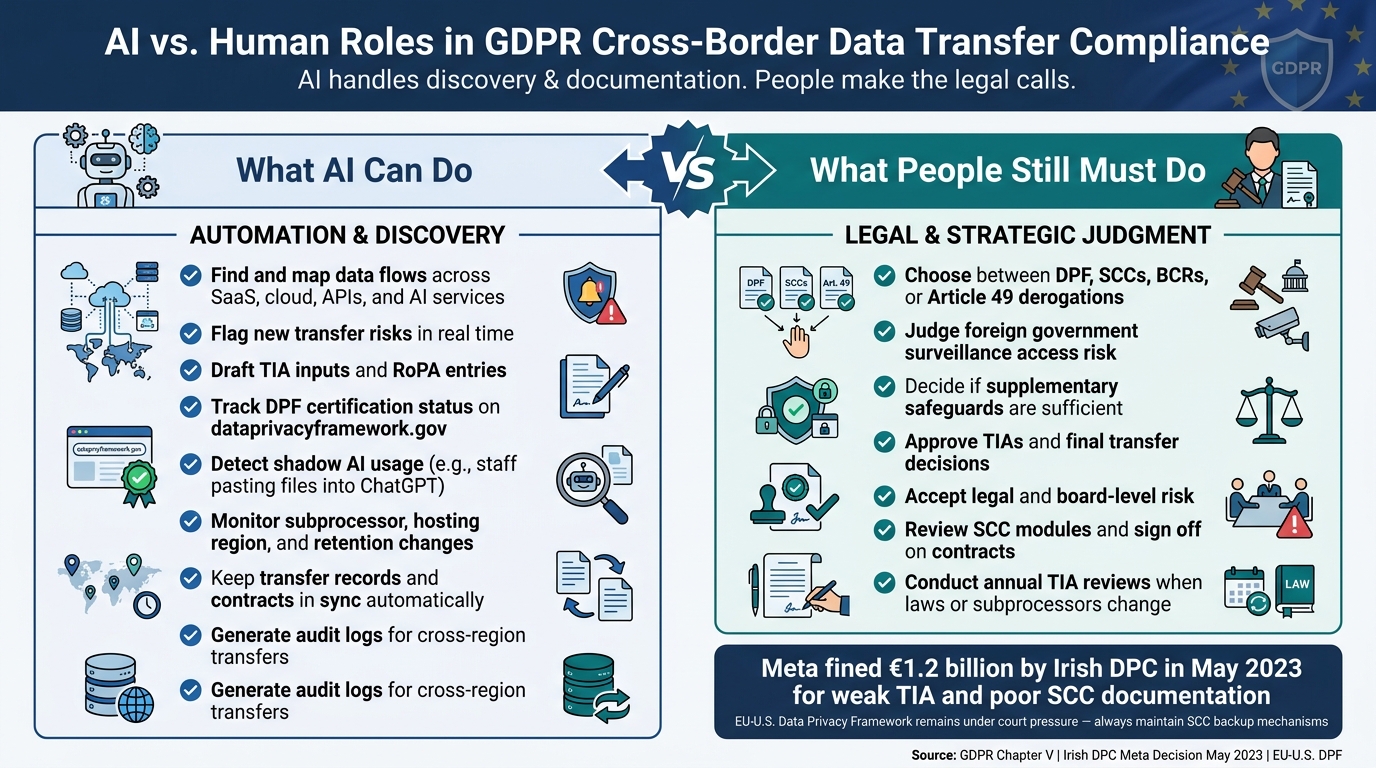 {AI vs. Human Roles in GDPR Cross-Border Data Transfer Compliance}
:::
{AI vs. Human Roles in GDPR Cross-Border Data Transfer Compliance}
:::
Where AI Closes the Biggest Transfer Compliance Gaps
AI-Driven Data Flow Mapping Across Systems and Vendors
The first gap AI closes is visibility. Automated discovery can map personal data across SaaS, cloud, and AI vendors, including transfer paths that manual reviews often miss [6][8].
That means more than the obvious systems. It also includes subprocessors, logs, backups, and intermediate API calls. Each one can be tied to the transfer mechanism that applies to it. A useful map should show:
- The service in use
- The data involved
- The transfer mechanism
- The subprocessor region
AI helps cut transfer risk because it keeps that map up to date, not because it finds data one time and stops. Once the map is in place, AI can watch for drift and surface changes as they happen.
Continuous Detection of New Transfer Risks
Instead of waiting for a scheduled review, teams can monitor subprocessor, hosting, retention, and tool-use changes in real time [6][7].
The point is simple: catch transfer issues when they appear. That includes flagging new unauthorized SaaS or AI tools, spotting when a vendor changes its hosting region, catching updates to retention settings, and finding new categories of personal data showing up in prompts [4][6].
When the system detects a change, it can open a review, classify the destination, suggest a transfer mechanism, and send it to a human for approval using ISMS Copilot EU [7].
Automated Records and Evidence Collection
RoPA, vendor assessments, and transfer documents need to stay in sync because they all support the same transfer decision. AI platforms help by auto-filling RoPA entries from discovered data flows and linking each entry to the related subprocessor, geographic location, and transfer mechanism [1][2].
If a vendor updates its subprocessor list, the system can flag whether the change is adverse, which would call for a 30-day notice review and a TIA refresh, or control-neutral, like adding a vetted provider to an existing Zero Data Retention-enforced allowlist [2].
For AI agent interactions that happen at high frequency, runtime audit logs can verify cross-region transfers in real time and generate audit logs for cross-region transfers [9].
With the map and records kept current, the next step is to match each flow to the right transfer mechanism and TIA.
How to Automate GDPR Transfer Mechanisms and Assessments
Choosing the Right Transfer Mechanism
Once AI maps a transfer, it can send that flow to the right legal path.
Adequacy decisions under Article 45 are the easiest route. If the destination country has been recognized by the EU as offering equivalent protection - such as the UK, Japan, South Korea, or DPF-certified U.S. organizations - there's no need for an extra contract. Still, it's smart to treat adequacy as a convenience layer and keep SCC and TIA systems ready as a backup [3].
Standard Contractual Clauses (SCCs) under Article 46 are the most common fallback for transfers to countries without adequacy. The 2021 updated SCCs use a modular setup that covers different transfer scenarios [10].
| SCC Module | Transfer Direction | Typical Use Case |
|---|---|---|
| Module 1 | Controller → Controller | Two controllers sharing personal data |
| Module 2 | Controller → Processor | An EU controller using a non-EU processor |
| Module 3 | Processor → Processor | A processor using a non-EU subprocessor |
| Module 4 | Processor → Controller | A processor returning data to a controller |
Binding Corporate Rules (BCRs) are the longest-lasting option for intra-group transfers. They don't depend on adequacy decisions and can still be used if adequacy changes. The tradeoff is simple: they take a lot of work and time to put in place [3].
Derogations under Article 49 are narrow exceptions, such as explicit consent, contract performance, or vital interests. They're meant only for occasional, non-repetitive transfers.
AI can classify each discovered data flow and route it to the proper mechanism based on destination, recipient type, and residency rules. That turns a legal decision tree into an automated routing step. From there, that choice feeds into the TIA and the supporting records.
Using AI to Speed Up Transfer Impact Assessments
AI drafts. People approve. That's the line.
SCCs don't work on their own. As Dr. Thiébaut Devergranne, founder of Legiscope, explains:
"Standard Contractual Clauses are not a substitute for due diligence - they are the contractual foundation on which the Transfer Impact Assessment, supplementary measures, and ongoing monitoring sit." [10]
A Transfer Impact Assessment (TIA) is part of the due diligence required when SCCs are used for transfers to countries without adequacy. AI can pull risk signals, extract safeguards from DPAs, flag special-category data, and draft a lawyer-ready TIA. Final legal sign-off still belongs with a qualified reviewer.
That matters. The Irish DPC's €1.2 billion fine against Meta in May 2023 was tied to a weak TIA that failed to account for U.S. surveillance exposure [3]. AI won't stop every enforcement action, but it does help close the documentation gaps regulators often spot first.
TIAs aren't a one-and-done task either. They should be reviewed each year or whenever a subprocessor changes or destination-country law shifts [10][3]. Automated reassessment triggers keep the TIA current without depending on a calendar reminder that someone may miss.
Keeping SCCs and Transfer Documentation Current
Once the TIA is drafted, the next job is keeping contracts, annexes, and live data flows in sync.
AI helps stop drift by comparing contract terms against live data flows on a continuous basis. In practice, that means it can detect when a U.S. subprocessor is added without the right Module 2 SCCs, flag when a storage region changes without a TIA update, or spot missing annex details like specific data categories or technical security measures.
If a vendor's subprocessor list update is materially adverse, the system can trigger a 30-day notice review and queue a TIA refresh. If the change doesn't alter the control posture, it can move through faster [2].
For organizations using the DPF, AI can also track recipient certification status on dataprivacyframework.gov and flag lapses automatically. If that certification lapses, the legal basis for the transfer disappears [10]. Running Module 2 SCCs alongside DPF certification gives you a backup path if adequacy is later invalidated [3].
Controls That Reduce Cross-Border Transfer Risk
Pseudonymization, Encryption, and Data Minimization
Once the transfer mechanism is in place, the next move is simple: send less data.
The less personal data that leaves the EEA, the lower the transfer risk. AI redaction workflows can find and mask personal identifiers like names, emails, phone numbers, and organization names before data reaches an international AI provider [1][5]. That kind of masking lowers risk, but it does not make the data anonymous [11].
For higher-risk transfers, encryption with EU-managed keys is a strong extra safeguard. If decryption keys stay only in the EU, stored data remains unusable without those EU-controlled keys, even if foreign authorities compel access [3]. And when it is offered, EEA-only routing with zero retention can remove the transfer step for some AI workflows altogether, which can take them outside Chapter V scope [1][5].
Access Controls, Monitoring, and Policy Enforcement
Access controls and AI compliance assistants help cut down the human mistakes that lead to undocumented transfers.
Row-level security (RLS) and workspace isolation keep data from separate clients or departments apart, which helps stop unauthorized cross-access during processing [11].
Shadow AI discovery also matters. If an employee pastes HR files or audit reports into an unvetted consumer AI tool, that can create an undocumented cross-border transfer [4]. Browser- and network-layer monitoring can spot those unsanctioned transfers before they turn into incidents.
| Control Purpose | AI-Enabled Implementation | Transfer Risk Reduction | Effort |
|---|---|---|---|
| Data residency | EEA-only routing | High - eliminates transfer step | Low |
| Data minimization | Automated PII redaction | High - reduces sensitive scope | Low |
| Supplementary safeguard | Encryption with EU-managed keys | High - data unusable without EU keys | High |
| Policy enforcement | Shadow AI monitoring | Medium - detects unauthorized flows | Medium |
| Access isolation | Row-level security (RLS) | Medium - prevents internal leaks | Medium |
| Storage limitation | Zero-retention API tiers | Medium - reduces data footprint | Low |
Vendor and AI Model Governance
These controls matter most when outside AI vendors control routing, retention, and subprocessors.
Third-party processors and AI services are often where transfer risk is highest. AI vendors may route inference requests across several jurisdictions and subprocessors on the fly [8][4]. So what seems like one vendor relationship can, in practice, involve several processing locations, each with its own legal exposure.
Due diligence for AI services needs to go past the usual DPA checklist. The main questions are pretty direct:
- Where does inference actually run?
- Where are logs stored?
- Does the vendor use prompt data to train models?
- What are the retention defaults, and can they be set to zero?
- What is the deletion timeline?
- Is there a documented incident response commitment tied to cross-border exposure?
If a vendor adds infrastructure in a new jurisdiction or changes its subprocessor list in a way that is materially adverse, that change should trigger an automatic TIA review [1][5][8].
The next step is to put these controls into a repeatable transfer program using a cross-framework ISMS assistant.
Building an AI-Supported GDPR Transfer Program
A Practical Implementation Sequence
The aim is to turn discovery, legal routing, and controls into one repeatable transfer workflow.
In practice, that means following a fixed rollout sequence instead of waiting for a perfect tool. Start by inventorying all personal data. Then map each transfer path by recipient, destination country, and data category. Flag Article 9 data first, because it calls for the strictest controls.
From there, assign a lawful transfer mechanism to each route. Run SCCs in parallel with DPF where legal exposure could interrupt transfer continuity. Automate TIA inputs by extracting risk signals from DPAs, checking destination-law risk, and drafting supplementary measures. Then apply safeguards at the service level and trigger TIA refreshes when a vendor changes or the law shifts.
That gives teams one operating path instead of splitting work across legal, security, and vendor tracks. For ISO 27001 and SOC 2 teams, the same data map can also feed RoPA and audit evidence.
How ISMS Copilot Can Support the Workflow
Once the workflow is in place, the next challenge is keeping records and evidence up to date.
ISMS Copilot helps teams draft GDPR transfer documentation, structure TIA inputs with pre-built templates, align controls across ISO 27001, SOC 2, NIS 2, and GDPR at the same time, and keep RoPA and evidence in sync for internal and external reviews.
Key Takeaways for Security and Compliance Teams
The value of automation is not fewer decisions. It is faster, better-supported decisions.
AI can handle data discovery, TIA prep, vendor checks, and continuous monitoring. It speeds up the work, but legal and DPO sign-off still owns the decision. Use documented safeguards, automated evidence, and scheduled reviews to keep transfer compliance current.
GDPR AI Data Transfers: Cloud Regions, Access & Audit Proof | Module 3.5
::: @iframe https://www.youtube.com/embed/eLZKdoNJv1k :::
FAQs
::: faq
When does a cross-border transfer happen under GDPR?
A cross-border transfer under GDPR happens when personal data is made available to a recipient in a third country or to an international organization outside the EEA.
That can happen in a few ways. The data might be sent directly, stored or processed on systems located in another country, or accessed from abroad. And the access doesn't have to be deliberate. Even incidental access can count as a transfer. :::
::: faq
Can AI automate TIAs and SCC reviews end to end?
Yes. AI can automate Transfer Impact Assessments (TIAs) and support SCC reviews from start to finish, including with tools like ISMS Copilot.
It can generate TIAs automatically based on transfer routes, legal frameworks, and supplementary measures, but human review still matters. :::
::: faq
What should trigger a new transfer risk review?
A new transfer risk review should be triggered when there’s a major change in how data is handled or in the legal picture around it.
That includes things like:
- updates to sub-processors or data flows
- changes in U.S. surveillance laws
- new guidance from data protection authorities
- major changes to data processing activities
- the introduction of new tools, vendors, or workflows
Put simply, if the data path changes, the legal rules shift, or a new party gets involved, it’s time to take another look. :::
Related Posts
The internal audit that never finds anything
ISO 19011 changed edition in May 2026. The failure mode it exists to prevent did not: the internal audit that has, by drift, stopped disagreeing with management.
Under NIS2, "important" is not a lighter security tier
Teams read the important label as NIS2-lite and scope their controls down. The security measures in Article 21 are the same either way; the tier changes supervision, some enforcement tools, and the floor on the national fine maximum.
Your ISO 27001 certificate does not start DORA's clocks
Financial entities keep mapping ISO 27001 controls onto DORA articles and calling the residue paperwork. DORA's real additions are duties that must be performed, to a specification and on a clock, that a certificate was never designed to test.