 ISMS Copilot
AI-Powered Compliance Monitoring: How It Works
How ML, NLP, and data integration enable 24/7 compliance monitoring, evidence reuse, risk scoring, and automated remediation.

AI-Powered Compliance Monitoring: How It Works
AI-powered compliance monitoring is transforming how businesses maintain regulatory standards. By using machine learning (ML) and natural language processing (NLP), this approach ensures continuous, real-time oversight of infrastructure, access controls, and data handling. Unlike periodic audits, it identifies and addresses compliance issues within minutes, keeping organizations audit-ready at all times.
Key Benefits:
- 24/7 Monitoring: Detects misconfigurations and access violations instantly.
- Automated Evidence Collection: Reduces manual effort by continuously gathering and organizing compliance data.
- Framework Compatibility: Supports multiple security standards like ISO 27001, SOC 2, and NIST 800-53.
- Proactive Remediation: Fixes critical issues automatically or flags them for review.
How It Works:
- Define Scope: Identify systems, assets, and applicable frameworks.
- Connect Data Sources: Integrate with cloud platforms, identity providers, and CI/CD pipelines.
- Continuous Testing: Use ML and NLP to evaluate controls and detect violations in real time.
- Risk Scoring: Assign severity levels to incidents for prioritization.
- Evidence Reuse: Map compliance data across multiple frameworks to save time.
Example Tools:
Platforms like ISMS Copilot simplify compliance by automating tasks and providing audit-ready outputs tailored to over 50 frameworks. Starting at $20/month, it’s a cost-effective solution for businesses of all sizes.
AI-driven monitoring not only reduces audit preparation time by up to 40% but also minimizes risks by catching issues before they escalate. Ready to streamline compliance? Dive into the details below.
Core Technologies Behind AI Compliance Monitoring
Machine Learning for Anomaly Detection
Machine learning plays a key role in spotting patterns that might slip past human reviewers or traditional rule-based tools. By analyzing historical data, ML models establish a baseline and continuously monitor deployments, permission changes, and configurations in real time [1].
When something unusual happens - like an S3 bucket becoming publicly accessible or an IAM role acquiring excessive permissions - the system assesses the situation, assigns a severity score, and sends out an alert. Volodymyr Paslavskyy, R&D Lead at ELITEX, explains:
"Automated systems are designed in a way that when a misconfiguration or access violation happens at 2 AM on a Saturday, you'll know about it before attackers do." [1]
Some systems go a step further by initiating proactive remediation. For instance, if a security group rule becomes overly permissive, the system can automatically revert it as soon as the anomaly is detected [1].
While ML focuses on identifying anomalies in configurations, other technologies like NLP and LLMs handle the interpretation of regulatory requirements.
Natural Language Processing and Large Language Models
Natural Language Processing (NLP) and Large Language Models (LLMs) are used to decipher complex regulatory texts, such as ISO 27001 clauses or NIST 800-53 controls. These tools don't just identify the existence of controls - they interpret the specific obligations required.
One major benefit is automated cross-mapping, where a single piece of evidence is evaluated across multiple frameworks, such as SOC 2, ISO 27001, and HIPAA, all at once [7][8]. This "test once, comply with many" method saves significant time and effort.
However, a challenge with LLMs is hallucination - when the model generates information about non-existent controls. To address this, specialized platforms use a process called Dynamic Framework Knowledge Injection. By feeding verified framework knowledge into the model’s context, outputs are grounded in accurate requirements [3]. For example, ISMS Copilot employs this approach to provide audit-ready guidance for over 50 frameworks [3].
These AI capabilities are further enhanced by robust data integration, which ensures the system has access to reliable, real-time information.
Data Integration and Observability Tools
Accurate and reliable data is the backbone of AI compliance monitoring. These systems connect to infrastructure (like AWS, Azure, and GCP), identity platforms (such as Okta and Entra ID), and CI/CD pipelines through APIs and agents to continuously gather evidence [1][6]. Once collected, the data is normalized, allowing issues - like a misconfigured S3 bucket - to be mapped to relevant controls under frameworks like SOC 2 or ISO 27001 [1][6].
Modern platforms can automatically collect data for over 45 types of evidence across cloud, identity, and code tools [6]. This information is stored in a centralized, tamper-proof audit trail. Instead of relying on scattered spreadsheets and manual screenshots, teams get a searchable timeline for all compliance activities. Advanced implementations even generate SHA-256 hashes for evidence packs, offering auditors a way to verify data integrity [5].
AI for Compliance & Investigations: Detect Risk Faster and Resolve Cases with Confidence
::: @iframe https://www.youtube.com/embed/jterf1gLuBY :::
How AI Compliance Monitoring Works: Step-by-Step
::: @figure 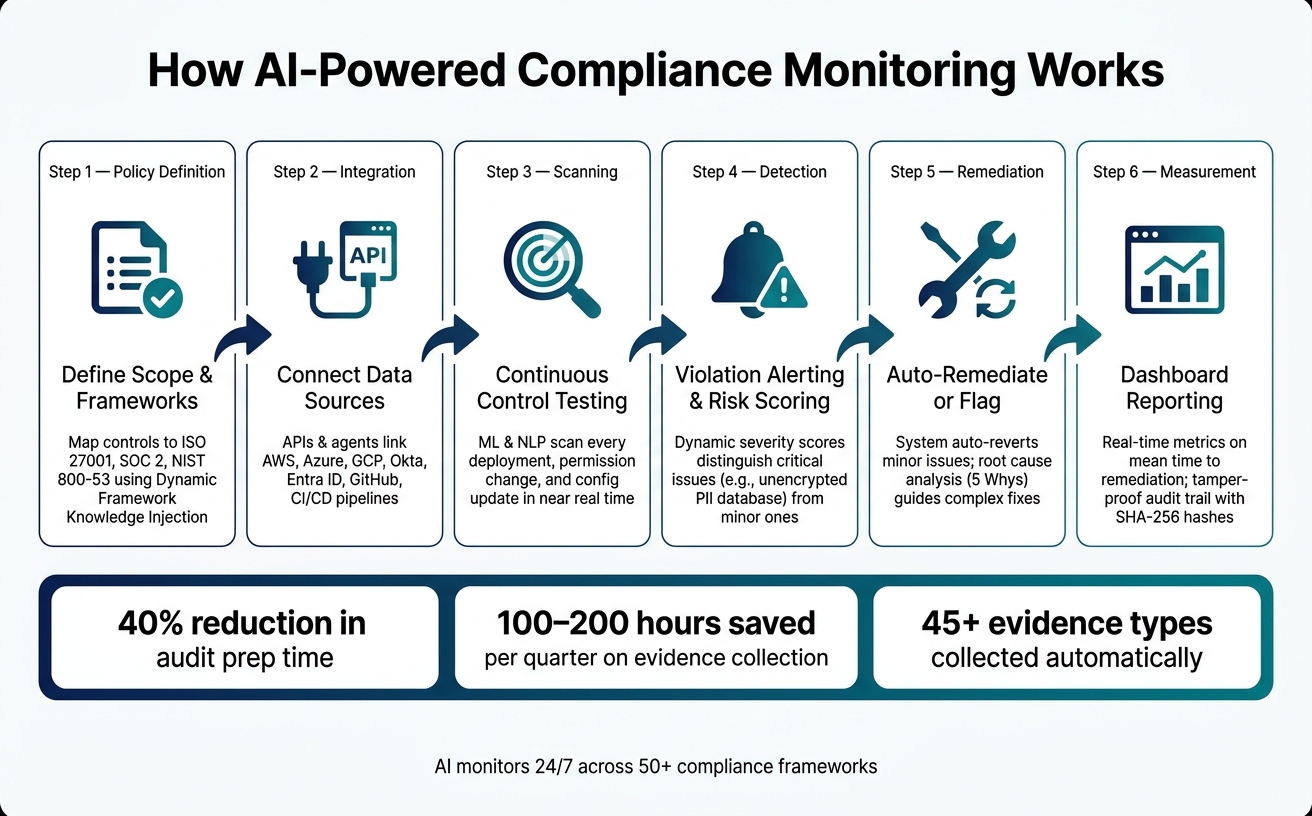 {How AI-Powered Compliance Monitoring Works: Step-by-Step}
:::
{How AI-Powered Compliance Monitoring Works: Step-by-Step}
:::
The process involves three key steps: defining what needs monitoring, connecting your data sources, and continuously testing and scoring controls.
Defining Scope, Frameworks, and Controls
Start by identifying the systems, assets, and processes that fall under compliance requirements. Then, determine which frameworks apply, such as ISO 27001, SOC 2, or NIST 800-53.
AI's Dynamic Framework Knowledge Injection plays a critical role here. It identifies relevant frameworks and retrieves precise controls and clauses, relying on structured, authoritative knowledge rather than generic data [3]. This creates machine-readable policy rules that the monitoring engine can actively test against.
By aligning multiple frameworks, overlapping controls are flagged early. This means you can define a control once, satisfying multiple frameworks simultaneously - eliminating redundant work right from the beginning [1].
Once the scope and controls are defined, the next step is to integrate live data for continuous monitoring.
Connecting Data Sources and Normalizing Evidence
Monitoring tools use APIs and agents to connect to cloud platforms (like AWS, Azure, and GCP), identity providers (such as Okta or Entra ID), CI/CD pipelines, and repositories like GitHub [6]. These connections provide an up-to-date view of your infrastructure.
The system then normalizes various data formats into a single, tamper-proof audit timeline. Each event is mapped to a specific compliance control. For example, a spike in failed logins detected by your SIEM could automatically be linked to access monitoring controls under ISO 27001 or SOC 2.
Continuous Control Testing and Risk Scoring
Once the data is normalized, the system continuously evaluates controls. Using machine learning and natural language processing, it scans every deployment, permission change, and configuration update in near real time, comparing them against your defined policy rules.
The table below outlines how the monitoring cycle works:
| Step | Action | AI Role |
|---|---|---|
| Policy Definition | Map controls to infrastructure rules | Dynamic knowledge injection of framework standards |
| Integration | Connect APIs and agents | Real-time visibility into cloud, IAM, and CI/CD |
| Scanning | Continuous evaluation | Near real-time detection of configuration changes |
| Detection | Violation alerting | Severity-based scoring and risk prioritization |
| Remediation | Auto-remediate or flag | Automated reverts or guided manual remediation |
| Measurement | Dashboard reporting | Real-time metrics on mean time to remediation |
When a violation occurs, the AI assigns a dynamic risk score based on its likelihood and impact. For instance, it distinguishes between a critical issue like an unencrypted database containing PII and a minor documentation error. In minor cases, the system may automatically revert changes. For more complex issues, the AI performs root cause analysis - using techniques like the "5 Whys" - to determine if the problem is isolated or part of a larger, systemic issue [1].
If you're just starting, it's a good idea to focus on a single framework, such as SOC 2 or ISO 27001. Trying to implement multiple frameworks at once can create unnecessary complexity without immediate benefits [1]. Get one framework running smoothly before expanding to others.
sbb-itb-4566332
AI Compliance Monitoring Across Security Frameworks
AI isn't just about internal monitoring - it also simplifies compliance across multiple frameworks and vendor ecosystems, making the entire process more efficient.
ISO 27001 and ISMS Monitoring
ISO 27001:2022 requires the 93 Annex A controls to operate consistently over a three-year cycle, not just during annual audits [9]. This continuous approach highlights the importance of AI in compliance monitoring.
AI can link each control to measurable, real-world metrics. For instance, a KPI like "mean time to patch critical vulnerabilities < 7 days" can be defined. AI then pulls data from tools like vulnerability scanners or SIEM systems to confirm compliance [9]. If something goes off track, alerts are triggered immediately - no need to wait for quarterly reviews.
AI also plays a key role after certification. During Year 2 and Year 3 surveillance audits, AI alternates control testing to ensure all areas are covered before recertification in Year 4 [9]. Tools like ISMS Copilot provide structured, framework-specific monitoring, leveraging verified ISO 27001 knowledge to minimize errors or misinterpretations of controls.
Multi-Framework Monitoring and Evidence Reuse
Most businesses juggle multiple compliance frameworks. For example, managing customer data might require adherence to SOC 2, GDPR, and NIST 800-53 simultaneously. AI can identify overlapping requirements across these frameworks. For example, ISO 27001's Annex A.9.2 (access control) aligns with SOC 2's CC6.1 and GDPR's Article 32. Once evidence is collected, AI maps it to multiple standards, allowing organizations to reuse it efficiently.
This approach can lead to significant savings - companies report cutting audit costs by 40–60% and saving 100–200 hours per quarter on evidence collection [4]. A centralized evidence repository ensures all documents are up-to-date and ready for audits, with each piece linked to the specific clauses it satisfies across frameworks [2].
But compliance isn't just about internal processes - vendor security is equally important.
Vendor Risk and Third-Party Monitoring
Using machine learning and natural language processing (NLP), AI enhances both internal and third-party compliance efforts. Vendor security practices are critical to maintaining a strong compliance posture. AI-powered platforms make this easier by classifying vendors based on risk and automating third-party risk assessments [6].
For instance, the system can flag expired SOC 2 Type II reports or detect regulatory changes as they happen, instead of waiting for an annual review. This creates a constantly updated view of third-party risk, directly tied to the compliance frameworks your organization follows.
How to Implement AI-Powered Compliance Monitoring
Set Up Governance and Define Success Metrics
Start by building a governance framework that translates regulatory requirements - like ISO 27001, HIPAA, or SOC 2 - into machine-readable rules. For instance, a rule might check for encrypted databases or ensure access roles are properly restricted. Assign an owner to each framework to monitor regulatory updates and revise policies quarterly. Defining clear metrics is also crucial. Here are some examples of key performance indicators (KPIs):
| KPI | Target |
|---|---|
| Mean time to patch critical vulnerabilities | < 7 days |
| Access reviews completed on time | 100% |
| Employees completing annual security training | 95%+ |
| Backup jobs successful | 98%+ |
| Security alerts reviewed within SLA | 100% |
In addition to these operational metrics, consider tracking the time saved during audit preparations and the number of violations identified before audits. These insights can help demonstrate the value of continuous compliance monitoring [1]. Once your metrics are in place, configure your AI tool to enforce these policies automatically.
Selecting and Configuring AI Tools
Avoid using general-purpose AI models for compliance, as they may produce inaccurate outputs or reference outdated regulations [3]. Instead, choose tools that are specifically designed for compliance monitoring and are built on verified, up-to-date standards.
"Our Team Used to Spend Weeks Preparing for Audits - Now, It's Done in Hours." - Lisa R, VP of Security and Compliance [8]
A tool like ISMS Copilot is a great example. It supports over 14 major frameworks, including ISO 27001:2022, SOC 2, GDPR, and the EU AI Act, ensuring its recommendations are tied to specific controls and clauses [3]. Pricing starts at $20/month, and there’s even a free tier for smaller teams [2].
When setting up your tool, focus on three main areas:
- Build a control catalog with measurable metrics.
- Configure escalation workflows to route critical alerts to on-call engineers, while lower-priority issues go into a backlog.
- Integrate compliance checks into your CI/CD pipeline.
Adopt a gradual approach - start with automating high-impact checks like MFA enforcement or identifying public storage exposure. Then expand to full compliance-as-code, and eventually incorporate risk-based prioritization using AI [10].
Once the tool is configured, the next step is training your teams to use it effectively.
Training Teams and Improving Models Over Time
To get the most out of your AI tool, invest in training tailored to each department’s needs. IT teams should focus on technical controls, developers on secure coding practices and CI/CD integration, and managers on understanding risk thresholds and escalation paths. While AI can streamline processes, it’s vital to treat its outputs as guidance, not a replacement for human judgment - especially when making decisions that involve significant risks [10]. Always validate AI-generated policies before submitting them for audits.
To refine your system over time, establish a feedback loop. Use performance data - like remediation times and violation trends - to adjust policy definitions. When incidents occur, document the lessons learned and turn them into practical training scenarios. This ongoing process ensures your team stays informed and ready to handle real-world compliance challenges.
"Sustainable compliance requires security becoming 'how we work' not 'compliance burden'." - ISMS Copilot [9]
Conclusion: Key Takeaways and What's Next for AI in Compliance
AI-powered compliance monitoring is reshaping how organizations handle security frameworks. Instead of the old cycle of annual "audit crunches", businesses now benefit from real-time, 24/7 visibility into their controls. The numbers tell the story: in 2020, manual audit prep took 8–10 weeks and around 120 hours. By 2024, that’s been cut down to just 2–3 weeks and 60 hours - a time savings of up to 40% [12].
At the heart of this transformation are technologies like machine learning, which identifies anomalies, and natural language processing (NLP), which interprets complex policy language. Combined with dynamic framework knowledge injection, these tools catch control failures before they turn into audit findings. Purpose-built compliance tools ensure outputs align with verified, up-to-date framework requirements, reducing errors and keeping organizations audit-ready [3]. These innovations not only make current processes more efficient but also lay the groundwork for the future of compliance.
Looking forward, compliance is evolving from being automated to becoming autonomous. AI agents are already starting to take on tasks like investigating findings, prioritizing risks, and closing evidence gaps - all without human intervention [11]. Rajat Dangi captured this shift perfectly:
"The next evolution of continuous monitoring, already well underway in 2026, is autonomous monitoring." [11]
This shift marks a move from continuous monitoring to fully autonomous compliance management. However, human expertise remains crucial - especially for handling severe issues and making strategic decisions. The future model is a partnership: AI manages the workload, while humans focus on the finer details [13].
For teams ready to ditch spreadsheets and stop scrambling for point-in-time audits, ISMS Copilot is a great option. Supporting over 50 frameworks like ISO 27001, SOC 2, GDPR, and the EU AI Act, it offers a free tier to get started and scales to just $20/month for individual use [2]. It’s a practical way to turn compliance from a stressful event into a smooth, ongoing process.
FAQs
::: faq
What data sources do I need to connect for AI compliance monitoring?
With ISMS Copilot, there’s no need to link external data sources. You can directly upload internal documents - like policies, procedures, and reports - in formats such as PDF, DOCX, or XLS. The platform processes these files along with its built-in compliance library. For ongoing tracking, you can manually upload periodic updates, like metrics or audit findings, to create management reviews and keep an eye on your compliance status. :::
::: faq
How does AI decide what’s a critical compliance risk vs a minor issue?
AI uses machine learning models to assess compliance risks by examining internal vulnerabilities alongside global threat intelligence. These risks are evaluated based on two key factors: the likelihood of an event occurring and its potential impact, such as financial losses or harm to reputation.
To prioritize issues effectively, a structured 5-point scale is employed. For instance, critical risks - like the absence of encryption for sensitive data - are ranked at the top of the scale. Meanwhile, less severe issues, such as incomplete documentation in systems with minimal risk, are assigned lower priority. This approach ensures that attention is focused where it's needed most. :::
::: faq
How can one piece of evidence satisfy multiple frameworks?
When it comes to meeting multiple compliance frameworks, control mapping can streamline the process. For example, a single control - like multi-factor authentication - can fulfill requirements for SOC 2, ISO 27001, and HIPAA. By creating a baseline of internal controls, you only need to test once and can reuse the same evidence across different standards.
To make this work effectively, the artifact should include key details like a timestamp and full context (e.g., a URL or configuration specifics). Tools like ISMS Copilot can help make this process much easier and more efficient. :::
Related Posts
NIS2 does not bind your company. Your national law does.
Directive (EU) 2022/2555 addresses Member States, not undertakings. The fines, the reporting clocks and the authority you answer to are written in national law, and those laws arrived on twenty-seven different calendars.
The internal audit that never finds anything
ISO 19011 changed edition in May 2026. The failure mode it exists to prevent did not: the internal audit that has, by drift, stopped disagreeing with management.
Under NIS2, "important" is not a lighter security tier
Teams read the important label as NIS2-lite and scope their controls down. The security measures in Article 21 are the same either way; the tier changes supervision, some enforcement tools, and the floor on the national fine maximum.