
KI-Tools für NIST-800-53-Compliance-Berichterstattung
KI ersetzt manuelle NIST-800-53-Berichterstattung durch Automatisierung der Beweissammlung, Kontrollabbildung und kontinuierlichen Überwachung.

KI-Tools für NIST-800-53-Compliance-Berichterstattung
NIST 800-53-Compliance kann ein mühsamer Prozess sein – insbesondere bei manueller Berichterstattung. KI-Tools revolutionieren dies, indem sie Aufgaben wie Beweissammlung, Kontrollabbildung und kontinuierliche Überwachung automatisieren. Hier ist, was Sie wissen sollten:
- Herausforderungen bei manuellen Prozessen: Das Sammeln von Protokollen, die Abbildung von Kontrollen und die Vorbereitung von Audits manuell ist zeitaufwendig und fehleranfällig.
- KI-Lösungen: Tools wie ISMS Copilot, Securiti und Secureframe vereinfachen die Compliance, indem sie diese Prozesse automatisieren – und sparen so erheblich Zeit und Kosten.
- Wichtige Funktionen:
- ISMS Copilot: Fokus auf Dokumentenworkflows und Rahmenwerkabbildung.
- Securiti: Spezialisiert auf Schutz sensibler Daten und Echtzeitüberwachung.
- Secureframe: Automatisiert die Beweissammlung für schnellere Audit-Vorbereitung.
Schnelle Übersicht
| Tool | Schwerpunkt | Wichtige Funktionen | Preis ab |
|---|---|---|---|
| ISMS Copilot | Mehrfachrahmenwerk-Abbildung | Richtlinienerstellung, Lückenanalyse, Arbeitsbereiche | 20 $/Monat |
| Securiti | Datenzentrierte Compliance | KI-gestützte Datenerkennung, kontinuierliche Scans | Individuelle Preise |
| Secureframe | Automatisierung der Beweissammlung | Protokollsammlung, Auditvorbereitung | Individuelle Preise |
KI-Tools verändern Compliance-Workflows, indem sie sie schneller, präziser und weniger stressig machen. Ob Sie Berater:in oder Teil eines großen Unternehmens sind – es gibt ein Tool, das zu Ihren Anforderungen passt.
KI-Tools für NIST 800-53-Compliance-Berichterstattung
ISMS Copilot: KI-Compliance-Assistent
ISMS Copilot ist ein KI-gestützter Compliance-Assistent, der speziell für die Unterstützung von NIST 800-53 und über 50 weiteren Rahmenwerken entwickelt wurde. Er bietet maßgeschneiderte, auditbereite Anleitungen durch Nutzung seiner Compliance-Bibliothek und ermöglicht die Abbildung zwischen Rahmenwerken wie ISO 27001, SOC 2 und GDPR. Das Tool kann Entwürfe für Richtlinien erstellen, Lückenanalysen durch Verarbeitung großer Dokumentenmengen durchführen und Beweise mit spezifischen Compliance-Kontrollen abgleichen.
Die Plattform ist darauf ausgelegt, gut strukturierte, auditbereite Dokumente zu erstellen. Zudem bietet sie dedizierte Arbeitsbereiche, mit denen Sicherheitsteams mehrere Audit-Projekte oder Kundenakten verwalten können, ohne dass es zu Verwechslungen kommt – ein häufiges Problem bei manuellen Prozessen. Sicherheit hat Priorität: Funktionen wie obligatorische Mehrfaktor-Authentifizierung, Ende-zu-Ende-Verschlüsselung, EU-Datenspeicherung in Frankfurt und eine Richtlinie zur Null-Datenspeicherung stellen sicher, dass Ihre Daten nicht für das KI-Training verwendet werden. Die Tarife beginnen bei 20 $ pro Monat und skalieren nach KI-Nutzung und Modellqualität, wobei jeder Bezahltarif 500 Datei-Uploads pro Monat (Fair Use) enthält [1].
Weitere KI-Lösungen bieten ähnliche Effizienzgewinne für Compliance-Aufgaben im Allgemeinen.
Securiti für KI-gestützte NIST-Compliance
Securiti verfolgt einen datenzentrierten und automatisierten Ansatz für die NIST-800-53-Compliance. Der Fokus liegt auf der Identifizierung und dem Schutz sensibler Daten in der gesamten Infrastruktur eines Unternehmens. Mithilfe von KI-gestützter Datenerkennung lokalisiert die Plattform personenbezogene Daten, automatisiert die Bearbeitung von Betroffenenanfragen und dokumentiert die Rechenschaftspflicht. Diese Funktionen entsprechen Kontrollen wie CA-2 (Sicherheitsbewertungen), CA-3 (Informationsaustausch) und CA-7 (kontinuierliche Überwachung).
Securiti automatisiert zudem Sicherheitsbewertungen und hilft Unternehmen, Verarbeitungsaktivitäten und damit verbundene Risiken zu bewerten. Durch kontinuierliches Scannen und Überwachen personenbezogener Daten können Teams Compliance-Lücken frühzeitig erkennen und verhindern, dass sie zu größeren Audit-Problemen werden. Darüber hinaus erweitert die Plattform ihre Fähigkeiten auf das Ökosystem von Anbietern und stellt so auch die Compliance von Drittanbietern sicher.
Während Securiti den Schutz sensibler Daten und die Risikobewertung betont, konzentriert sich Secureframe auf die Vereinfachung der Beweissammlung.
Secureframe für Compliance-Berichterstattung
Secureframe adressiert einen der mühsamsten Aspekte der NIST-800-53-Compliance: die Beweissammlung. Traditionell mussten Sicherheitsteams Protokolle, Konfigurationsdaten und Zugriffskontrollprotokolle manuell sammeln – ein zeitaufwendiger und fehleranfälliger Prozess, der oft zu letzter Minute Panik vor Audits führt. Secureframe automatisiert diesen Prozess, indem es Compliance-Beweise sammelt, überprüft und organisiert, was die Audit-Vorbereitung deutlich effizienter macht.
sbb-itb-4566332
Rahmenwerkabbildung automatisieren: NIST 800-53 zu ISO 27001
::: @iframe https://www.youtube.com/embed/UKAzNrxz_I0 :::
Tool-Vergleich für NIST-800-53-Berichterstattung
::: @figure 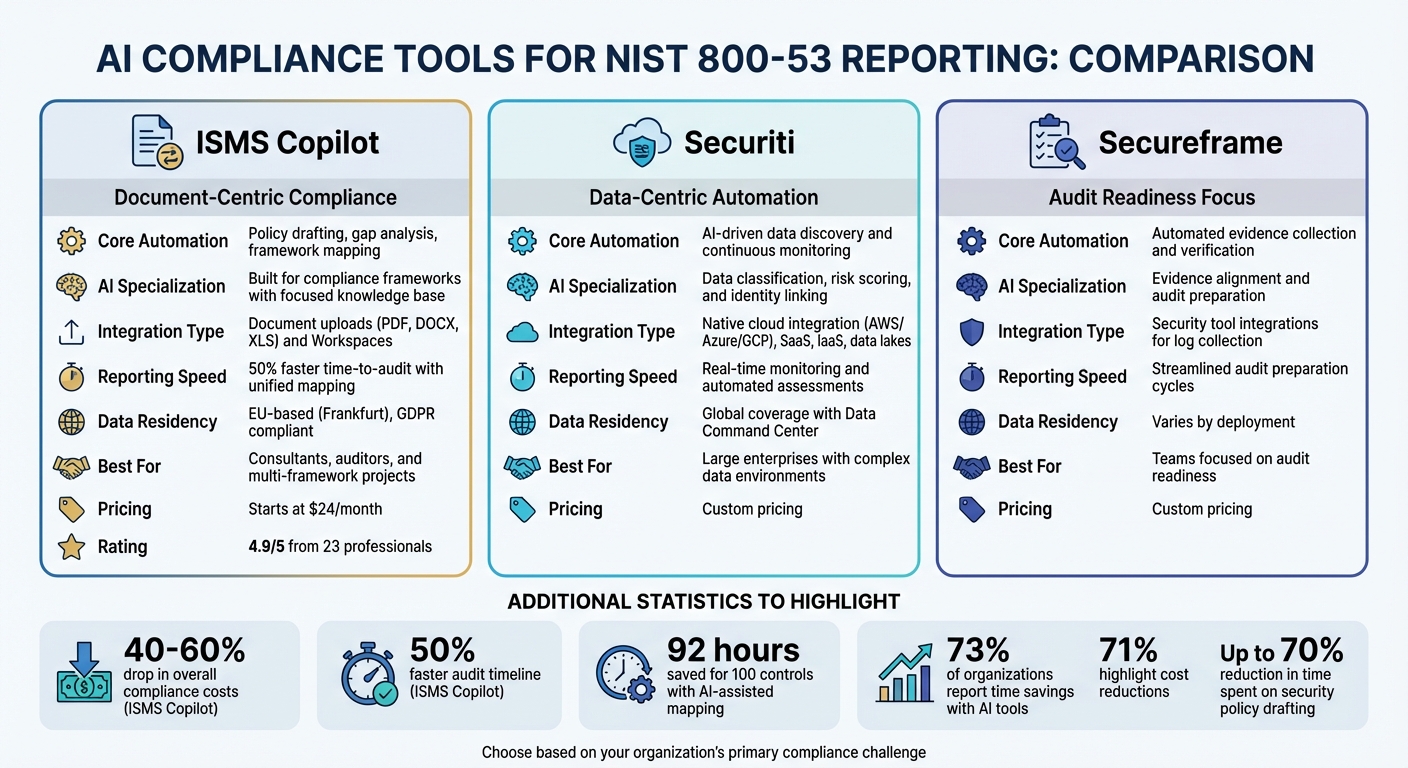 {KI-Tools für NIST-800-53-Compliance: Funktions- und Preisvergleich}
:::
{KI-Tools für NIST-800-53-Compliance: Funktions- und Preisvergleich}
:::
Vergleichstabelle der Funktionen
Bei der Bewertung von Tools für die NIST-800-53-Berichterstattung wird deutlich, dass jede Plattform unterschiedliche Stärken in den Bereichen Automatisierung, KI-Fähigkeiten und Integrationsmethoden bietet. Hier eine Übersicht der drei Tools:
ISMS Copilot ist auf Berater:innen und Auditor:innen zugeschnitten und legt den Fokus auf dokumentenzentrierte Workflows und Rahmenwerkabbildungen. Es ist darauf ausgelegt, schnelle, auditbereite Ergebnisse zu liefern. Securiti hingegen verfolgt eine datenzentrierte Strategie und integriert sich tief in Multicloud-Umgebungen wie AWS, Azure und GCP, um eine kontinuierliche Überwachung sensibler Daten zu ermöglichen. Secureframe konzentriert sich wiederum auf die Automatisierung der Beweissammlung und -überprüfung und hilft Teams, ihre Audit-Vorbereitung zu beschleunigen.
Hier ein direkter Vergleich der wichtigsten Funktionen:
| Funktion | ISMS Copilot | Securiti | Secureframe |
|---|---|---|---|
| Kernautomatisierung | Richtlinienerstellung, Lückenanalyse, Rahmenwerkabbildung | KI-gestützte Datenerkennung und kontinuierliche Überwachung | Automatisierte Beweissammlung und -überprüfung |
| KI-Spezialisierung | Für Compliance-Rahmenwerke mit speziellem Wissensspeicher | Datenklassifizierung, Risikobewertung und Identitätsverknüpfung | Beweisabgleich und Auditvorbereitung |
| Integrationsart | Datei-Uploads (PDF, DOCX, XLS) und Arbeitsbereiche | Native Cloud-Integration (AWS/Azure/GCP), SaaS, IaaS, Data Lakes | Integration mit Sicherheitstools für Protokollsammlung |
| Berichtserstellungsgeschwindigkeit | 50 % schnellere Zeit bis zum Audit mit einheitlicher Abbildung [3] | Echtzeitüberwachung und automatisierte Bewertungen | Vereinfachte Audit-Vorbereitungszyklen |
| Datenspeicherung | EU-basiert (Frankfurt), DSGVO-konform | Globale Abdeckung mit Data Command Center | Variiert je nach Bereitstellung |
| Ideal für | Berater:innen, Auditor:innen und Mehrfachrahmenwerk-Projekte | Große Unternehmen mit komplexen Datenumgebungen | Teams, die sich auf Audit-Vorbereitung konzentrieren |
Wichtige Highlights von ISMS Copilot
Ein herausragendes Merkmal des NIST-800-53-Copilot in ISMS Copilot ist die einheitliche Compliance-Abbildung. Dieses Tool verbindet NIST-CSF-2.0-Ergebnisse direkt mit NIST-800-53-Rev.-5-Kontrollen und erstellt eine detaillierte Compliance-Matrix. Diese Matrix verfolgt den Implementierungsstatus, weist Kontrollverantwortlichkeiten zu und identifiziert Beweisstandorte – was den redundanten Arbeitsaufwand deutlich reduziert. Nutzer:innen berichten von einer Senkung der Compliance-Kosten um 40–60 % und einer 50 % schnelleren Audit-Vorbereitung im Vergleich zur unabhängigen Verwaltung von Rahmenwerken [3].
Ein weiterer Vorteil von ISMS Copilot ist sein spezialisierter Wissensspeicher, der auf realen Beratungserfahrungen basiert und nicht auf Internetsuchen angewiesen ist. Dieser Ansatz minimiert das Risiko von Fehlern wie erfundenen Sicherheitskontrollen. Die Plattform legt zudem großen Wert auf Datenschutz im Unternehmensmaßstab mit einer Richtlinie zur Null-Datenspeicherung, die sicherstellt, dass sensible Informationen geschützt bleiben.
Preise und Nutzerfeedback
ISMS Copilot bietet flexible Preise, beginnend bei 20 $ pro Monat, wobei die Tarife nach KI-Nutzung und Modellqualität skalieren. Jeder Bezahltarif enthält 500 Datei-Uploads pro Monat (Fair Use), und Jahresabonnements bieten etwa 17 % Ersparnis [2]. Die Plattform genießt einen exzellenten Ruf mit einer Bewertung von 4,9/5 von 23 Compliance-Expert:innen [2].
Als Nächstes erfahren Sie, wie Sie das ideale KI-Tool für Ihre Compliance-Ziele auswählen.
Das richtige KI-Tool auswählen
Worauf Sie bei der Tool-Auswahl achten sollten
Bei der Suche nach dem richtigen KI-Tool sollten Sie zunächst Plattformen in Betracht ziehen, die Rahmenwerke wie NIST 800-53 auf andere Standards wie CMMC, ISO 27001 oder SOC 2 abbilden können. Diese Art der Querabbildung hält Compliance-Bemühungen einheitlich und vermeidet unnötige Doppelarbeit [3][5]. Dies ist ein entscheidender Schritt, um mit KI präzise und effiziente Audit-Dokumentation zu erstellen.
Ein weiterer wichtiger Faktor ist die KI-Genauigkeit. Tools, die speziell für Compliance-Aufgaben entwickelt wurden, basieren oft auf kuratiertem Wissen aus realen Beratungsprojekten und sind damit zuverlässiger als allgemeine Modelle wie ChatGPT, die auf breite Internetdaten zurückgreifen, die veraltet sein können. Spezialisierte Tools neigen auch weniger dazu, „halluzinierte“ nicht existente Sicherheitskontrollen zu erzeugen [2]. Fortgeschrittene Lösungen bieten oft Funktionen wie semantische Ähnlichkeitsanalysen und Konfidenzbewertungen (z. B. Hoch-, Mittel- oder Niedrig-Bewertungen). Diese Funktionen ermöglichen es Ihrem Team, KI-generierte Abbildungen vor der finalen Dokumentation zu überprüfen und zu genehmigen [5].
Auch die Integration ist entscheidend. Das gewählte Tool sollte nahtlos mit Ihren bestehenden Systemen wie GRC-Plattformen, SIEM-Tools, Schwachstellen-Scannern oder Cloud-Infrastrukturen wie AWS GovCloud verbunden werden können [4][6][7]. Für reibungslosere Workflows sollten Sie nach Tools suchen, die sich in Aufgabenmanagementsysteme wie Jira oder ServiceNow integrieren lassen, um die Zuweisung und Nachverfolgung von Compliance-bezogenen Aufgaben zu erleichtern.
Vernachlässigen Sie nicht Datenschutz und Sicherheit. Das Tool sollte robuste Schutzmaßnahmen bieten, darunter Mehrfaktor-Authentifizierung, Ende-zu-Ende-Verschlüsselung und eine Richtlinie zur Null-Datenspeicherung, um sicherzustellen, dass die sensiblen Daten Ihrer Organisation nicht zum Training öffentlicher KI-Modelle verwendet werden [2][4]. Für Organisationen mit strengen regulatorischen Anforderungen sollten Sie bestätigen, dass das Tool Optionen für die Datenspeicherung in bestimmten Regionen wie den USA oder der EU bietet [2][4].
Letztlich sollten Sie bewerten, wie gut diese Funktionen zu Größe und Komplexität der Compliance-Anforderungen Ihrer Organisation passen.
Tools an die Bedürfnisse Ihrer Organisation anpassen
Sobald Sie potenzielle Tools identifiziert haben, konzentrieren Sie sich darauf, wie gut sie die spezifischen Compliance-Herausforderungen Ihrer Organisation adressieren.
Für Berater:innen oder kleinere Teams sind Tools, die dokumentenzentrierte Workflows und einheitliche Abbildungen betonen, von unschätzbarem Wert. KI-gestützte Abbildungen können den manuellen Aufwand deutlich reduzieren – etwa 92 Stunden für 100 Kontrollen [5].
Für größere Unternehmen, die komplexe Datenumgebungen verwalten, sollten Sie Tools priorisieren, die kontinuierliche Überwachung statt statischer Berichterstattung bieten. Plattformen, die Ihre technische Umgebung in Echtzeit auf Nichtkonformitäten scannen und KI-gestützte Anleitungen zur Behebung von Compliance-Lücken bereitstellen, helfen Ihnen, Probleme vor Audits zu lösen – und nicht erst währenddessen [6][7]. Bemerkenswerterweise berichten Organisationen, die bereits KI einsetzen, von erheblichen Vorteilen: 73 % nennen Zeitersparnis und 71 % Kostensenkungen [8].
Wenn Ihre Organisation mehrere Audits durchführt oder verschiedene Kund:innen betreut, sollten Sie Tools mit Funktionen wie „Arbeitsbereichen“ in Betracht ziehen, um Projekte organisiert und getrennt zu halten [2]. Indem Sie die Fähigkeiten des Tools an die Größe und Komplexität Ihrer Organisation anpassen, können Sie Compliance von einem zeitaufwendigen manuellen Prozess in einen effizienten, automatisierten Workflow verwandeln.
Fazit
KI-Tools verändern die Art und Weise, wie Organisationen NIST-800-53-Berichte erstellen, indem sie mühsame Aufgaben automatisieren und die Abbildung von Rahmenwerken vereinfachen.
Die Zeiten, in denen Compliance-Berichterstattung Ihr Team zeitlich und ressourcentechnisch auslastete, sind vorbei. Mit spezialisierten KI-Tools können Sicherheitsrichtlinien in nur wenigen Minuten erstellt werden – und sparen so bis zu 70 % der Zeit [10]. Unternehmen, die eine einheitliche Compliance-Abbildung über Rahmenwerke wie NIST 800-53, ISO 27001 und SOC 2 hinweg nutzen, können ihre Gesamt-Compliance-Kosten um 40–60 % senken und Audits um 50 % beschleunigen – im Vergleich zu traditionellen, unverbundenen Methoden [3].
Für optimale Ergebnisse sollten Sie Tools wählen, die speziell für Compliance-Expert:innen entwickelt wurden. Plattformen wie ISMS Copilot stechen hervor, indem sie proprietäre Wissensspeicher nutzen, die auf Hunderten von Beratungsprojekten basieren, um zuverlässige, auditbereite Ergebnisse zu liefern. Im Gegensatz zu generischen KI-Tools vermeidet ISMS Copilot häufige Fallstricke wie Ungenauigkeiten und veraltete Empfehlungen [2][10]. Wichtige Funktionen umfassen automatisierte Rahmenwerkabbildungen, dedizierte Arbeitsbereiche zur Isolierung von Projekten und Datenschutz im Unternehmensmaßstab, wie etwa eine Richtlinie zur Null-Datenspeicherung, die sicherstellt, dass die Ausgaben selbst den strengsten Auditor-Anforderungen entsprechen [2].
Ob Sie Teil eines kleinen Teams oder eines großen Unternehmens sind – das richtige KI-Tool kann Compliance von einem arbeitsintensiven Prozess in einen reibungslosen, automatisierten Workflow verwandeln. Beginnen Sie damit, Ihre Sicherheitsdokumente für eine Lückenanalyse hochzuladen, und lassen Sie KI-generierte Abbildungen die wichtigsten Kontrollen identifizieren, während sie gleichzeitig den Abgleich mit offiziellen NIST-Standards sicherstellt [2][9].
Die Pläne für ISMS Copilot beginnen bei 20 $/Monat, wobei Jahresabonnements etwa 17 % Ersparnis bieten. Mit Unterstützung für über 30 Rahmenwerke und der Fähigkeit, Dokumente mit mehr als 20 Seiten zu analysieren, ist es eine praktische Lösung für Teams jeder Größe.
FAQs
::: faq
Wie kann ich KI für NIST-800-53-Berichte nutzen, ohne sensible Daten preiszugeben?
Um KI sicher für NIST-800-53-Berichte zu nutzen, stellen Sie sicher, dass alle Daten in sicheren, kontrollierten Umgebungen verarbeitet werden. Dies kann lokale Systeme oder sichere Cloud-Plattformen umfassen, die strenge Datenschutzstandards erfüllen. Vermeiden Sie das Teilen von Rohdaten; setzen Sie stattdessen auf anonymisierte oder zusammengefasste Eingaben. Wählen Sie KI-Tools, die speziell für Compliance entwickelt wurden und Funktionen wie Verschlüsselung, Zugriffskontrollen und private Wissensspeicher bieten, um das Risiko von Datenschutzverletzungen zu minimieren. :::
::: faq
Wie validiere ich KI-generierte Kontrollabbildungen und vermeide „halluzinierte“ Kontrollen?
Um die Genauigkeit von KI-generierten Kontrollabbildungen zu gewährleisten und „halluzinierte“ Kontrollen zu vermeiden, ist es wichtig, die Ausgaben mit autoritativen Standards wie den ISO-27001- oder SOC-2-Kriterien abzugleichen. Verwenden Sie immer exakte Kontrollbezeichner in den Eingabeaufforderungen und weisen Sie die KI an, Unsicherheiten anzugeben, wenn sie keine definitive Antwort liefern kann. Durch die Kombination manueller Überprüfungen mit präzisen, detaillierten Abfragen können Sie zuverlässige Ergebnisse erzielen und das Risiko von Fehlern reduzieren. :::
::: faq
Kann ISMS Copilot NIST 800-53 auf andere Rahmenwerke abbilden, die ich bereits nutze?
Ja, ISMS Copilot kann NIST 800-53 auf andere Rahmenwerke abbilden, die Sie bereits verwenden. Durch den Einsatz von KI interpretiert und verknüpft es Kontrollen zwischen verschiedenen Standards und erleichtert so die Querabbildung von Rahmenwerken. Diese Funktion ermöglicht eine nahtlose und präzise Verwaltung der Compliance. :::
Verwandte Beiträge
Die interne Audit, die nichts findet
ISO 19011 wurde im Mai 2026 aktualisiert. Das Versagen, das sie verhindern soll, blieb: die interne Audit, die sich durch Abweichung daran gewöhnt hat, dem Management nicht mehr zu widersprechen.
Unter NIS2 ist „wichtig“ keine leichtere Sicherheitsstufe
Teams deuten die Bezeichnung ‚wichtig‘ als NIS2-light und schränken ihre Kontrollen ein. Die Sicherheitsmaßnahmen aus Artikel 21 gelten jedoch in beiden Fällen gleichermaßen; die Stufe ändert lediglich die Aufsicht, einige Durchsetzungsinstrumente und die Untergrenze für nationale Höchststrafen.
Dein ISO-27001-Zertifikat startet nicht die Uhren von DORA
Finanzunternehmen bilden weiterhin ISO-27001-Kontrollen auf DORA-Artikel ab und bezeichnen den Rest als reine Dokumentationsarbeit. DORAs eigentliche Neuerungen sind jedoch Verpflichtungen, die zu einer bestimmten Spezifikation und innerhalb einer festgelegten Frist erfüllt werden müssen – etwas, wofür ein Zertifikat nie ausgelegt war.