 ISMS Copilot
Best Practices for Cross-Framework Audit Prep
Centralize controls, map overlapping requirements, and automate evidence to reduce audit time and costs across multiple compliance frameworks.

Best Practices for Cross-Framework Audit Prep
Managing multiple compliance frameworks can be overwhelming, but a unified strategy simplifies the process. By centralizing controls, mapping overlapping requirements, and using automation, you can save time and reduce costs. Here's how:
- Centralize Controls: Create a master control library to manage policies and evidence in one place.
- Map Overlapping Requirements: Align controls across frameworks like SOC 2, ISO 27001, and NIST CSF to avoid duplicating efforts.
- Automate Evidence Collection: Use tools to gather and tag evidence automatically, reducing manual tasks by up to 70%.
- Stay Audit-Ready Year-Round: Shift from reactive to continuous monitoring with daily, weekly, and monthly checks.
- Assign Clear Ownership: Designate a compliance lead and define responsibilities for seamless coordination.
Organizations that adopt these practices report up to 60% time and cost savings, turning compliance from a burden into a streamlined process. Non-compliance can cost an average of $14.82 million, making a unified approach essential for managing risks and maintaining trust.
Mastering Control Cross-Mapping for Enhanced Compliance
::: @iframe https://www.youtube.com/embed/4RXJPdZ5L6o :::
Core Principles for Multi-Framework Audit Readiness
Most compliance teams don't fail audits because they lack the expertise - they fail because they rely on reactive practices. When managing multiple frameworks, last-minute preparation can quickly spiral out of control. Organizations that consistently succeed in audits follow a few essential practices.
Staying Audit-Ready Year-Round
The key to effective multi-framework compliance is shifting from sporadic preparation to continuous control monitoring (CCM). Delaying routine checks not only increases risks but also drives up costs. Yet, 54% of compliance teams still spend over five hours per week on manual audit tasks[10]. Many teams remain stuck in a reactive, checklist-driven cycle.
A better approach is to establish a layered schedule that includes daily checks, weekly reviews, and monthly audits. This rhythm helps identify and address control issues early - before they escalate into findings. For organizations juggling staggered audit deadlines (e.g., SOC 2 in Q1, ISO 27001 in Q3, and NIS2 in Q4), continuous readiness ensures you're never starting from square one.
To sustain this readiness, it's crucial to rely on a single, centralized source for controls and evidence.
Building a Single Source of Truth
Disorganized policies and duplicative evidence make audits unnecessarily complex. A Master Control Framework can simplify this by centralizing all policies, controls, and evidence into one repository.
Each control in this framework is assigned a unique identifier (e.g., UC-AC-01 for access control) and mapped to every applicable framework. For instance, a single access control policy can simultaneously align with ISO 27001 Annex A, SOC 2 Trust Service Criteria, and HIPAA. This eliminates the need for separate documents. As Clarysec explains:
"The SoA is effectively a bridging document: it links your risk assessment/treatment to the actual controls you have." [7]
This unified approach also streamlines gap analysis. When adopting a new framework, you can quickly compare its requirements against your existing controls to pinpoint overlaps and identify gaps.
A well-organized control repository lays the groundwork for focusing on the most impactful areas.
Prioritizing Controls Based on Risk and Reuse
Start by prioritizing controls that are both high-risk and widely applicable - like access management, incident response, vendor oversight, and data protection. These areas are core to nearly all major frameworks, so investing here benefits compliance efforts across SOC 2, ISO 27001, HIPAA, and PCI DSS simultaneously[10].
Using a "superset" approach can further streamline efforts. For overlapping requirements, adopt the stricter standard as your baseline. For example, a detailed PCI DSS access control requirement can automatically satisfy broader ISO 27001 standards. This method allows organizations to reuse up to 70% of their existing work when pursuing additional certifications[10].
| Activity | Without Mapping | With Mapping | Savings |
|---|---|---|---|
| Policy creation | 4 separate versions | 1 version + mapping | ~75% [3] |
| Evidence collection | 4 separate collections | 1 collection | ~75% [3] |
| Audit preparation | 4 separate packages | 1 package + matrices | ~60% [3] |
| Ongoing maintenance | 4 separate updates | 1 update | ~75% [3] |
Building a Unified Control and Evidence Foundation
::: @figure 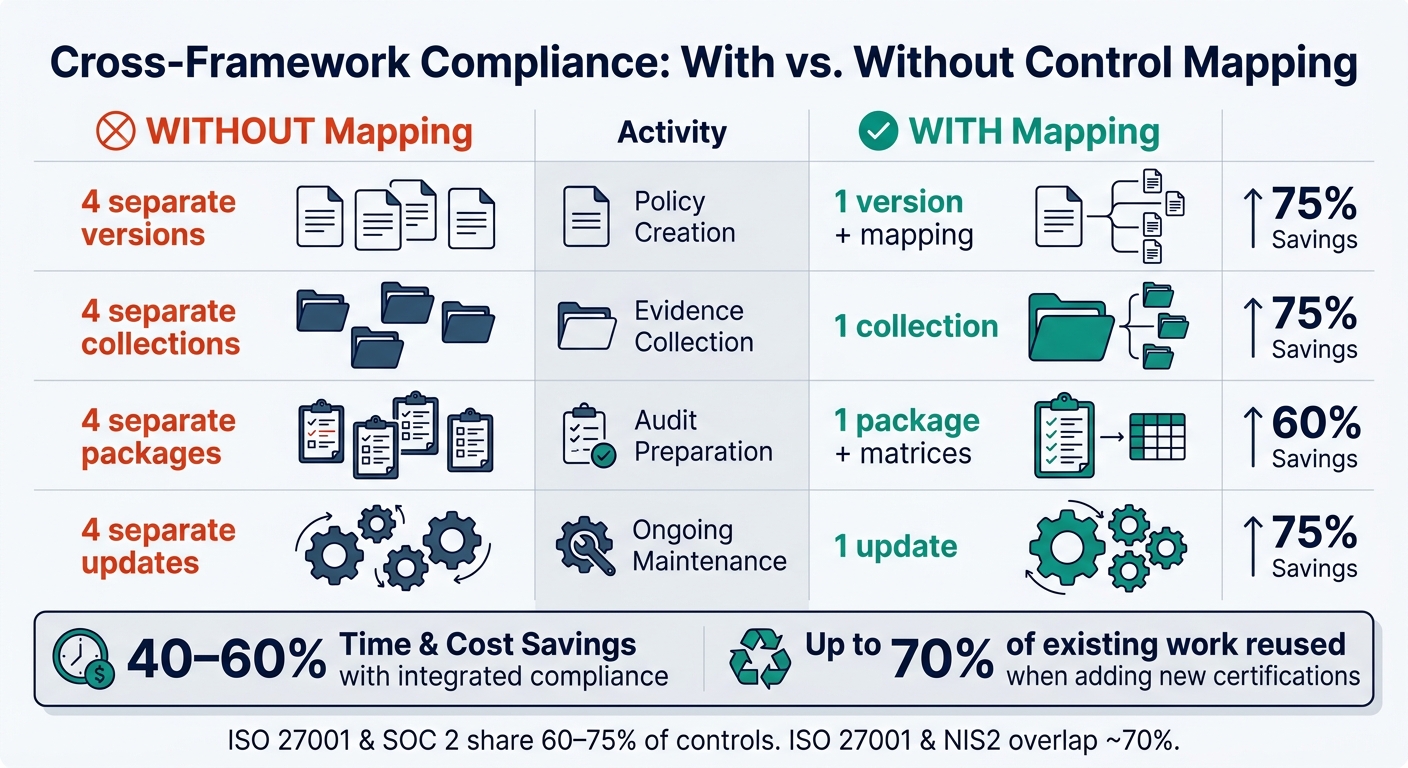 {Cross-Framework Compliance: With vs. Without Control Mapping}
:::
{Cross-Framework Compliance: With vs. Without Control Mapping}
:::
Once you've set up continuous readiness and a master control framework, the next step is creating a unified control inventory. This inventory serves as the backbone for managing controls, streamlining audits, handling evidence requests, and ensuring smooth team transitions. It's your go-to resource for keeping everything organized across multiple audits.
Creating a Consolidated Control Inventory
Managing multiple frameworks gets easier with a control-first approach. Start by listing every unique control required across all frameworks. Then, consolidate functionally identical controls and implement each group just once [5].
Here’s an example: ISO 27001 and SOC 2 share about 60–75% of their controls [3]. ISO 27001 and NIS2 overlap by roughly 70% [3]. This means most compliance tasks can be completed once and reused for multiple audits. The remaining 25–40% of tasks will be framework-specific, like HIPAA's 60-day breach notification rule or PCI DSS's quarterly ASV scans, which require separate attention [3].
"A well-implemented access control policy with associated processes fulfills all four frameworks. Document once, map to all." - Securapilot [3]
To keep things organized, assign each control a unique internal ID (e.g., UC-IR-01 for incident response) and document it in a central catalog. This approach eliminates conflicting versions and reduces the effort needed for maintenance.
How to Map Controls Across Frameworks
Mapping controls involves documenting how each internal control meets the requirements of various frameworks [9]. Auditors need this context to ensure your unified controls align with their expectations.
One effective method is using a crosswalk table. This table lists internal control IDs, descriptions, corresponding framework requirements, and confidence levels [11]. It creates a clear audit trail that helps auditors understand your rationale and allows your team to identify gaps when new frameworks are introduced.
| Internal Control | ISO 27001 | NIS2 | GDPR | SOC 2 |
|---|---|---|---|---|
| Access Control Policy | A.5.15–A.5.18 | Art. 21.2i | Art. 32.1b | CC6.1–CC6.8 |
| MFA Implementation | A.8.5 | Art. 21.2j | Art. 32 | CC6.1 |
| Incident Handling | A.5.24–A.5.28 | Art. 21.2b | Art. 33–34 | CC7.3–CC7.5 |
Source: Securapilot [3]
Engage auditors early by explaining your mapping process before the formal audit begins. This proactive step builds trust in your unified approach and helps avoid last-minute surprises. Once controls are mapped, the same structure can guide how evidence is collected, tagged, and stored for reuse across frameworks.
Organizing Evidence for Maximum Reuse
The "test once, comply with many" model works best when evidence is stored and tagged consistently [12]. Start with a standardized naming convention. For instance, a file named "screenshot-mfa-config-2026-06.png" is easy for an auditor to understand, while "final_v3_REAL.png" is not. Pair this with a folder structure that mirrors your control catalog (e.g., "01-Governance", "02-Access-Control", "03-Incident-Response") to make evidence easy to locate [5][7].
Enhance your evidence with metadata, such as control ID, frameworks, collection date, owner, and retention period [12][7]. This transforms a static file repository into a searchable, audit-ready library. When new framework requirements arise, you can simply search by tags instead of manually digging through folders.
"The primary value of consolidation is found in the recovered hours of high-value internal staff." - Shane Peden, Managing Director, Information Assurance Services, Aprio [2]
Using Automation and AI to Speed Up Audit Prep
Once your control inventory and evidence library are ready, the next hurdle is keeping them up-to-date without drowning in manual work. This is where automation and AI step in to lighten the load.
Automating Evidence Collection and Control Testing
Gathering evidence manually is one of the most time-consuming parts of audit preparation. Teams often spend weeks pulling together logs, screenshots, and configuration exports. Rob Pierce, a Partner at Linford & Co, sums it up well:
"Automation doesn't replace people. It equips teams to complete tasks efficiently." [13]
Modern automation tools can integrate directly with cloud platforms like AWS, Azure, and GCP to collect evidence automatically, eliminating the last-minute rush before audits. This is especially helpful for organizations juggling three or more compliance frameworks [3].
Automated Continuous Control Monitoring (CCM) takes this a step further by flagging configuration drift in real time, ensuring compliance across multiple frameworks. When paired with multi-framework tagging, a single access review can cover requirements for SOC 2, ISO 27001, and NIST CSF all at once [1].
"Automated evidence collection genuinely changes the game - it's the difference between a compliance program that's always catching up and one that's always ready." - Cyber Sierra Knowledge Team [9]
This level of automation paves the way for smoother, more efficient compliance management across frameworks, as demonstrated by tools like ISMS Copilot.
How ISMS Copilot Supports Cross-Framework Compliance
Building on your centralized control repository, ISMS Copilot simplifies the process of mapping controls across frameworks. Unlike general-purpose AI tools like ChatGPT or Claude - which require extensive prompting to produce compliance-specific outputs - ISMS Copilot is specifically trained on over 50 information security frameworks, including ISO 27001, SOC 2, GDPR, and NIST 800-53.
This specialization means it can help draft reusable policies, perform gap analyses, generate risk assessments, and create audit-ready documentation using the precise language auditors expect. One of its standout features is its cross-framework mapping capability. It identifies where a single control satisfies multiple frameworks, making it easier to manage overlapping requirements. For instance, ISO 27001 and NIS2 share about 70% of their control requirements, so compliance leads can implement controls once and reuse the evidence wherever applicable [3].
While ISMS Copilot can streamline compliance efforts, human oversight is still critical to ensure everything meets the high standards required for audits.
Using AI Outputs Safely in Audit Documentation
AI-generated content should always be reviewed by a compliance lead to confirm its accuracy and alignment with auditor expectations. AI can draft, but humans must verify. Additionally, explaining the rationale behind each control mapping is crucial - it provides auditors with the context they need to trust your framework [9].
"Don't just draw the line between controls - explain why they satisfy the mapped requirement. This is what gives auditors the context they need to trust your framework." - Cyber Sierra [9]
Interestingly, while 77% of organizations use AI in their security stack, only 37% have a formal AI policy in place [3]. This gap can itself become an audit risk, particularly as frameworks like the EU AI Act introduce stricter governance requirements around AI. To stay compliant, treat AI tools like any other control: document their use, assign ownership, and review them regularly.
Governance, Ownership, and Team Coordination
A control library is only as strong as the people managing it. While technology addresses the "what" of compliance, it’s the human element that handles the "why" and "how." Clear accountability is what separates organizations that are always audit-ready from those that scramble at the last minute.
Assigning Clear Roles and Ownership
One of the biggest reasons audit preparations fail is the lack of a clear owner. When responsibilities are spread too thin across multiple teams without defined accountability, deadlines get missed, and evidence gaps show up at the worst possible time.
"When responsibility is scattered, deadlines slip. When it's centralized, you stay ahead." - Rob Pierce, Partner, Linford & Co [13]
The solution? Designate a Compliance Lead (or Chief Compliance Officer) to act as the main coordinator. This person interprets framework requirements and maps ISO 27001 to legal requirements to assign tasks to key teams like engineering, HR, legal, and IT. A RACI matrix can help clarify who owns what, ensuring that every control has a designated owner.
Here’s a breakdown of how responsibilities typically align in a cross-framework program:
| Role | Primary Responsibility |
|---|---|
| Compliance Lead / CCO | Interprets frameworks, manages auditor relationships, and coordinates cross-functional tasks |
| Control Owners | Manage specific controls and provide evidence across all mapped frameworks |
| Senior Management | Provide oversight, conduct management reviews, and allocate resources |
| Internal Audit Team | Perform independent testing of the unified control set before external audits |
| Legal / Privacy Lead | Address regulatory overlaps (e.g., GDPR vs. CCPA) and handle data subject rights |
Some frameworks even require leadership accountability by law. For example, NIS2 mandates that management undergo security training [3]. This level of clarity in ownership ensures that all teams are aligned and ready to meet compliance demands.
Keeping Teams Aligned Across Functions
A centralized control library only works if teams are coordinated. Cross-framework compliance isn’t just an IT challenge - it’s a business-wide effort. Teams from IT, legal, compliance, and business units need to work together to address all regulatory requirements [9].
One effective approach is monthly evidence sprints. Set aside two hours each month for teams to gather documentation for all active audits at once. This transforms compliance from a chaotic, last-minute scramble into a steady, manageable process [13]. Pair these sprints with a shared dashboard linked to your control library, so everyone has real-time visibility into the status of compliance efforts - no more outdated files or version confusion. For those managing complex, multi-step workflows, using an AI designed for detailed compliance tasks can further streamline these sprints.
"One audit shouldn't mean triple the effort. Do it once. Do it well. Reuse. Repeat." - Rob Pierce, Partner, Linford & Co [13]
Aligning Internal Audits and Management Reviews Across Frameworks
With clear roles and coordinated teams in place, the next step is to streamline internal audits and management reviews. Combining these efforts into a single, integrated process can save significant time and effort.
For example, a single "assessment sprint" can cover walkthroughs and interviews that meet the requirements for SOC 2, ISO 27001, and PCI DSS - all in one go [2]. Afterward, draft the deliverables for all frameworks in parallel to maintain consistency across reports.
The same principle applies to management reviews. By consolidating incident metrics, risk updates, and framework statuses into one narrative, you can present a unified picture to senior management [7]. Shane Peden, Managing Director at Aprio, sums it up well:
"The goal of compliance is not merely to pass an audit. The goal is to demonstrate trust to the market while preserving the operational capacity of the business." [2]
Want to test the effectiveness of your evidence chain? Take a single incident or change from the past year and trace it from the original ticket to the risk register and management review minutes. If you can’t follow the trail, it’s a gap you’ll want to fix before an auditor points it out [7].
Key Takeaways for Cross-Framework Audit Success
Mastering cross-framework audits isn’t about piling on more work - it’s about refining how audits are handled. Organizations that juggle multiple frameworks successfully without overwhelming their teams tend to follow a few key practices. They maintain readiness throughout the year, create systems where a single piece of evidence can serve multiple purposes, and assign clear ownership for every control.
Research shows that integrated compliance can save 40–60% in both time and costs, while automation reduces routine tasks by as much as 70% [3][14][6]. These savings highlight the importance of streamlining processes to make cross-framework audits more efficient.
Here are the core principles that drive success:
- Build a master control library: This serves as your central resource for all compliance needs.
- Map controls across frameworks: Cover multiple standards by connecting similar controls.
- Tag evidence for reuse: Avoid duplicating efforts by tagging evidence once for multiple uses.
- Assign clear ownership: Ensure every control has a designated person responsible for it.
"Multi-framework compliance has become a commercial differentiator as much as a legal obligation." - Gourishankar Reddy, Information Security and Compliance Auditor [8]
The stakes are high. Non-compliance costs average $14.82 million, which is nearly three times the $5.47 million typically spent on compliance [4]. A unified approach to compliance not only reduces risks but also delivers both operational and financial advantages.
FAQs
::: faq
Where do I start when combining SOC 2, ISO 27001, and NIS2 prep?
Rather than handling SOC 2, ISO 27001, and NIS2 as entirely separate checklists, focus on a control-first strategy. Start by cataloging the unique requirements of each framework. You’ll often discover overlaps, especially in areas like risk management and access governance, which serve as common foundations.
To simplify compliance efforts, build a master control framework. This involves creating unified controls - like comprehensive access management policies - and mapping them to the relevant standards. Tools like ISMS Copilot can make this process more efficient by offering tailored guidance to align your controls across multiple frameworks. :::
::: faq
How do I prove one control meets multiple frameworks to an auditor?
To demonstrate how one control aligns with multiple frameworks, use a unified control matrix. This matrix maps a single control to the specific requirements of various frameworks. During audits, present this mapping alongside shared evidence to prove compliance.
For instance, a quarterly access review can simultaneously satisfy requirements for SOC 2 (CC6.1), ISO 27001 (A.9.2.5), and HIPAA (164.308(a)(4)). Tools like ISMS Copilot can help streamline the process of building and managing these mappings efficiently. :::
::: faq
What evidence should be automated first for the biggest time savings?
To make the most of your time, focus on automating evidence collection for shared controls that are relevant across various frameworks. Controls like access management, logging, and change management often overlap, so addressing them together is a smart move. A unified control matrix allows you to tackle multiple standards with a single effort. Additionally, using a centralized evidence repository, such as a GRC platform, helps eliminate redundant tasks. Tools like ISMS Copilot streamline this process, offering support for over 50 frameworks. :::
Related Posts
NIS2 does not bind your company. Your national law does.
Directive (EU) 2022/2555 addresses Member States, not undertakings. The fines, the reporting clocks and the authority you answer to are written in national law, and those laws arrived on twenty-seven different calendars.
The internal audit that never finds anything
ISO 19011 changed edition in May 2026. The failure mode it exists to prevent did not: the internal audit that has, by drift, stopped disagreeing with management.
Under NIS2, "important" is not a lighter security tier
Teams read the important label as NIS2-lite and scope their controls down. The security measures in Article 21 are the same either way; the tier changes supervision, some enforcement tools, and the floor on the national fine maximum.