 ISMS Copilot
How AI Simplifies ISO 27001 Gap Analysis
AI-powered tools make ISO 27001 gap analysis faster, more accurate, and less resource-intensive, significantly shortening implementation timelines.

AI-powered tools make ISO 27001 gap analysis faster, more accurate, and less resource-intensive. Instead of spending months on manual assessments and spreadsheets, AI automates the process, identifying gaps in hours while improving accuracy. Here's how:
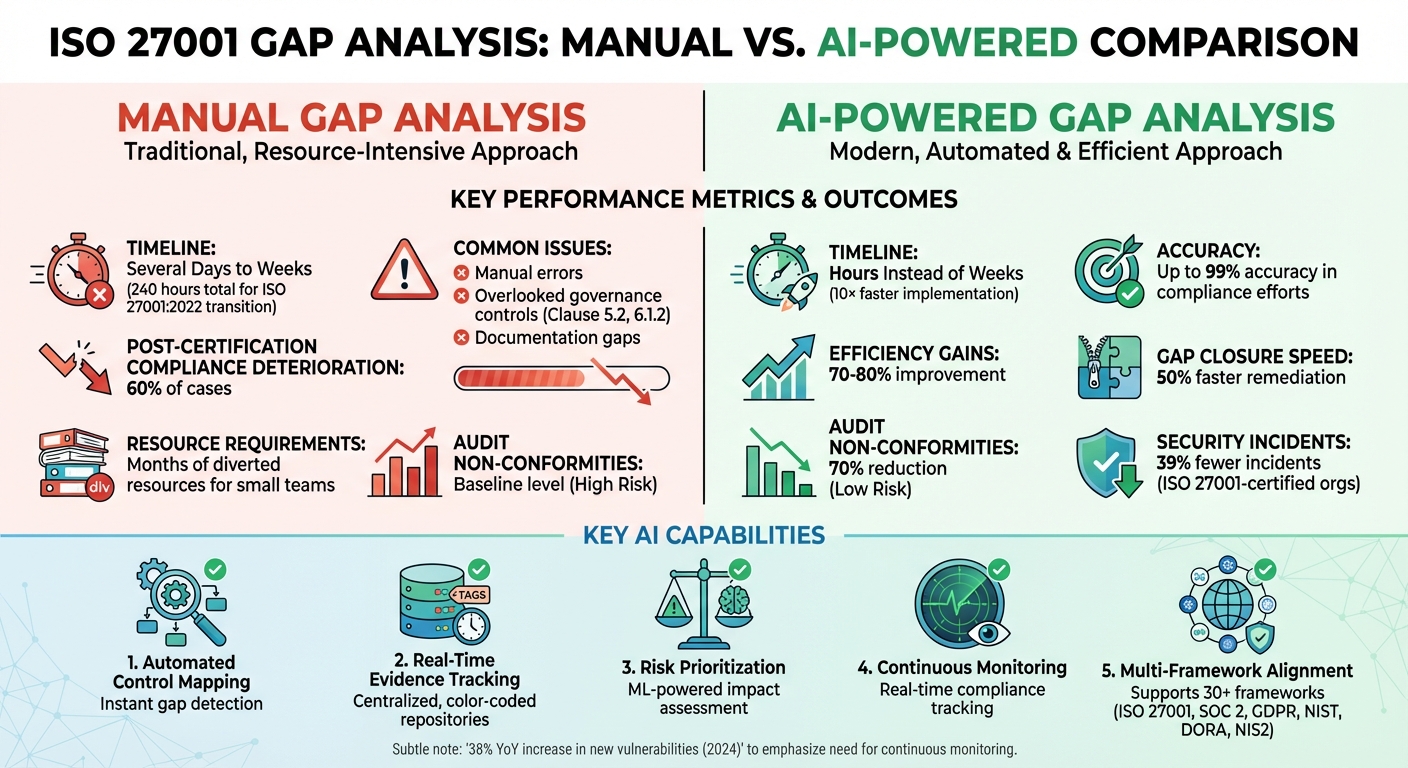
- Automated Control Mapping: AI scans your policies and systems, comparing them against ISO 27001 controls to find gaps instantly.
- Real-Time Evidence Tracking: Centralized repositories keep documentation updated and audit-ready, reducing errors and missing records.
- Risk Prioritization: AI ranks gaps by impact and likelihood, helping teams focus on critical issues first.
- Continuous Monitoring: AI tracks compliance in real time, flagging deviations as they happen.
- Multi-Framework Alignment: AI maps overlapping controls for SOC 2 vs ISO 27001, GDPR, and more, saving time and effort.
Key takeaway: AI reduces the time and complexity of ISO 27001 compliance, helping organizations prepare for audits efficiently while improving security. Tools like ISMS Copilot significantly shorten implementation timelines and improve the consistency of compliance work.
Main Challenges in ISO 27001 Gap Analysis
Manual gap analysis can be a tedious and error-prone process, often prioritizing technical controls while neglecting essential governance elements. Here's a closer look at the challenges this approach presents, impacting both efficiency and accuracy.
Manual Errors and Time-Intensive Work
When teams manually map Annex A controls, mistakes are almost inevitable. The focus tends to lean heavily on visible technical controls - like firewalls, encryption, and access logs - while critical governance requirements, such as mapping ISO 27001 to legal requirements in Clause 5.2 and Clause 6.1.2, are often overlooked. This creates accountability gaps where no one is clearly responsible for specific controls.
The time commitment is another major hurdle. Conducting a manual gap analysis can take anywhere from several days to weeks. For organizations transitioning to ISO 27001:2022, the process can consume about 240 hours in total. For smaller teams, this often means diverting resources from essential business operations for months.
Difficulty Aligning Security Practices with Annex A
Aligning existing security measures with ISO 27001's Annex A controls is no small feat. Organizations juggling multiple frameworks, such as SOC 2, NIST, and GDPR, often find it challenging to consolidate overlapping requirements into a single, cohesive set of controls. This redundancy can prolong the process, sometimes for months.
The task becomes even more daunting with evolving standards. For instance, transitioning from ISO 27001:2013 to the 2022 version introduces new controls that demand specialized expertise. Adding to the complexity are organization-specific contexts, which require tailored application of controls. Without deep knowledge, this customization is nearly impossible. Traditional frameworks may also fail to address emerging risks, such as AI-specific issues like model poisoning or the need for algorithmic transparency. Interestingly, organizations already certified to ISO 27001 can adapt to AI governance standards 30% to 40% faster than those starting from scratch.
Limited Resources for Smaller Organizations
For smaller organizations, the challenges are compounded by limited resources. Without dedicated Governance, Risk, and Compliance (GRC) staff, these teams often lack the expertise needed to interpret ISO 27001 requirements accurately. Budget constraints make hiring specialized consultants difficult, leaving many to rely on generic templates that offer a false sense of security.
These resource limitations often lead to misallocated efforts. Small teams may overinvest in unnecessary controls while missing critical gaps. Without automation, smaller teams are left scrambling to manually track evidence, update documentation, and hope they've covered everything before an auditor arrives.
How AI Improves Gap Analysis Efficiency
AI has revolutionized the gap analysis process by automating tasks that once required weeks of manual effort. Instead of painstakingly cross-referencing spreadsheets or chasing down missing evidence, organizations can now rely on AI and an ISO 27001 Toolkit to streamline control mapping and documentation tracking.
Automated Control Mapping and Gap Detection
AI tools excel at scanning existing policies, procedures, and system configurations to compare them automatically against ISO 27001's Annex A requirements. This eliminates the need for manual control tracking. For example, AI can pinpoint discrepancies and validate them in real time, often catching gaps that human reviewers might overlook. Tasks that traditionally took weeks can now be completed in just hours, with some platforms reporting efficiency gains of 70% to 80%. Additionally, AI ensures a thorough review by addressing both technical controls and governance requirements, offering coverage across all Annex A areas.
Real-Time Evidence Collection and Documentation
AI platforms simplify evidence tracking by using centralized repositories that automatically update and manage documentation. These systems assign color-coded statuses - green for compliant, amber for partially implemented, and red for critical gaps - while linking evidence directly to specific ISO 27001 clauses. Features like integrated version control and automated workflows ensure that documentation stays current without manual input. When processes change or new evidence emerges, the AI flags outdated materials and updates audit trails automatically.
Example: How ISMS Copilot Simplifies Gap Analysis
ISMS Copilot is a great example of how AI can transform the gap analysis process. Users can upload policies in formats like PDF, DOCX, or XLS, and the platform analyzes these documents against Annex A controls using natural language processing. It identifies gaps - such as non-compliant risk assessments or missing incident response protocols - and generates detailed reports that highlight specific risk levels.
For instance, a retail company managing third-party data processors might use ISMS Copilot to scan access logs. The platform could flag missing GDPR-aligned records under Annex A.5 (information security policies) and provide an updated, timestamped report. It also tracks remediation progress in real time, helping organizations close gaps much faster — turning what typically takes months of manual effort into a matter of weeks.
AI-Powered Risk Assessment and Action Prioritization
AI takes automated gap detection a step further by helping organizations prioritize risks effectively. Not all gaps carry the same level of threat. For instance, a missing encryption protocol for customer payment data poses a far greater risk than an outdated internal training document. AI tackles this by analyzing risk factors through machine learning models that process global threat data alongside internal vulnerabilities. These systems focus on two key dimensions: how likely an incident is to occur and the severity of its potential impact - whether in terms of financial loss, reputational harm, or legal consequences.
Risk-Based Gap Prioritization
AI-driven platforms help security teams allocate resources wisely by ranking gaps based on their criticality. Instead of treating all nonconformities equally, AI uses a 5-point scale to evaluate both likelihood and impact. For example, outdated access controls for a healthcare provider's patient database might be flagged as a top priority, while a minor documentation issue in a low-traffic system could be ranked much lower. This prioritization is essential, especially as new vulnerabilities saw a 38% year-over-year increase in 2024 compared to the previous year.
AI doesn't stop at identification - it also aids in root cause analysis. By identifying recurring issues, such as repeated failures in access management, AI can trace the problem back to systemic causes like poor change management processes or insufficient staff training. This ensures that organizations address the underlying issues rather than just applying temporary fixes.
Tailored Recommendations for Control Implementation
Once risks are prioritized, AI generates action plans tailored to the organization's specific needs and Annex A controls. These aren't one-size-fits-all lists; instead, they are precise, context-driven recommendations. For example, an AI system might suggest implementing multi-factor authentication for remote access or updating encryption protocols for data at rest.
"ISMS Copilot X transformed our ISO 27001 implementation. What would have taken months was completed in weeks, with better quality and consistency than traditional consulting." - Sarah Chen, Information Security Manager
Using proprietary compliance libraries, ISMS Copilot delivers framework-specific, accurate guidance aligned to the latest ISO 27001 standards.
Continuous Monitoring and Real-Time Compliance Management
Traditional gap analysis offers only a static snapshot, which falls short in today's fast-changing environments. Systems evolve, threats grow, and vulnerabilities appear daily. Relying on annual gap analyses means organizations might uncover serious issues only during audits, leaving them scrambling to fix problems under tight deadlines. AI shifts this outdated model to a continuous compliance process. By actively scanning systems, policies, and controls against ISO 27001 requirements in real time, AI identifies and flags deviations as they happen.
Continuous Gap Identification and Remediation
AI tools continuously track logs, configurations, and documents to spot compliance gaps instantly. For instance, if audit trails disappear (as required by Annex A.12.4), the system flags the issue and suggests corrective actions. This can reduce remediation timelines from weeks to just days. Without continuous monitoring, compliance often deteriorates post-certification - this happens in 60% of cases. Organizations using AI report closing gaps 50% faster and see a 70% drop in audit non-conformities. Additionally, AI updates the risk register in real time, correlating gaps with risk levels. It then generates prioritized action plans and step-by-step remediation guides tailored to the organization's specific needs.
Integration with Multi-Framework Compliance
AI doesn't just monitor ISO 27001 compliance; it simplifies managing multiple frameworks simultaneously. Many organizations must comply with other standards like SOC2, GDPR, NIST 800-53, and newer ones like NIS2 or DORA. Handling these independently often leads to duplicate efforts, scattered documentation, and audit fatigue. AI solves this by mapping overlapping controls across frameworks, allowing a single implementation to meet multiple requirements.
For example, ISMS Copilot supports 20+ frameworks, including ISO 27001, SOC2, GDPR, NIST 800-53, DORA, and NIS2. It automatically aligns shared controls - for instance, ISO 27001's Annex A.9.2 (access control) overlaps with SOC2's CC6.1 and GDPR's Article 32. This means one assessment and remediation effort can address all three frameworks. AI centralizes evidence collection in one dashboard, continuously monitors compliance across frameworks, and generates audit-ready reports for each standard.
Faster Audit Readiness with AI
AI is changing the game for audit readiness, turning what was once a lengthy, manual process into a streamlined, automated one. Traditionally, preparing for an ISO 27001 certification audit could take months of gathering evidence and organizing documentation. Now, AI ensures that documentation stays up to date, evidence remains neatly organized, and potential issues are addressed ahead of time.
Automated Audit-Ready Documentation
Gone are the days of manually piecing together audit documentation. AI tools now handle the heavy lifting, generating standardized, audit-ready reports that align perfectly with Annex A controls. This eliminates the need for tedious cross-referencing or formatting. For instance, ISMS Copilot can draft complex policies - like Acceptable Use or Privileged Access policies - in just minutes, a task that used to take hours.
AI doesn't stop at drafting documents - it also reviews uploaded files like PDFs, Word documents, and Excel sheets to spot gaps and confirm that existing evidence aligns with framework controls. Even better, it maps overlapping requirements across frameworks like ISO 27001, SOC 2, and NIST, enabling a "Build Once, Comply Everywhere" strategy. This means one set of documentation can cover multiple audits, cutting down on redundant work.
Internal Audit Support and Fewer Non-Conformities
AI doesn't just prepare organizations for audits - it helps them ace internal reviews too. By analyzing audit reports and risk assessments, AI identifies potential non-conformities before external auditors step in. It also provides actionable feedback on implementation, helping to close gaps in security management systems.
"I've been surprised by the speed of answers and the precision of implementation steps." - Ramona D., Senior Cybersecurity Consultant
AI also ensures that evidence is sufficient to meet specific framework requirements. By keeping separate digital workspaces for different audit cycles or clients, AI tools prevent data from mixing and offer a clean slate for each review. The result? Faster, more thorough internal audits that leave organizations well-prepared for external certification.
Conclusion
ISO 27001 gap analysis doesn't have to be a lengthy, error-filled process. AI has changed the game by automating control mapping, reducing manual mistakes, and focusing on risks that carry the most impact. Instead of drowning in documentation, organizations can zero in on fixing critical issues - like missing incident response plans or incomplete supplier security measures.
The move from one-off assessments to continuous monitoring shifts compliance into an ongoing practice rather than a rushed effort before audits. AI tools make this easier by tracking evidence in real time, aligning requirements across frameworks like SOC 2 and NIST, and keeping documentation audit-ready.
Specialized tools are also emerging to simplify compliance further. For instance, ISMS Copilot is an AI-powered compliance assistant designed with practical expertise. It can draft policies in minutes, identify gaps in uploaded documents, and supports 20+ frameworks with a "Build Once, Comply Everywhere" methodology. Unlike general-purpose AI, it provides structured, accurate outputs without the risk of generating incorrect security controls.
Organizations that use AI for gap analysis see tangible benefits, including fewer non-conformities, faster audits, and improved security. In fact, ISO 27001-certified organizations report 39% fewer security incidents. Automation not only saves time but also strengthens security resilience. Whether you're a consultant managing multiple clients or a small team working on your first certification, AI turns gap analysis into a manageable, ongoing process that reinforces your security efforts.
FAQs
What inputs does AI need to run an ISO 27001 gap analysis?
To make AI effective for ISO 27001 compliance, it needs specific inputs from your organization. This includes details like your organization's context, the scope of your compliance efforts, existing policies, control requirements, risk assessments, and any relevant documentation. These inputs allow the AI to pinpoint gaps and offer insights that are specifically tailored to your compliance needs.
How can I validate AI findings before an ISO 27001 audit?
To ensure the accuracy of AI-generated outputs - like gap analyses or policy drafts - start by conducting an internal review. Compare these outputs against ISO 27001 standards and your existing documentation to identify any discrepancies. For more intricate areas, it's wise to involve domain experts or auditors who can provide deeper insights and validation. Tools such as ISMS Copilot, specifically built for ISO 27001, can be incredibly helpful. They offer tailored guidance and templates to streamline the process, minimize errors, and help you stay on track before your audit.
How do I start continuous compliance after my first gap analysis?
To kick off continuous compliance, tools like ISMS Copilot can help fine-tune your Information Security Management System (ISMS). Start by reassessing your system to spot areas that need improvement. Then, prioritize actions based on the level of risk and map out any updates that are required.
Make it a habit to regularly review and update your controls, policies, and risk assessments. With AI, tasks can be automated, personalized guidance becomes accessible, and alignment with ISO 27001's Plan-Do-Check-Act (PDCA) cycle is streamlined. This approach ensures your ISMS remains effective and adaptable as time goes on.
Related Posts
He ran client audits on a raw Anthropic key. Then a client asked where their evidence went.
An EU consultant can run an entire audit practice on a frontier model key and never once ask where client evidence actually goes. The moment a client's security team asks, the answer is an A.5.14 finding waiting to happen. Here is the honest fix: EU processing aliases, zero retention, and a receipt on every response.
How AI Enhances Multi-Framework Compliance
AI unifies control mapping, automates evidence collection, and provides real-time monitoring to cut audit prep time and reduce compliance errors.
How Real-Time Alerts Reduce ISO 27001 Non-Compliance Risks
Real-time alerts detect threats fast, cut breach costs and audit failures, and keep ISO 27001 logs tamper-proof for continuous compliance.