
How Predictive Analytics Simplifies Multi-Framework Compliance
Use AI-driven predictive analytics to map overlapping controls, prioritize risks, and reuse evidence across ISO 27001, SOC 2, and NIS 2.

How Predictive Analytics Simplifies Multi-Framework Compliance
Managing multiple compliance frameworks like ISO 27001, SOC 2, and NIS 2 is complex. Predictive analytics makes this process smoother by using AI and historical data to identify risks early and streamline efforts.
Here’s how it helps:
- Overlapping Requirements: Up to 80% of tasks overlap across major frameworks. AI tools map these shared controls, reducing duplicate work.
- AI-Powered Tools: Platforms like ISMS Copilot use advanced features (e.g., Dynamic Framework Knowledge Injection) to align with the latest standards and simplify multi-framework compliance best practices.
- Data-Driven Insights: Predictive models analyze logs, policies, and risks to prioritize fixes, automate evidence collection, and provide early alerts.
- Efficient Audits: Teams save time by reusing evidence, automating documentation, and focusing on high-impact tasks.
The ‘F’ Word Part II: AI and Framework Compliance Deployed with Confidence
::: @iframe https://www.youtube.com/embed/OhNL3Oyebdk :::
sbb-itb-4566332
Foundations of Multi-Framework Compliance
::: @figure 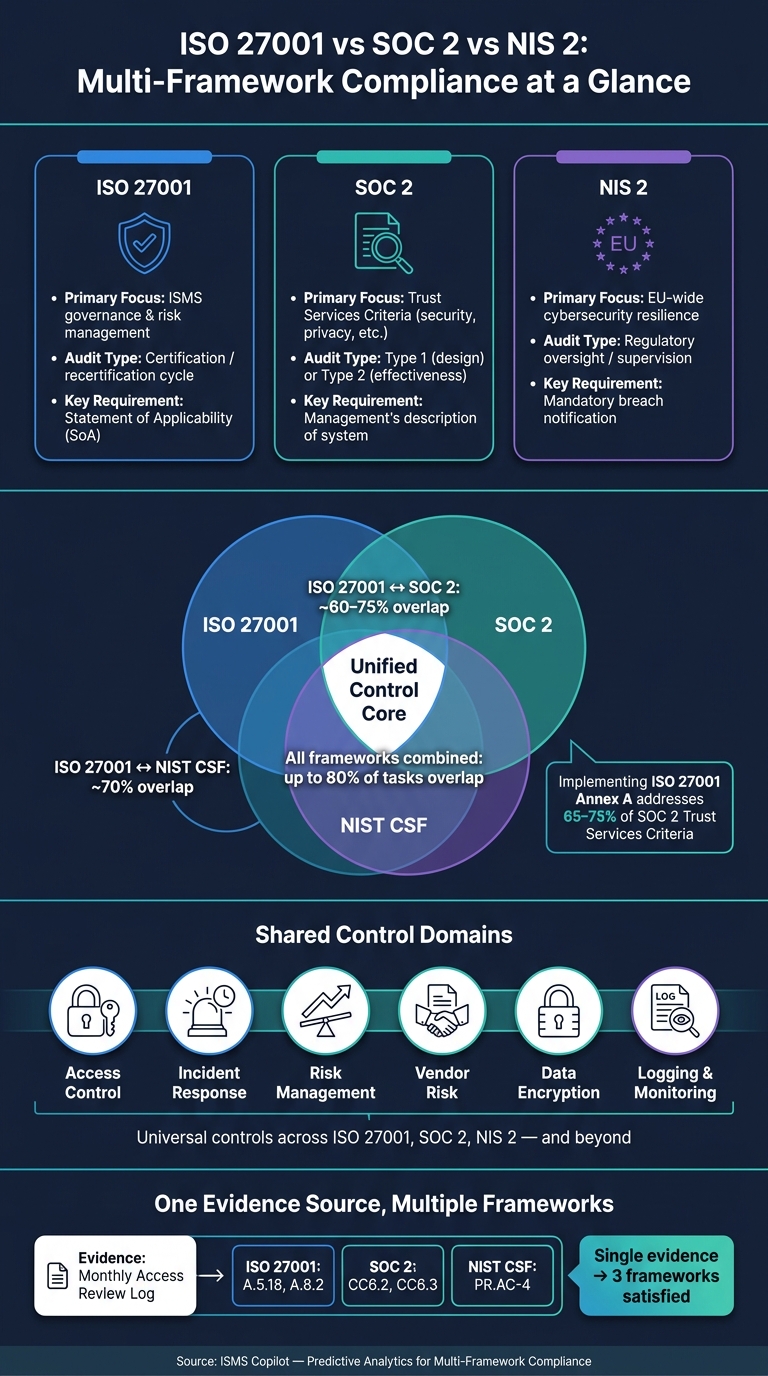 {ISO 27001 vs SOC 2 vs NIS 2: Multi-Framework Compliance Overlap}
:::
{ISO 27001 vs SOC 2 vs NIS 2: Multi-Framework Compliance Overlap}
:::
ISO 27001, SOC 2, and NIS 2 at a Glance
Understanding the basics of each compliance framework is key to integrating predictive analytics into compliance efforts. ISO 27001:2022 emphasizes creating an Information Security Management System (ISMS) through a risk-based approach. A critical part of this process is the Statement of Applicability (SoA), which outlines applicable controls and their justification [7][9]. SOC 2, developed by the AICPA, focuses on assessing the effectiveness of security controls. Type 1 audits evaluate control design, while Type 2 audits test how well these controls perform over time [7][8]. Meanwhile, NIS 2 is a mandatory EU directive aimed at securing critical infrastructure and digital services, requiring breach notifications and regulatory oversight rather than voluntary certification [4].
| Feature | ISO 27001 | SOC 2 | NIS 2 |
|---|---|---|---|
| Primary Focus | ISMS governance and risk management | Trust Services Criteria (security, privacy, etc.) | EU-wide cybersecurity resilience |
| Audit Type | Certification/recertification cycle | Type 1 (design) or Type 2 (effectiveness) | Regulatory oversight/supervision |
| Key Requirement | Statement of Applicability (SoA) | Management's description of system | Mandatory breach notification |
Control Domains Shared Across Frameworks
Although these frameworks differ in scope and application, they share several overlapping control areas. Access control, incident response, risk management, vendor risk, data encryption, and logging/monitoring are universal across ISO 27001, SOC 2, and NIS 2, as well as many other standards. This overlap allows organizations to streamline compliance efforts. For instance, a single data source, like MFA enforcement logs, can fulfill requirements across multiple frameworks [2][7][10]. Take access management policies as an example - they can simultaneously address ISO 27001 A.5.15–A.5.18, SOC 2 CC6.1 and CC6.2, and NIST PR.AC-1 and PR.AC-3 [2][7].
Common Pain Points in Multi-Framework Programs
Managing multiple compliance frameworks often leads to inefficiencies that can overwhelm teams. Below is a breakdown of common challenges and their practical impacts:
| Pain Point | What It Looks Like in Practice |
|---|---|
| Redundant evidence collection | Repeatedly gathering the same access logs for both ISO 27001 and SOC 2 audits [8] |
| Control mapping gaps | Misunderstanding which controls meet specific requirements, resulting in either over-documentation or missed areas [8] |
| Audit fatigue | Overlapping audit schedules that strain small security teams [8] |
| Fragmented ownership | Lack of clear responsibility across departments like IT, HR, Legal, and Finance for shared controls [8] |
| Evidence overload | Handling the large volume of samples needed for Type 2 audits and continuous monitoring [8] |
These challenges aren't just operational headaches - they're patterns that generate data, making them ideal candidates for predictive analytics. By addressing these inefficiencies, organizations can reimagine how compliance programs operate and prepare for audits more effectively.
How Predictive Analytics Simplifies Compliance Programs
The challenges discussed earlier - such as redundant evidence collection, audit fatigue, and fragmented ownership - all share a common thread: they generate a massive amount of data. Predictive analytics steps in to transform this raw data into early warnings and smarter decisions, turning compliance efforts from reactive chaos into a smoothly managed, ongoing process.
Data Inputs That Power Predictive Models
The effectiveness of predictive models depends heavily on the quality of the data they process. These inputs fall into four main categories: technical telemetry, operational records, governance data, and contextual signals.
- Technical telemetry includes data like Identity Provider (IdP) logs, CI/CD authentication events, repository audit logs, and token usage patterns. This type of data helps spot anomalies, such as unauthorized access or privilege creep, before they escalate into audit findings [11].
- Operational records cover incident reports, vulnerability scans, access reviews, and vendor risk assessments. This data exposes recurring weaknesses in control systems [11][6].
- Governance data - such as policy documents, exception logs, and framework catalogs - supports gap analysis by identifying areas where standards aren't being met.
- Contextual signals, like asset exposure (e.g., internet-facing vs. internal systems) and software bill of materials (SBOMs), allow models to prioritize risks based on real-world reachability rather than relying solely on generalized severity scores [11].
One often overlooked but valuable input is exception and override records. A sudden increase in policy overrides can indicate weak controls or broken processes that need immediate attention [11].
Key Analytic Techniques in Compliance
Predictive analytics for compliance relies on three main techniques to deliver results:
- Anomaly detection identifies unusual patterns in identity and infrastructure behavior. It can flag issues like entitlement drift, unexpected deployment activity, or abnormal access to CI/CD tokens without requiring manual log reviews [11].
- Transitive mapping uses logic-based algorithms to link controls across multiple frameworks. For instance, a single access review log could simultaneously satisfy requirements for ISO 27001 A.5.18, SOC 2 CC6.2, and NIST PR.AC-3 [6][10].
- Dynamic framework knowledge injection ensures that AI-driven analysis stays aligned with the latest versions of compliance frameworks. This reduces the risk of outdated references, which could lead to failed audits [4].
These approaches move compliance beyond a simple "check-the-box" exercise. Instead of asking, "Did the tool run?" the focus shifts to a deeper question:
"AI changes the question from 'Did the control run?' to 'Is the control operating effectively in the current environment, and can we explain and defend that conclusion?'" - GRC PROS [11]
By applying these techniques, teams can better prioritize risks and streamline audits, saving time and effort.
Outputs of Predictive Models
Predictive models take raw data and generate actionable insights. Here’s what they produce:
- Risk scores rank controls and assets based on their actual exploitability, focusing on vulnerabilities that are both reachable and internet-exposed - not just those with high CVSS scores [11].
- Remediation priorities highlight critical issues that demand immediate attention.
- Early warning alerts identify configuration drift or unusual access activity before they escalate into audit findings [11].
One of the most practical outputs is draft audit narratives. These are pre-written explanations detailing how a control was enforced during a specific timeframe or release [11]. While these narratives aren't the evidence itself, they serve as a structured summary.
"Narrative is a wrapper, not the evidence. Narratives must cite retained log sources with integrity protections, along with timestamps, control identifiers, and artifact links." - GRC PROS [11]
This distinction is crucial. Without a clear link back to raw, integrity-protected logs, narratives won't hold up under scrutiny. Predictive models that document their own decision-making process - such as input sources, thresholds, and scoring logic - ensure that every output is defensible in an audit [11].
Applying Predictive Analytics Across Multiple Frameworks
Mapping and Grouping Controls Across Frameworks
Handling multiple compliance frameworks doesn’t have to mean running separate programs for each one. In fact, many frameworks share a significant amount of overlap. For example, ISO 27001 and NIST CSF have about 70% of their requirements in common, while SOC 2 and ISO 27001 overlap by roughly 60% to 75% [3][6]. Predictive analytics helps make those overlaps more visible and actionable.
With AI-driven tools, you can create a unified control library that maps individual controls across multiple frameworks. Take a monthly access review log as an example - it can simultaneously satisfy ISO 27001 A.5.18 and A.8.2, SOC 2 CC6.2 and CC6.3, and NIST CSF PR.AC-4. This means a single piece of evidence can support compliance across three different programs [2][6].
| Evidence Type | ISO 27001 Mapping | SOC 2 Mapping | NIST CSF Mapping |
|---|---|---|---|
| Vulnerability Scan Report | A.8.8 | CC7.1 | DE.CM-8 |
| Vendor Risk Assessment | A.5.19, A.5.22 | CC9.2 | ID.SC-2 |
| Incident Response Test | A.5.24, A.5.26 | CC7.3, CC7.4 | RS.RP-1 |
ISO 27001 often serves as a strong anchor framework because of its broad scope. Using it as a foundation, predictive tools can pinpoint the unique requirements of other frameworks - like SOC 2 or NIST CSF - that fall outside its coverage. This approach ensures that you only focus on the remaining 20–30% of requirements that are unique to each additional framework [6][2]. This streamlined mapping lays the groundwork for more efficient risk scoring and audit planning.
Unified Risk Scoring and Evidence Reuse
Once controls are mapped, predictive models can assign a benefit score to remediation tasks based on how many frameworks they address. For instance, fixing a weak MFA implementation might simultaneously meet ISO 27001 A.8.5, SOC 2 CC6.1, NIST CSF PR.AC-7, and even GDPR Article 32 [1]. This scoring helps prioritize efforts where they’ll have the greatest overall impact.
Automated tagging further simplifies the process by enabling evidence reuse across all relevant frameworks. Instead of reconstructing audit documentation from scratch, teams can filter and repurpose existing artifacts or use an AI policy assistant to generate compliant documentation [6]. For example, in 2025, a cloud analytics company working in finance and healthcare built a unified control library. By reusing 75% of their ISO 27001 controls for their SOC 2 audit, they completed certifications for ISO 27001, SOC 2, and NIST CSF in under 8 months - a process that would typically take 18 months. This efficiency helped them secure $10 million in new enterprise deals [2]. Predictive analytics doesn’t just save time; it also enables smarter, more targeted audit planning.
Smarter Audit Planning with Predictive Insights
Predictive analytics transforms the way audit planning is done. Instead of relying on periodic reviews, continuous monitoring with predictive tools allows teams to maintain ongoing compliance. This approach helps identify potential issues early, well before they become audit findings [5][6].
The result? A single monthly governance review that covers the status of unified controls across all frameworks. Teams no longer need to juggle separate review cycles for each standard. On top of that, AI-generated gap analyses often reveal that up to 80% of a new framework’s requirements are already met through existing work. This insight reduces the additional workload of adopting a new framework, making multi-framework compliance more manageable than it might seem at first glance [2].
Putting Predictive Analytics to Work with ISMS Copilot
What ISMS Copilot Does for Compliance Teams
ISMS Copilot simplifies compliance management by connecting the dots across frameworks through features like evidence reuse, unified control mapping, and smarter audit planning - all in real time.
At its core, ISMS Copilot uses ISO 27001:2022 as a central hub, mapping its 93 Annex A controls to other frameworks such as SOC 2, NIS 2, NIST CSF, GDPR, and TISAX. This means when you implement a control in one framework, its impact is automatically reflected across others. For example, implementing ISO 27001 A.5.1 at full coverage contributes about 95% toward TISAX INF-1.1 and 90% toward NIS 2 Article 21.2.a, saving compliance teams from repetitive manual work [10].
The platform also incorporates an AI QA Correlation Engine, which uses a four-layer verification process to cross-check your compliance documents against over 5,000 indexed requirement chunks from 45 normative standards. This system identifies potential compliance gaps before an auditor does, offering a proactive way to manage compliance [14].
These advanced mapping and verification tools highlight why ISMS Copilot’s specialized AI is a step ahead of general-purpose tools.
How ISMS Copilot Differs from General AI Tools
General-purpose AI tools like ChatGPT have limitations when used for compliance tasks. Since these tools are trained on broad internet data, they can provide outdated or inaccurate guidance. For instance, updates to ISO 27001:2022 might be missing or misrepresented because of static training data [4].
ISMS Copilot takes a different route. In December 2024, the platform upgraded from standard Retrieval-Augmented Generation (RAG) to its proprietary Dynamic Framework Knowledge Injection system. Instead of retrieving text fragments based on how a query is phrased, this system injects structured, verified framework knowledge directly into the AI's context. This ensures responses are accurate down to the clause level, with response times averaging between 5 and 15 seconds [4].
"Dynamic Framework Knowledge Injection is the core technology that makes ISMS Copilot different from general-purpose AI assistants... ensuring accurate, audit-ready responses grounded in actual framework requirements." - ISMS Copilot Help Center [4]
The difference is clear in the outputs. While ChatGPT might create free-form text that requires manual reformatting, ISMS Copilot generates ready-to-use compliance documents like Statements of Applicability, risk treatment plans, and internal audit checklists. Additionally, it maintains persistent per-client workspaces, storing asset registers, uploaded evidence, and past audit findings, so context is never lost between sessions - unlike with general AI tools.
Data Privacy and Governance in ISMS Copilot
ISMS Copilot goes beyond AI innovation by addressing key data privacy and governance concerns, crucial for compliance teams. Uploading sensitive documents to US-based AI services can create challenges under GDPR Chapter V, Schrems II, and ISO 27001 A.5.14 - the very regulations compliance teams aim to meet [13].
To tackle this, ISMS Copilot offers a 100% EU mode. This mode processes data exclusively through Mistral models hosted on AWS servers in Frankfurt and Amsterdam, ensuring no data is transferred to the US. Temporary chat sessions are also available, with no logs or data retention [13]. EU mode is off by default. Turn it on in Settings → Data Protection, on every plan [13].
Every AI-generated response includes precise citations linking back to the relevant framework clause or control number, creating a verifiable audit trail. Additionally, the knowledge base is reviewed by GRC engineers before deployment, adding a human layer of verification to ensure accuracy and reliability [4].
Conclusion: Where Predictive Analytics Takes Compliance Next
Key Takeaways
The old way of handling compliance - juggling multiple frameworks, enduring separate audits, and duplicating evidence - often led to team burnout. Predictive analytics flips this script in three practical ways, forming the backbone of the transformation discussed throughout this guide.
- Shifting focus: Instead of just proving that a control ran, the emphasis moves to demonstrating that the control is effective. Even better, teams can explain and defend this conclusion in real time.
- Streamlining with overlap: Implementing ISO 27001 Annex A can address 65%–75% of SOC 2 Trust Services Criteria [12]. Predictive analytics makes it easier to spot and reuse overlapping controls instantly.
- Simplifying audit prep: What used to take months now takes hours. Automated evidence tagging slashes preparation time from days to just a few hours [12].
What Comes Next
With predictive analytics as the foundation, compliance is evolving to meet new regulatory demands and the need for real-time assurance. As regulations like the EU AI Act, GDPR, and CCPA continue to tighten, businesses face increasing pressure to enhance security controls. On top of that, enterprise buyers now expect real-time assurance instead of relying on outdated audit reports [5].
The solution? Build a common control framework once and map it across all necessary standards. AI tools take this further by enabling continuous monitoring, correlating evidence, and generating up-to-date reports. This isn't just a vision for the future - it's already happening with leading compliance teams. For example, ISMS Copilot uses these advancements to deliver actionable, real-time insights to compliance professionals.
One key principle remains: AI-generated outcomes must always connect back to sources with integrity [11]. Tools like ISMS Copilot, which integrate traceability through clause-level citations and a human-reviewed knowledge base, make this level of governance achievable.
The path forward is clear: shift from reactive to predictive, from occasional checks to continuous monitoring, and from piecemeal frameworks to a unified approach. AI-driven compliance isn't just about keeping up - it's about staying ahead, turning reactive processes into proactive risk management.
FAQs
::: faq
What data do I need to start using predictive analytics for compliance?
To make the most of predictive analytics for compliance, start with clean, well-organized data. A centralized control library is essential - it should map requirements across various frameworks. You'll also need API access to critical evidence sources like cloud infrastructure, HR systems, and identity providers. Don't forget to include historical data, such as incident reports and internal audit findings. These elements work together to help AI spot patterns and accurately predict compliance risks. :::
::: faq
How can I reuse one set of evidence across ISO 27001, SOC 2, and NIS 2?
To make evidence reusable across ISO 27001, SOC 2, and NIS 2, focus on a control-first strategy rather than handling each framework as an isolated project. The idea is to create a centralized control library where a single control, like multi-factor authentication, can be mapped to multiple frameworks. Additionally, ensure that the evidence you collect is tagged to all the relevant requirements it satisfies. Tools like ISMS Copilot simplify this process by helping you map controls, tag evidence efficiently, and produce auditor-ready reports tailored to different standards. :::
::: faq
How do I prove AI-driven compliance insights will hold up in an audit?
To show that AI-driven compliance insights are ready for audits, make sure they rely on verified and current framework knowledge. Include authoritative citations for controls and requirements to back up your findings. It's also important to use continuous, automated evidence collection to link controls directly to specific framework requirements. This approach ensures that evidence remains consistent, traceable, and easily accessible during audits. :::
Related Posts
NIS2 does not bind your company. Your national law does.
Directive (EU) 2022/2555 addresses Member States, not undertakings. The fines, the reporting clocks and the authority you answer to are written in national law, and those laws arrived on twenty-seven different calendars.
The internal audit that never finds anything
ISO 19011 changed edition in May 2026. The failure mode it exists to prevent did not: the internal audit that has, by drift, stopped disagreeing with management.
Under NIS2, "important" is not a lighter security tier
Teams read the important label as NIS2-lite and scope their controls down. The security measures in Article 21 are the same either way; the tier changes supervision, some enforcement tools, and the floor on the national fine maximum.