 ISMS Copilot
Unified Control Mapping Across Frameworks: Best Practices
Consolidate overlapping framework requirements into a single control library to cut audit time and centralize evidence.

Unified Control Mapping Across Frameworks: Best Practices
Unified control mapping simplifies compliance by consolidating overlapping requirements from multiple frameworks like ISO 27001, SOC 2, and GDPR into a single control library. This strategy reduces redundancy, saves time, and improves efficiency in audit preparation. With up to 60–80% of controls overlapping across major frameworks, organizations can achieve 40–60% savings in compliance efforts by implementing unified controls.
Key takeaways:
- Identify relevant frameworks: Base this on geography, data type, industry, and customer requirements.
- Group overlapping requirements: Spot shared domains like Access Control or Incident Response to streamline controls.
- Use a metaframework: Tools like NIST CSF or Unified Compliance Framework simplify cross-framework mapping.
- Normalize controls: Consolidate varied terminology into single, framework-neutral controls.
- Leverage automation: Tools like ISMS Copilot automate mapping, evidence collection, and framework updates.
Unified control mapping not only reduces compliance costs but also ensures better alignment across frameworks, making audits smoother and more manageable.
How AI Agents automate Common Control Frameworks and mappings #ai #cybersecurity #compliance
::: @iframe https://www.youtube.com/embed/K6h6XG4UReE :::
Scoping and Preparing for Unified Mapping
Before diving into control mapping, it’s crucial to define your scope. Without a clear scope, you risk wasting resources, overlooking important requirements, or falling victim to scope creep.
Identify Which Frameworks Apply to Your Organization
Start by asking yourself: What frameworks are relevant to our organization? The answer depends on four key factors: your geographic location, the type of data you handle, the customers you serve, and the requirements specific to your industry.
For instance, your location and the data you process often determine regulatory obligations. If you handle personal data from EU residents, GDPR applies. Manage U.S. healthcare data? HIPAA is likely in scope. If your business serves the federal government, you’ll need to consider FedRAMP. Beyond regulatory mandates, customer and contractual expectations can’t be ignored. Many enterprise clients now require SOC 2 Type 2 reports or ISO 27001 certifications as part of their vendor evaluation process. These frameworks often become commercially necessary, even if not legally mandated.
"Multi-framework compliance has become a commercial differentiator as much as a legal obligation. Organizations that can demonstrate readiness across multiple frameworks close deals faster." - Gourishankar Reddy, Information Security and Compliance Auditor, CertPro [3]
Once you’ve identified the applicable frameworks, organize their requirements into shared domains like Access Control, Incident Response, Data Protection, and Risk Assessment. This grouping helps you spot overlaps - such as the fact that ISO 27001 and NIST CSF share about 85% of their controls [1].
With frameworks grouped and overlaps identified, the next step is to define your control objectives and risk tolerances to guide effective mapping.
Set Control Objectives and Risk Tolerances
Understanding which frameworks apply is just the starting point. You also need to establish what your controls are designed to achieve at a business level, independent of the language used by specific frameworks.
This is where involving a cross-functional team is essential. Bring together representatives from IT security, legal, compliance, and key operational units. Use tools like a RACI matrix to define roles - who is Responsible, Accountable, Consulted, and Informed for each control area. Without clear ownership, implementation can become inconsistent or incomplete. By setting clear objectives, you not only streamline the implementation process but also improve alignment across multiple frameworks.
One common challenge is navigating the tension between rigid requirements and flexible, risk-based frameworks. For example, PCI DSS lays out specific technical mandates like cardholder data segmentation, while ISO 27001 allows for more flexibility based on your risk assessment. Your unified control set should meet the strictest requirements while avoiding unnecessary complexity in lower-risk areas. Before mapping any new control, review your existing policies and technical measures to create a baseline. This ensures you build on what’s already in place rather than reinventing the wheel.
Consider Using a Metaframework
If your organization is juggling three or more frameworks, consider adopting a metaframework to simplify the process. Tools like the Unified Compliance Framework (UCF) or the Secure Controls Framework (SCF) provide pre-mapped cross-references between hundreds of standards. These tools serve as a reliable resource, saving you the time and effort of manually reconciling individual frameworks.
NIST CSF is often recommended as a foundational metaframework because it aligns closely with many major standards. By starting with NIST CSF, much of the groundwork for mapping is already laid out, leaving you with fewer gaps to address when adding additional frameworks. This approach speeds up the consolidation of controls, making your unified mapping strategy more efficient.
Platforms like ISMS Copilot take this a step further. They allow you to query control relationships across 50+ frameworks, including ISO 27001, SOC 2, GDPR, NIST 800-53, and NIS 2. Instead of spending weeks building a mapping matrix manually, you can quickly identify shared controls and flag unique requirements - like NIS 2’s 24-hour incident notification rule - that need special attention. This kind of automation can save time and reduce errors, ensuring a more seamless mapping process.
Building a Unified Control Catalog
Once you've defined your scope and selected a metaframework, the next step is to create a unified control catalog. This catalog acts as a central hub for compliance requirements, reducing redundancy and making audits simpler. Think of it as the link between your initial compliance planning and the day-to-day operations that follow.
Normalize and Consolidate Requirements
Different frameworks often use varied terminology to describe the same underlying requirement. For instance:
- ISO 27001 calls it "access control" (Annex A.5.15)
- SOC 2 refers to it as CC6.1
- GDPR addresses it under Article 32
Despite these differences, all three describe the same basic principle. Treating them as separate controls only adds unnecessary work.
The key is normalization: rephrasing requirements into simple, framework-neutral language and grouping similar controls. Then, consolidate them into a single control that meets the strictest standard. For example, a unified "User Access Management" control can fulfill ISO 27001 A.5.15, SOC 2 CC6.1, and GDPR Article 32 with one set of policies and evidence. This approach avoids duplication and streamlines audits.
"A well-implemented access control policy with associated processes fulfills all four frameworks. Document once, map to all." - Securapilot [2]
AI tools like ISMS Copilot can be invaluable here. By leveraging Dynamic Framework Knowledge Injection, these tools rely on curated, version-specific reference files instead of generic training data, avoiding common errors. As Ricardo Cabral, Founder of Rakenne, notes:
"All models hallucinate annex A controls and often mistake :2013 controls instead of using :2022." [6]
Once controls are normalized, the next step is to create a structured schema that ensures consistency and audit-readiness.
Design a Structured Control Schema
A clear, well-organized schema is essential for mapping unified controls to specific framework requirements. Each control should follow a consistent format, like this:
| Attribute | Description | Example |
|---|---|---|
| Unified ID | Unique internal identifier | UC-AC-001 |
| Control Name | Descriptive title | User Access Management |
| Objective | What the control achieves | Ensure only authorized users have system access |
| Implementation | Technical or procedural details | RBAC, MFA, quarterly access reviews |
| Framework Mapping | Framework IDs linked to requirements | ISO 27001: A.5.15; SOC 2: CC6.1; GDPR: Article 32 |
| Evidence Required | Artifacts needed to prove compliance | Access review reports, termination checklists |
Using a Unified ID ensures consistent references, even as frameworks evolve. The Framework Mapping column directly ties internal controls to external requirements, making it easy for auditors to trace compliance back to its source.
Policies should be written in framework-neutral language, with all relevant control numbers listed in the document header. For instance, a single "Access Control Policy" referencing ISO A.5.15, SOC 2 CC6.1, and GDPR Article 32 is far more efficient than managing separate policies for each framework.
Build and Maintain a Mapping Matrix
The mapping matrix is the glue that holds the unified control catalog together. Usually maintained as a spreadsheet or within a GRC platform, it links each framework requirement to its corresponding unified control. This setup provides bidirectional traceability, allowing you to trace any framework requirement to its unified control - or vice versa.
Organizations juggling three or more frameworks often report time savings of 40–60% using this approach [2]. However, keeping the matrix up-to-date can be a challenge, as frameworks and regulations frequently change.
This is where tools like ISMS Copilot shine. By offering automated bidirectional traceability, they ensure mappings stay current as frameworks evolve, eliminating the need for manual reviews. Tagging evidence with all applicable framework IDs from the beginning also makes audit preparation far easier, turning it into a routine process instead of a last-minute scramble.
Implementing and Operating Unified Controls
Turn your unified control catalog and mapping matrix into actionable policies, specific technical controls, and daily procedures that work across all applicable frameworks. Here's how to align policies, centralize evidence, and prepare thoroughly for multi-framework audits.
Align Policies, Procedures, and Technical Controls
Group your controls by functional domain - like Access Management, Data Protection, or Incident Response - and create a Master Control Library. Each domain should include one policy, one set of procedures, and one technical control that addresses all relevant frameworks simultaneously [9][3].
When designing technical controls, aim to meet the strictest requirement across frameworks. For instance, implementing encryption that satisfies PCI DSS ensures compliance with SOC 2, which has a less stringent standard. Similarly, you can apply this principle to tasks like setting logging retention periods, enforcing multi-factor authentication (MFA), and scheduling system patches [9][1].
Assign a single accountable owner to each control. This person is responsible for collecting one specific evidence artifact on a defined schedule. Avoid the pitfalls of shared ownership, where accountability often becomes unclear [9][3].
"If you're collecting the same evidence three times for three frameworks, you're doing it wrong." - Justin Leapline, episki [9]
Centralize Risk Management and Evidence Collection
A centralized evidence repository is key to staying audit-ready. By collecting evidence once and tagging it with all relevant framework IDs, you can streamline your process and maintain a unified risk baseline for remediation [4]. For example, a quarterly access review report tagged with SOC 2 CC6.1, ISO 27001 A.9.2.5, and GDPR Article 32 can serve all three frameworks with a single artifact.
"The most painful part of an audit is typically evidence gathering. You end up on long calls with engineers who may or may not speak GRC and hope they remember where to find a config and take a screenshot with a timestamp." - Cyber Sierra Knowledge Team [4]
Tools like ISMS Copilot can simplify this process. Its cross-framework mapping capability allows you to tag controls and evidence artifacts across 50+ frameworks, keeping your repository organized and audit-ready without constant manual updates whenever new requirements arise.
Prepare for Multi-Framework Audits
With centralized evidence and a unified risk register, you can simplify multi-framework audits by involving auditors early. Share your mapping matrix and demonstrate how a single control meets multiple framework requirements. Most auditors will accept this approach if they can trace the mapping back to specific control IDs [4].
For framework-specific documentation - like an ISO 27001 Statement of Applicability or a SOC 2 narrative - you’ll still need materials written in each framework’s specific format. This is where tools like ISMS Copilot shine. It can generate audit-ready documentation based on the latest framework versions (e.g., ISO 27001:2022), helping you avoid errors that might derail an audit [5][6]. The tool also performs completeness checks to ensure every control ID is accounted for, giving you 100% coverage before the audit begins [6].
The results are impressive. Organizations that adopt a unified approach report up to a 75% reduction in time spent on policy creation and evidence collection, as well as a 40% overall time savings compared to managing frameworks individually [2].
Keeping Unified Control Mapping Up to Date
::: @figure 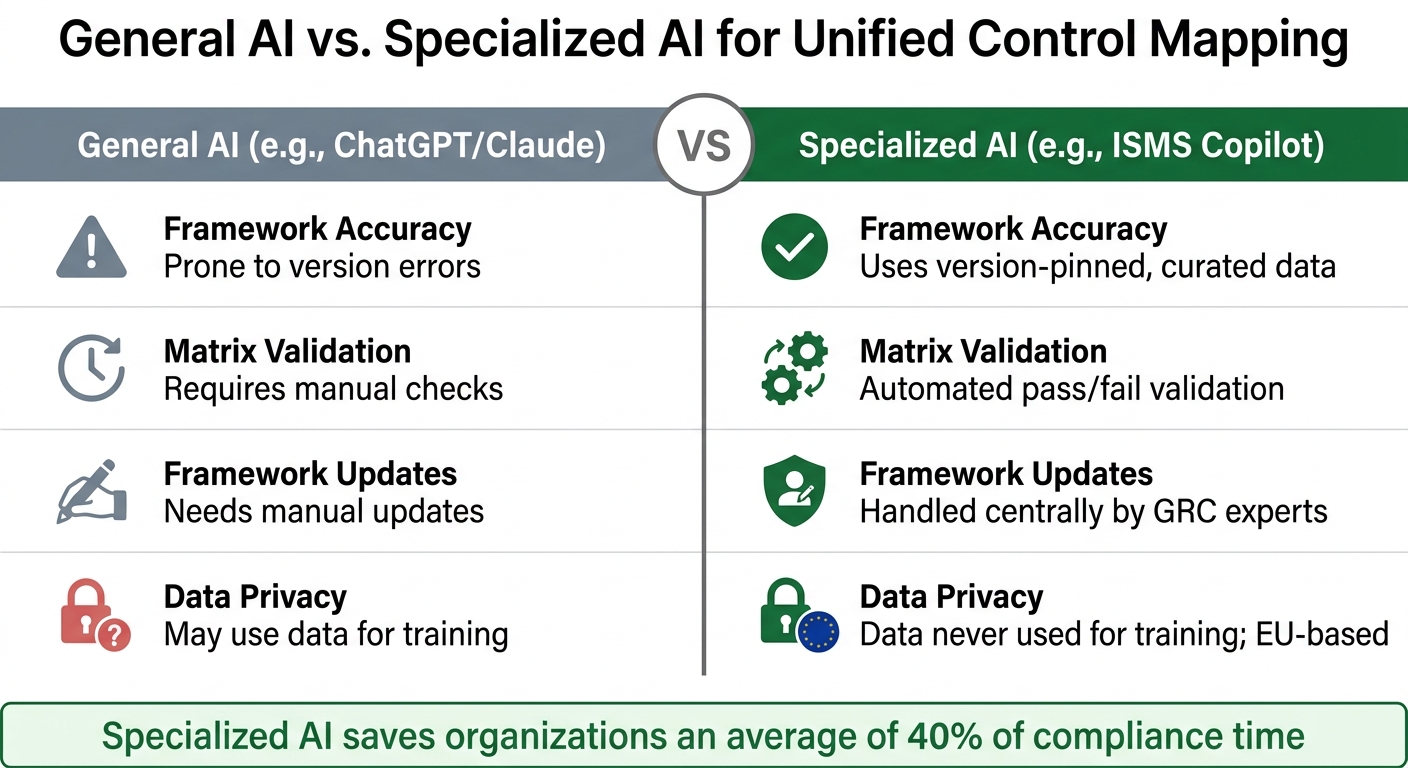 {General AI vs. Specialized AI for Unified Control Mapping}
:::
{General AI vs. Specialized AI for Unified Control Mapping}
:::
Unified control mapping is not a one-and-done task - it needs regular updates to remain effective. Without consistent attention, even the most well-designed mapping matrix can quickly fall out of sync with current standards.
Track Regulatory and Framework Updates
The transition from ISO 27001:2013 to ISO 27001:2022 is a perfect example of why staying aware of version changes is critical. Updates like these can significantly alter the structure and requirements of controls. Similarly, the EU AI Act, set to roll out between 2025 and 2026, introduces new risk-based requirements that compliance teams must incorporate into their frameworks [3].
To tackle this, tools like ISMS Copilot rely on version-pinned reference files instead of general training data, ensuring accuracy. Supporting more than 69 frameworks across 19 jurisdictions, ISMS Copilot releases updates every one to two weeks. This approach eliminates the need for manual research whenever a standard is revised [7]. Once updates are integrated, it's essential to test controls regularly to ensure they remain effective.
Review and Test Control Effectiveness
Annual reviews are no longer sufficient. Instead, quarterly reviews should be conducted, especially after significant changes like tool updates, infrastructure modifications, or expansions in scope. These reviews help identify "control drift", where subtle changes (like a configuration tweak) can weaken existing controls [10][11].
A streamlined approach is to consolidate these reviews into a monthly security assessment. This process can uncover control drift and evidence gaps across all active frameworks [8]. It also aligns with ISO 27001 requirements for internal audits and management reviews (Clauses 9.2 and 9.3), enabling organizations to meet multiple obligations efficiently [12].
When addressing gaps, prioritize fixes that offer the most cross-framework coverage. For instance, enhancing a multi-factor authentication policy could simultaneously address compliance needs for SOC 2, ISO 27001, NIS 2, and GDPR.
Use Automation and AI to Improve Mapping Over Time
Keeping up with frequent framework changes and manual updates can be overwhelming, especially since many organizations manage 4 to 6 compliance frameworks at once [2]. Automation provides a scalable solution to this challenge. It can flag outdated control references, validate matrix completeness, and automatically link new evidence artifacts to the relevant framework IDs. This turns audit preparation into a much faster process, saving organizations an average of 40% of their time on compliance tasks [2].
The table below highlights how specialized tools like ISMS Copilot outperform general AI platforms in maintaining unified control mapping:
| Dimension | General AI (e.g., ChatGPT/Claude) | Specialized AI (e.g., ISMS Copilot) |
|---|---|---|
| Framework accuracy | Prone to version errors [6] | Uses version-pinned, curated data [5] |
| Matrix validation | Requires manual checks [6] | Automated pass/fail validation [6] |
| Framework updates | Needs manual updates [6] | Handled centrally by GRC experts [5] |
| Data privacy | May use data for training [7] | Data never used for training; EU-based [7] |
Conclusion: Key Takeaways for Unified Control Mapping
Unified control mapping offers a smarter way for compliance teams to manage overlapping requirements across multiple frameworks. By implementing a single control that satisfies several framework demands, teams can achieve up to 60% time savings and cut down on repetitive tasks[2].
Given the significant overlap among major frameworks, creating a well-structured master control library can cover most compliance needs without duplicating efforts. This approach ensures that compliance is both efficient and effective.
Tools like ISMS Copilot take this a step further by automating key processes like gap analysis, ensuring mapping accuracy, and keeping framework references up-to-date across more than 50 frameworks. Designed specifically for information security compliance, ISMS Copilot reduces errors and delivers quicker, more dependable results.
Unified control mapping doesn’t just simplify compliance - it also frees up resources to focus on enhancing overall security measures.
FAQs
::: faq
How do I choose a baseline framework for unified controls?
Start by selecting a framework that provides extensive coverage and a solid structure. Frameworks like ISO 27001 or NIST CSF are excellent starting points because they take a risk-based approach and often align with other standards, making integration smoother.
If your organization already holds certifications, leverage them as a foundation. For instance, you can map additional requirements from standards like SOC 2, HIPAA, or GDPR onto your existing ISO 27001 controls. This approach allows you to build on what you already have, saving time and effort while ensuring compliance. :::
::: faq
What’s the best way to handle controls that don’t overlap across frameworks?
When dealing with controls that don’t overlap, treat them as distinct, framework-specific requirements within your unified library. While shared controls typically address 60%–80% of your needs, it’s essential to pinpoint gaps by mapping your central controls against the specific criteria of each framework. Any uncovered areas should be documented as "net-new" requirements to ensure nothing slips through the cracks when it comes to compliance. By clearly separating shared controls from unique ones, you can better navigate audits and avoid overlooking critical regulatory mandates. :::
::: faq
How often should I review and update my unified mapping matrix?
You should update your unified mapping matrix whenever there are changes to regulations or framework structures, such as revisions to ISO 27001:2022 or CMMC 2.1. Make sure to use version control to track changes, document updates, and maintain accuracy throughout the process. Tools like ISMS Copilot can make this easier by providing tailored guidance across more than 50 frameworks, ensuring your documentation stays accurate and ready for audits. :::
Related Posts
NIS2 does not bind your company. Your national law does.
Directive (EU) 2022/2555 addresses Member States, not undertakings. The fines, the reporting clocks and the authority you answer to are written in national law, and those laws arrived on twenty-seven different calendars.
The internal audit that never finds anything
ISO 19011 changed edition in May 2026. The failure mode it exists to prevent did not: the internal audit that has, by drift, stopped disagreeing with management.
Under NIS2, "important" is not a lighter security tier
Teams read the important label as NIS2-lite and scope their controls down. The security measures in Article 21 are the same either way; the tier changes supervision, some enforcement tools, and the floor on the national fine maximum.