
AI in Multi-Framework Non-Conformance Management
AI automates multi-framework non-conformance: detects gaps, maps controls across standards, suggests fixes, and enforces governance.

AI in Multi-Framework Non-Conformance Management
AI is transforming how businesses handle compliance gaps across multiple frameworks like ISO 27001, SOC 2, and NIS 2. Here's the key takeaway: AI tools reduce time, errors, and costs by automating non-conformance management. They analyze evidence, detect gaps, and even suggest corrective actions tailored to each framework.
Key Highlights:
- Challenges: Managing overlapping compliance standards manually is time-consuming and error-prone, requiring multi-framework compliance best practices to streamline the process.
- AI Solutions:
- NLP: Analyzes documents to identify gaps across frameworks.
- Machine Learning: Detects anomalies and assigns risk scores.
- Knowledge Graphs: Maps relationships between controls to streamline cross-framework compliance.
- Benefits: AI reduces audit preparation time by up to 200 hours per quarter and cuts audit costs by 40–60%.
- Governance Needs: Human oversight is essential to ensure accuracy and compliance with regulations like the EU AI Act.
AI simplifies compliance by automating tasks, connecting related controls, and generating audit-ready reports. Tools like ISMS Copilot are leading the way, helping organizations manage over 50 frameworks efficiently.
::: @figure 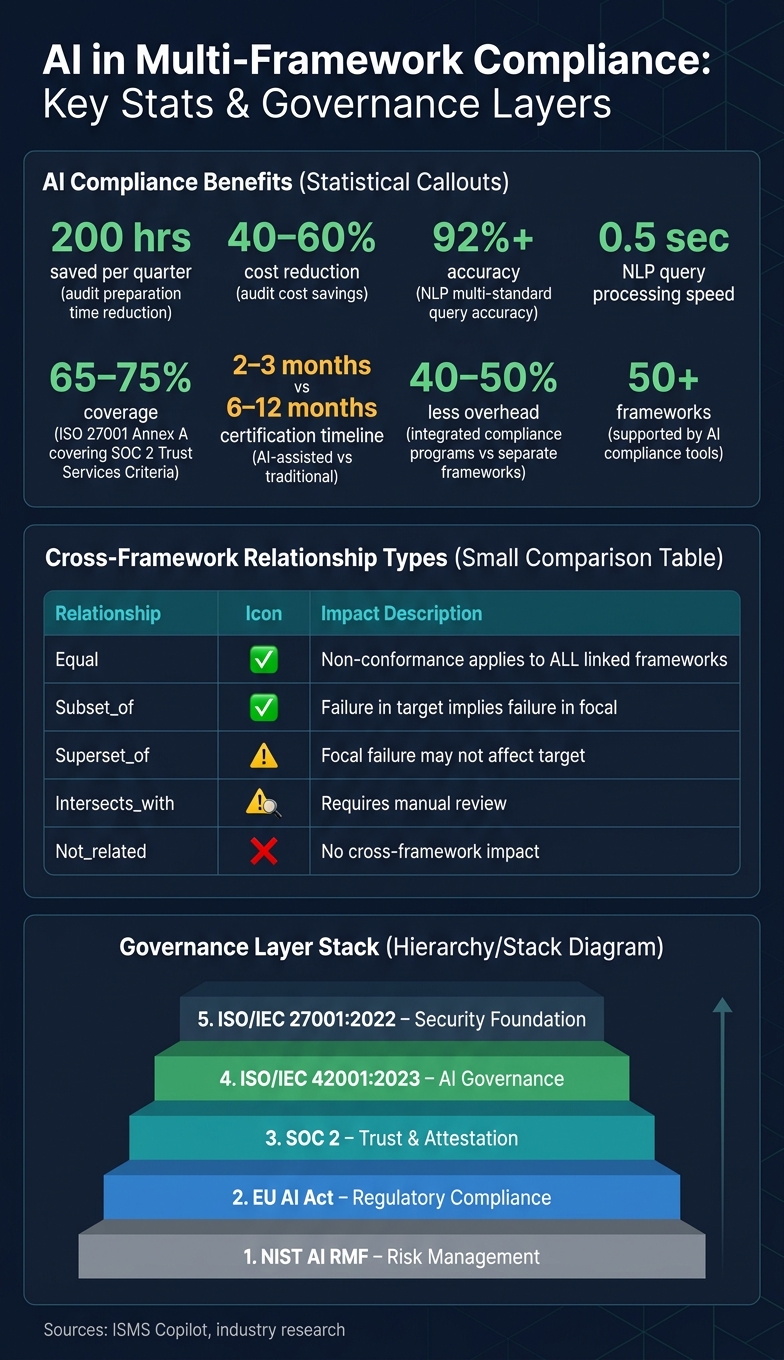 {AI-Powered Multi-Framework Compliance: Key Benefits & Governance Layers}
:::
{AI-Powered Multi-Framework Compliance: Key Benefits & Governance Layers}
:::
AI Techniques for Multi-Framework Non-Conformance Management
Using NLP to Parse Compliance Evidence
Auditors often face the challenge of sifting through scattered evidence found in policies, logs, and configurations. Natural language processing (NLP) helps by analyzing these documents and interpreting their content intelligently.
Rather than simply searching for keywords, NLP systems focus on intent and how well the evidence aligns with documented procedures. For example, an AI using NLP can identify that a policy detailing "user authentication procedures" is relevant to both ISO 27001 A.8.2 and SOC 2 CC6.1 - even if those specific control names aren't explicitly mentioned in the document [3].
NLP also flags evidence that is outdated or incomplete. Advanced systems can process queries in as little as 0.5 seconds, achieving over 92% accuracy for multi-standard queries [4].
While NLP handles document analysis, machine learning (ML) takes on the task of monitoring compliance behaviors in real time.
Using Machine Learning to Detect Anomalies
Machine learning focuses on identifying behavioral deviations that could indicate non-conformance. ML drift checkers constantly compare current configurations to pre-established baselines. For instance, if a cloud setting changes and breaches a security baseline, the system immediately flags the issue. This is particularly helpful in dynamic environments where infrastructure evolves rapidly.
ML models also assign maturity scores - typically on a scale from 0 to 5 - to evaluate the quality of control narratives like System Security Plans. A score below 3 signals a high risk of non-conformance [5].
But compliance management doesn’t stop at individual frameworks. Understanding how different frameworks interact is just as important.
Cross-Framework Mapping with Knowledge Graphs
One of the biggest challenges in multi-framework compliance is determining how a single non-conformance affects multiple standards. Knowledge graphs simplify this by storing controls, clauses, and their relationships in a structured, queryable format.
A core tool for this is Set-Theory Relationship Mapping (STRM), which defines how overlapping or related requirements connect across frameworks. Here's how these relationships work [6]:
| Relationship | What It Means | Cross-Framework Impact |
|---|---|---|
| Equal | Requirements are materially identical | Non-conformance in one applies to all |
| Subset_of | Focal requirement is fully contained in the target | Non-conformance in target implies failure in focal |
| Superset_of | Focal requirement fully contains the target | Focal failure may not affect the target |
| Intersects_with | Partial overlap between requirements | Requires manual review to determine impact |
| Not_related | No meaningful overlap | No cross-framework impact |
This approach allows AI to determine whether a gap in one framework also constitutes a failure in another, reducing the need for manual cross-referencing. As cybersecurity expert Oussama Louhaidia explains:
"The MSPs who thrive build a common control framework once, map it to everything, and reuse evidence across every audit." - Oussama Louhaidia, Cybersecurity Founder and Expert [2]
The benefits of such mapping are clear. For example, proper implementation of ISO 27001 Annex A can cover about 65–75% of SOC 2 Trust Services Criteria [2]. Moreover, automated compliance systems using these techniques have been shown to cut audit costs by 40–60% and reduce certification timelines from 6–12 months to just 2–3 months [7].
How AI Is Applied in Non-Conformance Management
Automating Non-Conformance Records
When AI identifies a compliance gap - using techniques like drift detection or natural language processing (NLP) - it doesn't just stop there. It automatically creates a detailed non-conformance record. This record pulls together critical information such as the finding ID, severity level, affected controls, root cause analysis, and even a proposed corrective action plan.
A standout feature is how AI employs the "5 Whys" methodology to dig deeper into the root cause. For instance, if a missed access review is flagged, AI doesn’t just mark it as incomplete. Instead, it investigates whether the issue stems from unclear ownership, a failed workflow trigger, or a flaw in the access management policy. This structured approach ensures that the problem is fully understood, not just documented.
This level of organization also lays the groundwork for creating detailed, audit-ready reports.
Generating Audit-Ready Reports
AI takes these non-conformance records and transforms them into audit-ready reports, a process that can save compliance teams 100–200 hours per quarter [7]. This happens continuously, regardless of whether an audit is on the horizon.
What sets these reports apart is their traceability. Every finding is tied directly to a specific clause or control in frameworks like ISO 27001 Annex A, SOC 2 Trust Services Criteria, or NIS 2 requirements. By leveraging Dynamic Framework Knowledge Injection, AI ensures that the reports are grounded in the latest verified framework requirements, reducing the chance of inaccuracies [1]. This allows auditors to easily trace the path from raw evidence to findings and, ultimately, to the relevant framework clause.
AI-Suggested Corrective Actions Across Frameworks
AI doesn’t just identify issues - it also suggests targeted solutions. A single compliance failure can impact multiple frameworks, and AI provides actionable recommendations tailored to each one. Here’s how it works:
| Framework | Example AI-Suggested Corrective Action |
|---|---|
| ISO 27001 | Update Annex A control and revise Statement of Applicability (SoA) [8] |
| SOC 2 | Modify access management procedures under CC6.1 or CC6.6 [7] |
| GDPR | Apply encryption fixes or update the data retention policy for flagged PII [7] |
| NIS 2 / DORA | Strengthen incident reporting workflows and operational resilience controls [1] |
AI prioritizes these actions based on risk and severity, helping teams focus on the most pressing issues. It also tracks the progress of corrective actions to confirm their resolution, aligning with ISO 27001’s continual improvement requirement under Clause 10.2 [8].
"ISO 27001 certification isn't a one-time achievement - it's a commitment to ongoing security management." - ISMS Copilot Help Center [8]
ISMS Copilot embodies this philosophy, supporting corrective action tracking across over 50 frameworks. This ensures compliance teams can maintain a clear, auditable trail from identifying non-conformances to verifying their resolution.
Governance, Challenges, and Limits of AI in Compliance
Why Human Oversight Still Matters
AI can handle a lot of the heavy lifting in compliance work, but it can't take full responsibility for the outcomes. The ultimate accountability lies with human leaders. These individuals ensure controls stay up to date, manage relationships with auditors, and make critical decisions about risks.
Regulations like ISO 42001 Control A.9.3 and the EU AI Act Article 14 emphasize the need for human oversight, especially for high-risk AI systems. Ignoring these rules can result in hefty penalties - up to €35 million or 7% of global annual revenue, whichever is higher [11]. Moreover, Article 73 of the EU AI Act requires human-led incident reporting to regulators within 15 days of detection - or as quickly as 2 days for more severe violations [11].
An AI compliance assistant can assist by identifying non-conformances and suggesting corrective actions. However, humans must sign off on risk acceptance or exceptions. This human validation is also essential for addressing AI's accuracy and traceability challenges.
Accuracy, Bias, and Traceability Risks
AI models trained on broad datasets can sometimes produce results that are confidently incorrect. For instance, a model might reference a control from ISO 27001:2013 that was removed or updated in the 2022 revision.
"AI may reference outdated or nonexistent controls." - ISMS Copilot [1]
Traceability is another major issue. When shared API keys are used to access AI tools, it becomes unclear who authorized specific actions - violating SOC 2 CC6.1 [10]. Similarly, allowing AI to directly apply configuration changes in production environments undermines the traceability of change approvals [10].
"The safer position is for the CTO to explicitly signal that AI-authored code is reviewed more rigorously, not less." - Ryuta Hamamoto, TIMEWELL Inc. [10]
Short log retention periods (7–30 days) also conflict with SOC 2 and ISO 27001, which require logs to be retained for at least 90 days. To meet this requirement, logs should be forwarded to a SIEM platform like Splunk or Datadog for extended storage.
Balancing Automation with Governance Controls
Once oversight and accuracy risks are addressed, structured governance controls become essential. The NIST AI Risk Management Framework (AI RMF) provides a voluntary framework for managing AI risks without requiring formal certification. It works well alongside ISO 27001 and SOC 2, especially for organizations still building their AI governance strategies.
A Common Control Framework (CCF) can simplify compliance by consolidating multiple standards. Instead of managing ISO 27001, SOC 2, and ISO 42001 as separate programs, a CCF allows teams to map controls once and reuse evidence across audits. This approach not only reduces duplication but also aligns AI-driven decisions with regulatory requirements. Studies show that integrated compliance programs can cut management overhead by 40–50% compared to running frameworks independently [10]. On the flip side, managing SOC 2 and ISO 42001 separately increases the likelihood of certification failure [10].
A layered approach is often the most effective. Start with ISO 27001 as the foundation for security, add ISO/IEC 42001:2023 for AI-specific governance, and map both to SOC 2 or regulatory requirements like the EU AI Act. This structure clarifies accountability, minimizes duplication, and ensures AI-driven compliance decisions are both explainable and auditable.
| Governance Layer | Standard/Framework | Primary Focus |
|---|---|---|
| Security Foundation | ISO/IEC 27001:2022 | Information security management |
| AI Governance | ISO/IEC 42001:2023 | AI transparency, bias, and lifecycle management |
| Trust & Attestation | SOC 2 (AICPA) | Trust services criteria; annual CPA attestation |
| Regulatory Compliance | EU AI Act | High-risk AI; self-assessment or Notified Body |
| Risk Management | NIST AI RMF | Voluntary maturity framework; no formal certification |
Conclusion and Future Directions
Key Takeaways on AI in Multi-Framework Compliance
AI is reshaping how organizations manage non-conformance across overlapping compliance frameworks. The most impactful benefits come from automation and consolidation. AI-powered platforms streamline processes like evidence collection and gap analysis, delivering measurable efficiency improvements [7]. A Common Control Framework adds to this by allowing evidence to be mapped once across multiple standards, such as ISO 27001, SOC 2, and NIST CSF [2]. These advancements are driven by innovations in natural language processing (NLP), machine learning, and knowledge graph mapping.
Another noteworthy development is the move from traditional Retrieval-Augmented Generation (RAG) to Dynamic Framework Knowledge Injection. This approach ensures AI responses are grounded in structured, authoritative control data, reducing inaccuracies and improving response speed [1]. Together, these advancements highlight how AI is driving progress in AI tools for security compliance.
Emerging Research and Future Opportunities
The future of compliance technology is heading toward multi-agent systems and regulatory-as-code. Specialized AI agents are already handling specific tasks like continuous monitoring, gap analysis, and managing insurance requirements. As CEO Matt Wyman put it:
"Housekeeper AI's potential to transform compliance and drive growth is significant." [9]
Another exciting shift is the integration of compliance checks directly into developer workflows, such as through GitHub Actions. This innovation is turning audit preparation from a stressful quarterly task into a continuous, automated process [7].
Two emerging research areas stand out. First, machine-readable compliance standards - driven by protocols like the Model Context Protocol (MCP) - are enabling AI systems to interact directly with Governance, Risk, and Compliance (GRC) tools and live framework definitions, eliminating reliance on static documents [12]. Second, predictive audit preparation is gaining traction. By using machine learning to analyze past certification reports, AI can identify likely focus areas for future audits, reducing the risk of certification issues [8]. These advancements promise to address the complexities of multi-framework compliance with greater precision and efficiency.
How ISMS Copilot Supports Multi-Framework Compliance
These advancements highlight the importance of tools like ISMS Copilot, which are specifically designed for multi-framework compliance. ISMS Copilot stands apart from general-purpose AI tools like ChatGPT by automatically detecting framework references and injecting structured, authoritative control knowledge. It supports over 50 frameworks, including ISO 27001:2022, SOC 2, NIS 2, DORA, and ISO 42001, without requiring users to upload documentation [1].
Its cross-framework correlation engine is another standout feature. With 3,433 pre-built crosswalk objects spanning 44 framework pairs, completing an assessment for one standard automatically reveals relevant information for others [13]. For teams dealing with complex governance models, this capability significantly reduces compliance risks. By incorporating these AI-driven innovations, ISMS Copilot represents a forward-thinking solution for managing multi-framework non-conformance challenges.
How AI Agents automate Common Control Frameworks and mappings #ai #cybersecurity #compliance
::: @iframe https://www.youtube.com/embed/K6h6XG4UReE :::
FAQs
::: faq
How does AI map one finding across ISO 27001, SOC 2, and NIS 2?
AI simplifies compliance by connecting a single finding across multiple frameworks like ISO 27001, SOC 2, and NIS 2. It does this by automatically pinpointing relevant references within each framework. Then, it pulls structured knowledge from these frameworks and blends it into its analysis. This ensures that responses are aligned with the specific requirements and control mappings of each framework, saving time and reducing complexity in the compliance process. :::
::: faq
What human approvals are still required when AI suggests fixes?
Human involvement is crucial when reviewing and validating AI-suggested fixes for nonconformities and corrective actions. This step ensures that the solutions are accurate, thorough, and meet the requirements of standards like ISO 27001. While AI can help speed up the process, human oversight is key to ensuring compliance and tailoring solutions to the unique needs of an organization. :::
::: faq
How do you make AI compliance outputs auditable and traceable?
To make sure AI compliance outputs are both auditable and traceable, it's important to rely on structured evidence management and thorough documentation. Start by maintaining an evidence manifest that records key details such as the source, controls, timestamps, and approvals for every artifact.
Automating evidence collection can also help streamline the process. Use tools like version control systems and audit trails to create detailed logs that capture every change. However, human oversight remains essential - validation by people ensures the accuracy and reliability of the evidence.
Finally, linking all evidence to specific controls within a centralized system can significantly improve traceability. This setup makes audits more efficient and ensures every piece of evidence is easy to locate and verify. :::
Related Posts
NIS2 does not bind your company. Your national law does.
Directive (EU) 2022/2555 addresses Member States, not undertakings. The fines, the reporting clocks and the authority you answer to are written in national law, and those laws arrived on twenty-seven different calendars.
The internal audit that never finds anything
ISO 19011 changed edition in May 2026. The failure mode it exists to prevent did not: the internal audit that has, by drift, stopped disagreeing with management.
Under NIS2, "important" is not a lighter security tier
Teams read the important label as NIS2-lite and scope their controls down. The security measures in Article 21 are the same either way; the tier changes supervision, some enforcement tools, and the floor on the national fine maximum.