 ISMS Copilot
ISO 27001 vs SOC2: Key Differences for Startups
Compare ISO 27001 and SOC 2 for startups: scope, validation, costs, timelines, and which to choose for U.S. or international growth.

ISO 27001 vs SOC2: Key Differences for Startups
If you're a startup aiming to win enterprise clients, choosing the right security framework is critical. Here's the quick breakdown:
- ISO 27001: A globally recognized security standard, ideal for startups targeting Europe, the UK, or Asia. It requires a formal certification valid for three years and applies to the entire organization.
- SOC 2: A U.S.-focused framework, essential for B2B SaaS startups seeking American clients. It provides detailed audit reports (Type I or Type II), with annual renewals required.
Key Differences:
- Focus: ISO 27001 covers the entire organization; SOC 2 can be scoped to specific services.
- Validation: ISO 27001 offers a public certificate, while SOC 2 provides private audit reports.
- Cost: ISO 27001 has lower long-term costs due to its three-year cycle, but SOC 2 is faster to achieve initially.
- Market: SOC 2 dominates in the U.S., while ISO 27001 is preferred internationally.
Quick Comparison
| Feature | ISO 27001 | SOC 2 |
|---|---|---|
| Region | Global (Europe, Asia, UK focus) | U.S. focused |
| Validation | Public certificate (3 years) | Private audit reports (annual) |
| Scope | Entire organization | Specific products/services |
| Cost | $35,000–$135,000 (Year 1) | $25,000–$210,000 (Year 1) |
| Timeline | 6–12 months | 2–4 months (Type I) |
Start with the framework your target market demands most. If you're focused on U.S. clients, go for SOC 2. For international growth, ISO 27001 is the better choice. Many startups ultimately pursue both to maximize opportunities.
::: @figure 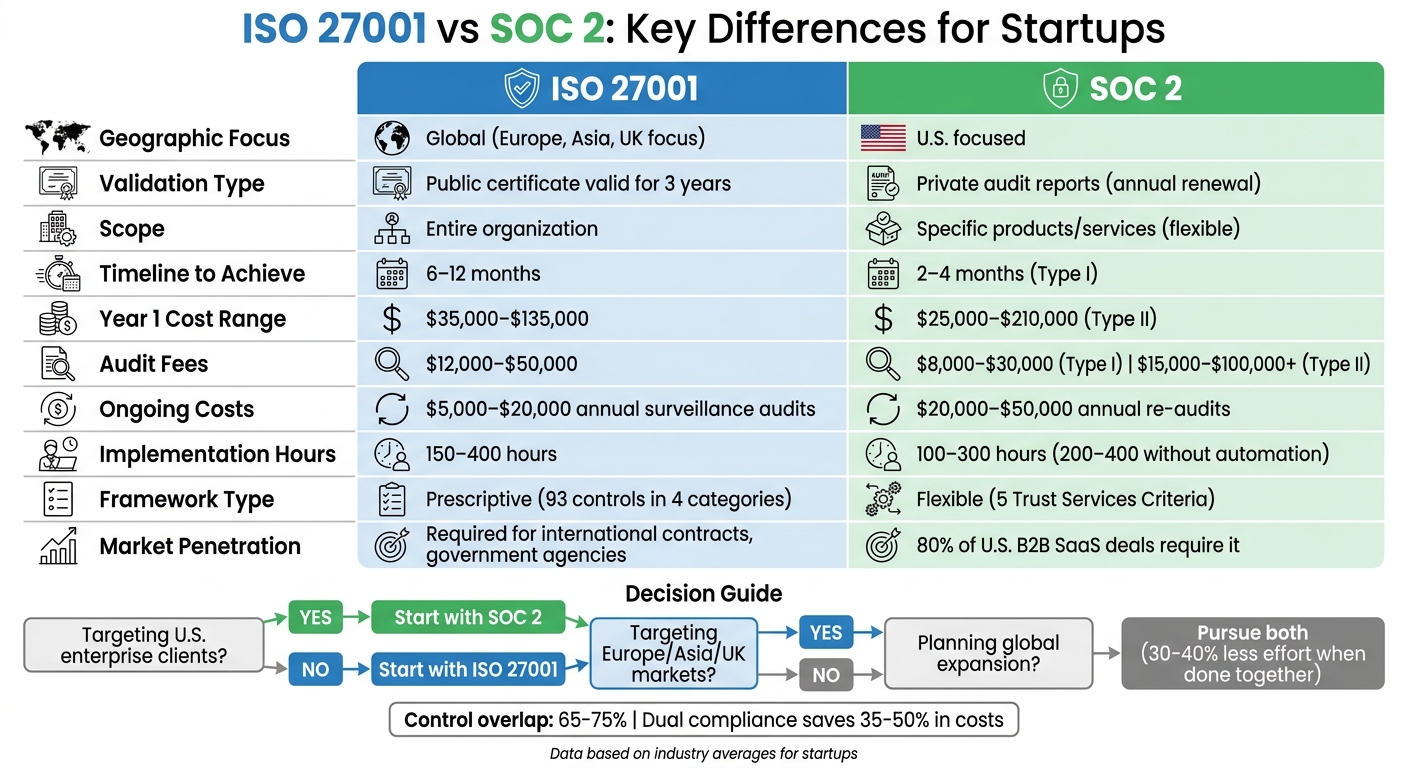 {ISO 27001 vs SOC 2: Complete Comparison for Startups}
:::
{ISO 27001 vs SOC 2: Complete Comparison for Startups}
:::
Main Differences Between ISO 27001 and SOC2
Framework Structure and Methodology
ISO 27001 and SOC 2 take different approaches to managing security. ISO 27001 is prescriptive, meaning it requires organizations to establish and maintain an Information Security Management System (ISMS). This involves adhering to seven mandatory clauses (Clauses 4-10) and implementing relevant controls from a set of 93 requirements. These controls are divided into four categories: Organizational, People, Physical, and Technological [5][2].
SOC 2, on the other hand, is more flexible and outcome-focused. Instead of dictating specific actions, it allows organizations to design their own controls to meet five Trust Services Criteria: Security, Availability, Processing Integrity, Confidentiality, and Privacy. Only the Security criterion is mandatory, and the others can be selected based on customer needs. This flexibility also means SOC 2 can focus on specific products or services, while ISO 27001 typically applies to the entire organization [3][1].
"SOC 2 provides an initial assessment option, whereas ISO 27001 formalizes your controls under a comprehensive program - you can take all those great controls you've done for SOC 2, put a program over them, and make them a more formal part of your organization." – Michelle Strickler, Lead Product & Compliance Experience Strategist, Strike Graph [4]
Both frameworks share common ground in areas like access management, encryption, incident response, and vendor management. This overlap means implementing one can give you a strong foundation for tackling the other. Using a cross-framework ISMS assistant can help manage these shared controls efficiently.
Certification Process vs. Audit Reports
The way each framework verifies compliance also sets them apart.
ISO 27001 provides a formal certification, issued by an accredited body and valid for three years. The certification process involves a two-stage audit: Stage 1 examines documentation, while Stage 2 tests the implementation of controls. To maintain certification, organizations must undergo annual surveillance audits and a recertification audit every three years [2][6].
SOC 2, on the other hand, results in a detailed audit report, prepared by a licensed CPA firm. These reports are typically shared privately with prospects under a non-disclosure agreement. SOC 2 offers two report types: Type I, which evaluates the design of controls at a specific point in time (completed in weeks), and Type II, which assesses the effectiveness of controls over a 3-12 month period. The Type II report is the one most enterprise buyers expect to see - over 90% demand it [2].
ISO 27001 certification provides a straightforward "yes, we're certified" statement for public use, while SOC 2 reports offer a deeper dive into how an organization safeguards data. These reports include detailed control descriptions, auditor feedback, and insights into the organization's security practices. SOC 2 reports expire after 12 months, requiring annual re-audits, whereas ISO 27001's three-year cycle spreads out the workload differently [2][1].
International vs. U.S. Market Focus
The geographic focus of these frameworks further highlights their differences.
ISO 27001 is a global standard, recognized in over 100 countries and often required for contracts in Europe, the UK, and the Asia-Pacific region. It's especially relevant for government agencies and industries with strict regulations. Additionally, international laws like NIS2 and DORA often reference ISO 27001 as proof of adequate security practices [2][1].
SOC 2 is primarily a North American standard, developed by the American Institute of Certified Public Accountants (AICPA). It has become a must-have for U.S. enterprise procurement, with roughly 80% of U.S. B2B SaaS deals requiring SOC 2 compliance as part of the sales process [3]. If you're targeting American enterprise clients, expect to be asked for your SOC 2 report in nearly every security questionnaire.
The costs for these frameworks also vary. ISO 27001 certification audits cost between $12,000 and $50,000, with total Year 1 expenses ranging from $35,000 to $135,000 [1][2]. SOC 2 audits are less predictable: Type I audits cost $8,000-$30,000 (total Year 1: $25,000-$45,000), while Type II audits range from $15,000 to over $100,000, with Year 1 expenses reaching $50,000-$210,000 [2][1]. Your choice will depend on your target market and revenue priorities.
sbb-itb-4566332
What Startups Should Consider When Choosing
Budget and Resource Needs
Costs can vary widely. The initial investment for ISO 27001 typically ranges from $35,000 to $135,000, which includes audit fees between $15,000 and $60,000, along with compliance tools. On the other hand, SOC 2 Type II can cost anywhere from $50,000 to $210,000 in the first year, with audit fees alone ranging from $15,000 to over $100,000 [2].
ISO 27001 is more cost-effective long-term. Its certification cycle spans three years, with smaller annual surveillance audits costing between $5,000 and $20,000. Meanwhile, SOC 2 requires a full Type II audit annually, resulting in recurring costs of $20,000 to $50,000 per year. If you're in a hurry, SOC 2 Type I can be achieved in 2–4 months, while ISO 27001 typically takes 6–12 months to complete [2].
Internal resource demands also differ. ISO 27001 often requires 150–400 hours to establish an ISMS (Information Security Management System) with involvement from top management. SOC 2, by comparison, requires 100–300 hours, but without automation, this can stretch to 200–400 hours for the initial process. That said, since the two frameworks share 65–75% of controls, pursuing both at the same time usually adds just 30–40% more effort [2].
These cost and time considerations play a key role in how startups prioritize their compliance strategies.
Customer Requirements and Target Markets
Market demands often dictate the choice of framework. In the U.S., SOC 2 is practically a must-have for enterprise buyers, with 80% of U.S. B2B SaaS deals now requiring SOC 2 as a baseline security standard. Most companies specifically ask for a Type II report to verify the ongoing effectiveness of controls [2].
ISO 27001 opens doors internationally. For companies targeting Europe, the UK, or Asia-Pacific, ISO 27001 is often seen as the standard. SOC 2 may not be accepted as an alternative in these regions. This makes ISO 27001 essential for startups looking to expand into global markets, regulated industries like finance or healthcare, or government contracts [2].
Choosing the right starting point is strategic. Startups often prioritize the framework that aligns with their primary revenue source - SOC 2 for U.S.-focused SaaS businesses or ISO 27001 for European expansion. Over time, they may add the second certification to support international growth, capitalizing on the overlap in controls. For startups needing quick validation in the U.S., a SOC 2 Type I report offers a "point-in-time" snapshot that many buyers accept as a temporary measure.
Long-Term Growth and Expansion Plans
Planning for growth requires foresight. If international expansion is part of your roadmap, ISO 27001’s global acceptance provides a strong foundation for scaling. Its predictable long-term costs also make it a practical choice for sustained growth.
SOC 2 offers flexibility for product-based growth. Startups can scope SOC 2 reports to specific products or services, rather than certifying the entire organization. This makes it easier to obtain additional reports as new offerings are launched. ISO 27001, in contrast, applies to the organization as a whole, offering more comprehensive coverage but less flexibility.
Automation can simplify compliance. Platforms designed for compliance can cut costs by 60–80% and streamline the process of managing multiple frameworks. If your goal is to pursue both certifications, staggering audits by 1–2 months can help balance the workload. This approach allows you to reuse evidence artifacts - such as policies, logs, and screenshots - across both frameworks, saving time and effort [2].
Achieving Both ISO 27001 and SOC 2 Compliance
Shared Controls Between Frameworks
ISO 27001 and SOC 2 share a substantial overlap in key areas like access control (around 95%), change management (roughly 90%), and incident response (approximately 90%) [8]. Both frameworks demand documented policies and risk assessments, though they differ in how controls are presented and evaluated.
"Companies that treat each framework as a separate project spend roughly the same effort twice. Companies that build a unified security program and map it to both frameworks spend about 30-40% less on the second one."
- Ali Aleali, Co-Founder & Principal Consultant, Truvo Cyber
This overlap highlights the efficiency of a unified approach. For example, in April 2026, a tech startup leveraged its existing SOC 2 documentation to achieve ISO 27001 certification in just 8 weeks - far shorter than the typical 6–12 month timeline. This rapid success was made possible by a compliance automation platform that mapped controls across both frameworks.
Streamlining Multi-Framework Compliance
A unified security program can simplify compliance efforts across frameworks. By creating a single "source of truth" for policies, evidence, and controls, you can map both frameworks to a shared control library [8][9]. This approach allows you to write policies once, collect evidence once, and maintain a single control library tagged for both frameworks [10].
Using the best AI assistant for ISO 27001 and other automation tools can make this process even smoother. Companies using GRC automation platforms have reported cutting dual-compliance costs by 35–50% and completing certifications 30–40% faster compared to manual methods [10]. Tools like ISMS Copilot enable startups to map controls, automate evidence collection from platforms like AWS, GitHub, and Okta, and generate audit-ready documentation simultaneously.
Timing is also crucial. The ideal sequence often starts with a SOC 2 Type I audit (focused on design at a specific point in time), followed by ISO 27001 Stage 1 and Stage 2 audits (covering the management system), and finally a SOC 2 Type II audit (assessing operational effectiveness) [8]. Spacing these audits 1–2 months apart helps manage workloads and allows you to reuse evidence - such as policies, logs, and screenshots - across assessments [2]. Additionally, working with an audit firm that can handle both frameworks can reduce combined audit fees by 15–30% [8][7].
Conclusion: Choosing the Right Framework for Your Startup
Summary of Key Differences
When choosing between SOC 2 and ISO 27001, it all comes down to aligning with your revenue goals. For most U.S. enterprise SaaS deals, SOC 2 is the go-to, covering about 80% of such agreements [3]. On the other hand, ISO 27001 acts as a global gateway, especially if you're eyeing markets in Europe, the UK, or the Asia-Pacific region. Here's how they differ:
- Certification and Validity: ISO 27001 provides a public certificate valid for three years, with annual surveillance audits. SOC 2, however, delivers a detailed attestation report shared under NDA and needs to be renewed annually.
- Cost Structure: SOC 2 requires yearly renewals, while ISO 27001 follows a three-year certification cycle. However, if you pursue both frameworks, you can save 20–30% by reusing evidence between them [2].
The smartest move? Let your revenue guide you. Focus on the framework your top prospects demand in their security questionnaires. Once you've nailed that, consider adding the second certification as you expand into international markets.
Using AI Tools to Simplify Compliance
AI tools are changing the compliance game, slashing timelines from months to just days. Take one startup, for example - they reached SOC 2 Type I audit readiness in under a week. That’s the power of AI.
Platforms like ISMS Copilot make dual-framework compliance much simpler. Dubbed "the ChatGPT of ISO 27001", this tool supports over 50 frameworks, including SOC 2, GDPR, and NIS 2. It automates tedious tasks like evidence collection, policy drafting, and control mapping across frameworks. Instead of wrestling with spreadsheets, startups can let ISMS Copilot handle the heavy lifting. It integrates with platforms like AWS, GitHub, and Okta to gather evidence automatically, maps controls efficiently, and generates audit-ready documents. This streamlined approach can cut dual-compliance costs by 35–50% and drastically speed up certification timelines [10].
ISO 27001 vs SOC 2: Do I Need Both?
::: @iframe https://www.youtube.com/embed/ksj8HYWRHF4 :::
Managing both frameworks simultaneously is often easier with an AI compliance assistant to streamline documentation.
FAQs
::: faq
Do I need ISO 27001, SOC 2, or both?
Your decision hinges on factors like your target audience, customer expectations, and long-term growth plans. SOC 2 is quicker to achieve and widely accepted across the U.S., making it a strong choice for domestic-focused businesses. On the other hand, ISO 27001 is better suited for companies operating globally or in industries that demand formal certification.
Interestingly, many startups find value in pursuing both frameworks since they share a significant overlap in controls. To make the process easier, tools like ISMS Copilot can streamline compliance efforts for either - or both - certifications. :::
::: faq
Should I start with SOC 2 Type I or go straight to Type II?
Start with SOC 2 Type I if you're looking for a quicker and less resource-heavy option. This provides a snapshot of how your controls are designed at a specific point in time, which can help you show prospects - especially in the U.S. - that you have basic security measures in place.
Once your controls have been running smoothly for 6–12 months, you can move on to SOC 2 Type II. This offers a deeper evaluation by validating how effective those controls are over a period of time, which is something enterprise clients often expect to establish long-term confidence. :::
::: faq
How can I reuse evidence to speed up both audits?
Creating a shared repository of security controls and documentation can help you reuse evidence effectively for both ISO 27001 and SOC 2 audits. Since 70-75% of the controls overlap, you can save time and effort by using common policies, risk assessments, and access controls to cover requirements for both frameworks.
Tools like ISMS Copilot simplify this process by helping you manage evidence consistently, ensuring everything stays organized and aligned across audits. This approach not only reduces duplication but also makes audit preparation much more efficient. :::
Related Posts
NIS2 does not bind your company. Your national law does.
Directive (EU) 2022/2555 addresses Member States, not undertakings. The fines, the reporting clocks and the authority you answer to are written in national law, and those laws arrived on twenty-seven different calendars.
The internal audit that never finds anything
ISO 19011 changed edition in May 2026. The failure mode it exists to prevent did not: the internal audit that has, by drift, stopped disagreeing with management.
Under NIS2, "important" is not a lighter security tier
Teams read the important label as NIS2-lite and scope their controls down. The security measures in Article 21 are the same either way; the tier changes supervision, some enforcement tools, and the floor on the national fine maximum.