 ISMS Copilot
How AI Tracks Regulatory Changes
Explains how AI uses NLP, ML, and real-time alerts to monitor regulatory updates, map impacts to controls, and reduce compliance workload.

How AI Tracks Regulatory Changes
Compliance is getting harder. With over 200 major AI-related policy updates issued globally in early 2026 alone, keeping up with regulations is overwhelming. Most compliance teams still rely on manual methods, which are slow, error-prone, and costly. Missing updates can lead to massive penalties - like TD Bank’s $3.09 billion fine in 2024.
AI offers a solution. It monitors regulations in real time, analyzing dense legal texts, filtering relevant updates, and providing actionable insights. This reduces manual work by up to 75%, saving time and cutting costs. Tools like ISMS Copilot automate tasks like policy drafting, risk assessments, and audit prep, making compliance faster and more accurate.
Key Benefits of AI in Compliance:
- Time Savings: Cuts monitoring time by 85%, reducing manual tasks.
- Cost Reduction: Lowers compliance costs by up to 30%.
- Real-Time Alerts: Tracks updates 24/7, ensuring no critical changes are missed.
- Error Reduction: Minimizes mistakes with AI-driven precision.
With regulatory enforcement penalties surging 417% in 2025, AI isn’t just helpful - it’s essential for staying compliant in today’s fast-changing landscape.
Automate Regulatory Compliance with Advanced AI and MongoDB
::: @iframe https://www.youtube.com/embed/H3cmJTSO3Fs :::
sbb-itb-4566332
Core Technologies Behind AI Regulatory Tracking
These technologies showcase how AI keeps compliance policies updated and precise.
Natural Language Processing for Legal Text Analysis
Natural Language Processing (NLP) is the backbone of transforming dense legal documents into actionable insights for compliance teams. It starts with intelligent ingestion, where unstructured formats like PDFs and web notices are converted into machine-readable text. This process eliminates unnecessary boilerplate text. Fine-tuned NLP models then extract critical details such as obligations, effective dates, affected entities, and financial thresholds.
To make sense of new updates, semantic linking comes into play. By using sentence embeddings and vector searches, it connects current updates with past regulations. For example, between 2020 and 2024, researcher Abhik Banerjee tested an NLP framework on 2,800 regulatory documents. The results were impressive: an F1 score of 0.84 for entity extraction and 0.86 for change classification, while reducing the average time-to-alert from 72 hours to just 4.5 hours [7].
"The shift from keyword matching to semantic understanding is where most compliance teams get stuck." - Harshvardhan Choubey, Regulatory Reporting Expert [7]
The financial benefits of NLP are hard to ignore. It can cut legal advisory hours by 40%, reduce spending on compliance content providers by up to 70%, and speed up regulatory-change impact assessments by 75% [8]. For firms spending an average of $31.7 million annually on financial crime compliance, these savings directly impact profitability [8].
Once NLP organizes the data, machine learning (ML) takes over to further refine and predict regulatory impacts.
Machine Learning for Pattern Recognition
After NLP extracts the relevant details, machine learning steps in to identify critical regulatory changes from routine updates. ML models also perform thematic filtering, matching updates to an organization’s specific needs, ensuring only relevant information reaches the right teams [9].
AI's predictive capabilities add another layer of efficiency. By monitoring legislative schedules, these systems can forecast the effective dates of new provisions and send alerts at intervals like six months, three months, and one month [9]. This proactive approach addresses a major challenge - 79% of legal professionals cite keeping up with changing laws as a top concern. Meanwhile, 58% of law firms using AI tools report higher client retention due to quicker and more confident advice [10].
This sophisticated tracking naturally evolves into real-time alerts, which are crucial for immediate action.
Real-Time Alerts and Contextual Filtering
Real-time monitoring ensures 24/7 tracking of regulatory sources such as government APIs (e.g., the Federal Register and Regulations.gov), legislative databases, and agency websites [1][12]. But monitoring alone isn’t enough - contextual filtering ensures alerts are actionable. AI cross-references new regulations with a company’s specific regulatory profile, taking into account jurisdictions, facility types, services, and internal policies [1][6][13].
Advanced systems go a step further by classifying updates based on severity (Critical, High, Medium, Low) and routing them to the appropriate stakeholders [6][13]. These platforms also reduce false positives by 50% to 80%, making compliance workflows far more efficient [13]. As a result, 73% of organizations report time savings as the main advantage of using AI in compliance, with 71% also noting significant cost reductions [11].
Together, these technologies deliver major improvements in regulatory compliance efficiency.
How AI Tracks and Processes Regulatory Changes
::: @figure 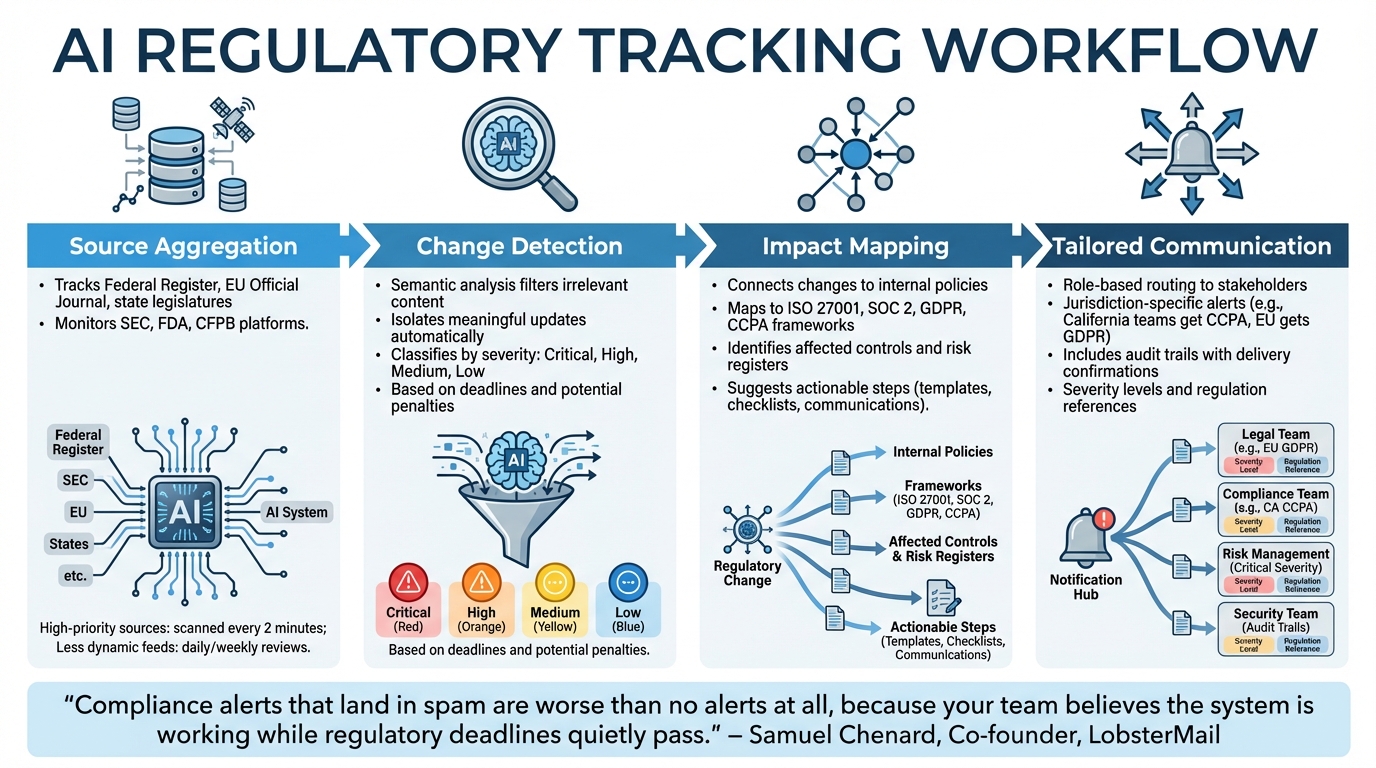 {How AI Tracks and Processes Regulatory Changes: 4-Step Workflow}
:::
{How AI Tracks and Processes Regulatory Changes: 4-Step Workflow}
:::
AI has revolutionized regulatory tracking, turning it into a proactive and efficient process. By leveraging advanced technologies, these systems ensure your organization stays ahead of regulatory updates without the stress of manual monitoring.
The process begins with source aggregation, where AI continuously tracks primary regulatory feeds. These include the Federal Register, EU Official Journal, state legislatures, and agency-specific platforms like the SEC, FDA, and CFPB [2][6]. Unlike traditional manual checks that may happen weekly or monthly, AI scans high-priority sources every two minutes, while less dynamic feeds are reviewed daily or weekly [14]. This constant monitoring allows organizations to capture critical updates as they happen.
Next comes change detection. Many teams still rely on manual reviews [2], but AI systems quickly identify and isolate meaningful updates. By using semantic analysis, AI filters out irrelevant elements, such as navigation menus and footers, focusing only on substantive changes [2][5]. Once detected, updates are classified by severity - Critical, High, Medium, or Low - based on factors like deadlines and potential penalties [6][5].
The third phase is impact mapping, where AI connects regulatory changes to your internal policies and frameworks. Whether it’s ISO 27001, SOC 2, GDPR, or CCPA, AI identifies which controls, risk registers, or code repositories are affected by new rules [6][15]. For instance, if the SEC introduces a new regulation, the system pinpoints the specific areas in your organization that need adjustments. Some platforms even go a step further, suggesting actionable steps like updating templates, revising checklists, or preparing staff communications [5].
After mapping the impact, AI ensures tailored communication across your compliance network. Automated notifications are sent through role-based routing, ensuring that updates reach the right people based on jurisdiction and business unit [6]. For example, California teams receive CCPA alerts, while EU staff are notified about GDPR changes. These notifications also include detailed audit trails with delivery confirmations, severity levels, and references to the specific regulations [6][14].
"Compliance alerts that land in spam are worse than no alerts at all, because your team believes the system is working while regulatory deadlines quietly pass."
– Samuel Chenard, Co-founder, LobsterMail [6]
This streamlined workflow transforms regulatory tracking from a chaotic, last-minute effort into a structured, scalable process that keeps pace with your compliance requirements.
Benefits of AI-Driven Regulatory Tracking
AI-driven regulatory tracking simplifies complex processes while delivering measurable improvements in efficiency, cost management, and risk mitigation. It ensures compliance policies remain effective and up-to-date.
Efficiency and Accuracy Gains
AI has revolutionized regulatory monitoring, turning what was once a tedious, manual process into a streamlined operation. Compliance teams can now reduce their monitoring time from 8–12 hours to just 1–2 hours per week - an impressive 85% time savings [17]. Tasks like policy gap analysis, which used to take 3–5 days, can now be completed in just 4–8 hours. Similarly, compiling audit evidence has been shortened from 2–3 weeks to only 3–5 days [17].
Consider this example: In December 2025, a regional bank with 500 employees implemented AI agents for monthly compliance reporting. Previously, this process required 8 hours of work from three team members, with a 12% error rate due to manual data collection and spreadsheet cross-checks. After adopting AI, the reporting time dropped to just 15 minutes, and the error rate plummeted to 0.2%. This change saved 1,128 staff hours annually, valued at approximately $84,000 [19].
These time savings don’t just improve efficiency - they also deliver significant financial returns.
Cost Savings for Compliance Teams
AI significantly reduces the financial burden of compliance. By automating 40–60% of manual tasks, AI can cut costs by up to 30% while boosting efficiency by 50% [18][17]. On average, manual compliance costs $10,000 per employee annually, which translates to $10 million for a workforce of 1,000 [18].
For instance, a mid-sized healthcare provider integrated AI into its billing workflows in August 2025. This led to a 22% reduction in claim denials and a 40% increase in coder productivity. Additionally, the system cut unbilled discharge cases by 50%, paying for itself in under six months [18]. These outcomes highlight how AI not only prevents revenue loss but also reduces operational costs.
These efficiencies also strengthen an organization's ability to navigate regulatory challenges.
Staying Ahead of Regulatory Changes
AI’s benefits go beyond saving time and money - it helps organizations proactively manage compliance. By providing real-time, contextual alerts, AI helps teams avoid costly penalties. On average, AI-driven compliance management has saved organizations $1.4 million in regulatory penalties and reputational damage [16]. The stakes are high: Meta, for example, faced a record €1.2 billion fine for GDPR violations, and non-compliance with the EU AI Act could result in fines of up to 7% of global annual turnover [18].
"The promise of AI in compliance programs lies in automating workflows, summarizing regulatory changes, reducing errors, streamlining compliance testing, and helping you manage your obligations with efficiency, accuracy, and agility."
– Resolver [16]
The global market for AI compliance monitoring is expected to grow from $1.8 billion in 2024 to $5.2 billion by 2030 [3]. With 52% of companies already utilizing AI for tasks like information research and data extraction [3], early adopters are well-positioned to handle regulatory complexities while maintaining effective compliance frameworks.
ISMS Copilot: Automating Compliance with AI
ISMS Copilot brings a focused solution to information security compliance, distinguishing itself from general-purpose AI tools like ChatGPT or Claude by offering specialized capabilities.
How ISMS Copilot Tracks Regulatory Changes
ISMS Copilot leverages AI to simplify compliance tracking for information security frameworks, combining automation with up-to-date regulatory insights.
Using Dynamic Framework Knowledge Injection (DFKI), it monitors over 50 frameworks, including ISO 27001, SOC 2, NIST 800-53, and GDPR. Unlike static systems, its proprietary knowledge base is regularly updated by GRC engineers, ensuring users always access the correct regulatory version - whether it's ISO 27001:2022 or the 2013 standard [20].
The tool employs regex-based pattern matching for precise framework mention detection [21]. For example, referencing "ISO 27001 Annex A.5.9" triggers the system to retrieve the exact clauses and requirements within 5 to 15 seconds. This process uses only 1,000–2,000 tokens, compared to the 10,000+ tokens needed for full document injection, boosting both speed and accuracy [21].
Tailored Guidance and Risk Assessments
ISMS Copilot uses Workspace Memories to provide compliance support tailored to your specific context. It automatically retains details like team size, tools, and certifications [23], ensuring that policies and risk assessments are personalized rather than generic.
The platform can auto-generate 80% of policy drafts and conduct risk assessments using quantitative scoring matrices (likelihood × impact). For SOC 2, it creates custom vendor risk questionnaires, while for NIST 800-53, it highlights high-risk control gaps using heat maps and prioritized action plans. Users have reported 95% accuracy in framework alignment and a 50% reduction in audit preparation time [27][28].
These insights integrate seamlessly with existing compliance processes, streamlining operations and reducing manual effort.
Integration with Existing Compliance Workflows
ISMS Copilot easily connects with GRC platforms like RSA Archer or ServiceNow through APIs, allowing regulatory alerts to sync directly with existing dashboards. This minimizes manual intervention and ensures updates, such as ISO 27001 changes, are routed to the right auditors or implementers via RACI role assignments [25][26].
With Team Workspaces, multiple members can collaborate on compliance projects while maintaining data isolation for different clients or initiatives [24]. For instance, a mid-sized firm implemented ISMS Copilot in just two weeks and reduced manual compliance checks by 60% [25]. Additionally, the platform adheres to Zero Data Retention (ZDR) agreements, ensuring sensitive compliance data is never used to train AI models [21][22].
Conclusion: The Future of AI in Regulatory Compliance
Key Takeaways
AI-powered tools for regulatory compliance are transforming how businesses handle monitoring and workflows. These systems can cut routine tasks by 40–60%, significantly reducing manual effort and freeing up time for more complex decision-making[17]. Unlike traditional keyword-based systems, modern AI uses natural language processing to interpret regulations in context and match them to specific business obligations. Alerts are then routed to the right stakeholders based on jurisdiction and role, minimizing alert fatigue while ensuring critical updates are addressed promptly[6].
"AI does not replace compliance judgment - it eliminates the 40–60% of compliance work that is research, documentation, and first-draft preparation."
These advancements not only highlight current achievements but also pave the way for even greater progress in the field.
Looking Ahead
The rapid advancements in AI-driven compliance solutions are setting the stage for a new era. Regulatory changes are occurring at a faster pace than ever. In the first half of 2026 alone, over 200 major AI-related policy updates were issued globally, including the enforcement of the EU AI Act starting in August 2026 and new legislative frameworks from the White House released in April 2026[4][17]. By April 2026, 74% of organizations are projected to adopt AI tools for governance and compliance tasks[17].
The next wave of innovation is focused on regulation-aware AI. This involves embedding compliance logic directly into AI models during training and inference, making adherence a built-in feature rather than an afterthought[4]. Tools like ISMS Copilot are leading this charge with features like Dynamic Framework Knowledge Injection, which ensures AI outputs align with current standards without the need for retraining[21][20]. With compliance failure costs projected to exceed $6.3 billion for AI companies in 2026, these tools are becoming essential for organizations to stay agile and compliant in an ever-changing regulatory environment[4].
FAQs
::: faq
What regulatory sources can AI monitor automatically?
AI has the ability to monitor a wide range of regulatory sources, such as official gazettes, the Official Journal of the EU, supervisory authority websites, case law, and public consultations. By doing this, it helps organizations stay informed about updates and changes, making it easier to maintain compliance. :::
::: faq
How does AI decide which updates actually matter to my business?
AI streamlines the process of spotting regulatory updates by scanning through sources like government databases and legal publications. It works based on specific criteria such as jurisdiction, industry, and control requirements. The system filters through the noise, flagging only the updates that directly impact your operations. By evaluating the seriousness and potential effects of these changes, AI helps you prioritize updates that could influence compliance. This ensures your team stays focused on critical matters without getting sidetracked by irrelevant details. :::
::: faq
How do AI alerts link a new rule to specific controls and policies?
AI alerts tie new rules directly to specific controls and policies by automatically incorporating relevant framework details, like controls, clauses, and requirements. This approach ensures responses are precise, prepared for audits, and aligned with compliance standards. :::
Related Posts
NIS2 does not bind your company. Your national law does.
Directive (EU) 2022/2555 addresses Member States, not undertakings. The fines, the reporting clocks and the authority you answer to are written in national law, and those laws arrived on twenty-seven different calendars.
The internal audit that never finds anything
ISO 19011 changed edition in May 2026. The failure mode it exists to prevent did not: the internal audit that has, by drift, stopped disagreeing with management.
Under NIS2, "important" is not a lighter security tier
Teams read the important label as NIS2-lite and scope their controls down. The security measures in Article 21 are the same either way; the tier changes supervision, some enforcement tools, and the floor on the national fine maximum.