
SOC2 Automation: Multi-Framework Integration
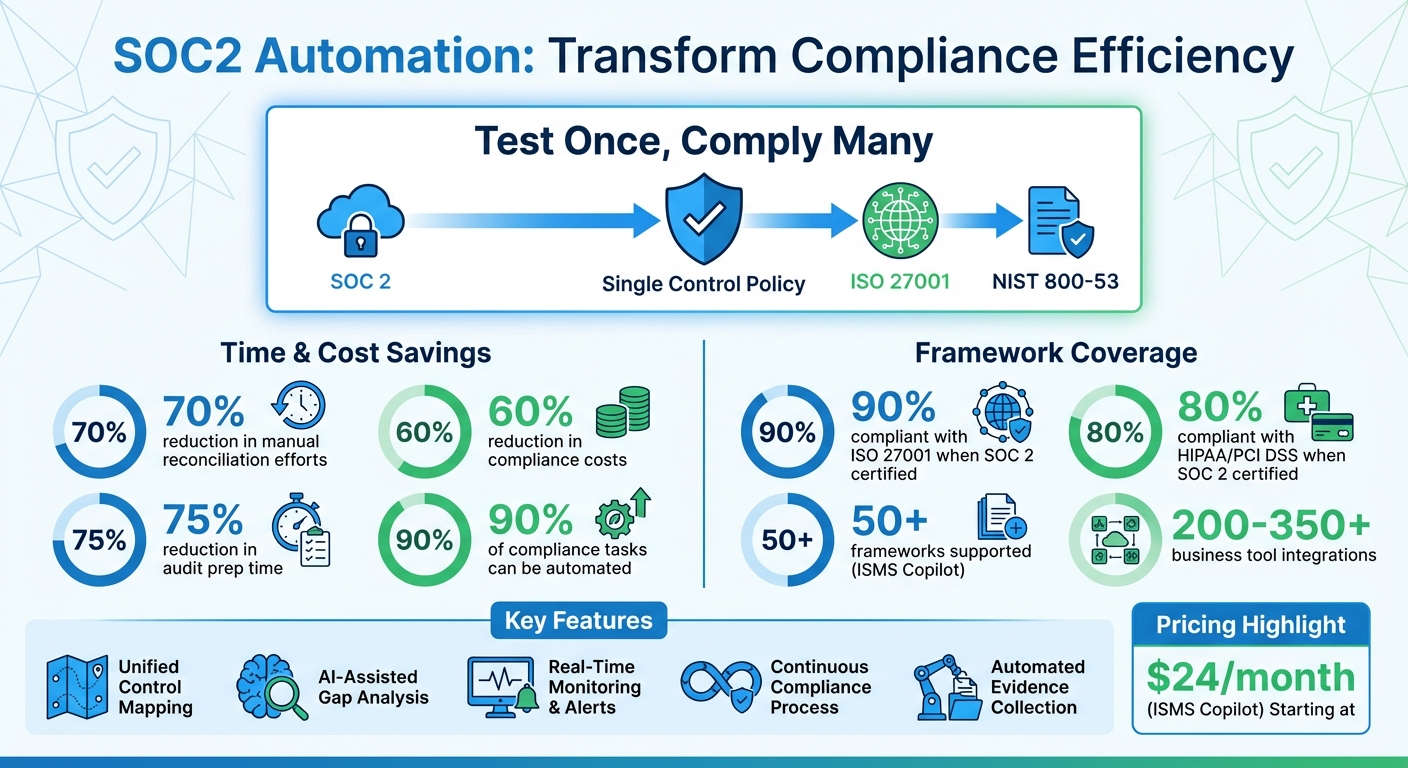
Automate SOC 2 compliance across multiple frameworks like ISO 27001 and NIST 800-53 with unified control mapping, cutting manual reconciliation by up to 70%.

SOC 2 compliance can be a time-consuming challenge, especially when managing multiple frameworks like ISO 27001 or NIST 800-53. The good news? Automation tools now allow you to "test once, comply many" by mapping overlapping requirements across frameworks, cutting manual reconciliation efforts by up to 70%. These tools transform compliance into a continuous process, keeping controls monitored and evidence ready for audits.
Key takeaways:
- Unified Control Mapping: A single access control policy can meet requirements across SOC 2, ISO 27001, and NIST 800-53.
- Time & Cost Savings: Automation reduces compliance costs by 60% and audit prep time by 75%.
- AI-Assisted Gap Analysis: Tools like ISMS Copilot use AI to identify gaps, map controls accurately, and ensure audit readiness.
- Real-Time Monitoring: Alerts and updates keep compliance on track without last-minute chaos.
ISMS Copilot stands out with features such as AI-driven policy drafting, support for 20+ frameworks, and EU-based GDPR-compliant data storage. Starting at just $20/month, it simplifies compliance for organizations of all sizes. Other tools also offer cross-framework integration, real-time alerts, and automated evidence collection, ensuring efficient compliance management.
1. ISMS Copilot
Multi-Framework Integration
ISMS Copilot simplifies compliance with its "Build Once, Comply Everywhere" strategy. By identifying overlapping requirements across frameworks like SOC 2, ISO 27001, and NIST 800-53, it creates a unified control set, removing the hassle of drafting separate policies for each standard.
The platform supports 20+ frameworks, including SOC 2, ISO 27001, NIST CSF 2.0, GDPR, DORA, and NIS2. It also allows users to set up client-specific or audit-specific Workspaces, keeping audit trails organized for each certification project.
Automation Features
With ISMS Copilot, drafting policy documents becomes a breeze. The AI generates framework-specific first drafts in minutes, leveraging Retrieval-Augmented Generation (RAG). Unlike general AI tools, this approach draws from a specialized library built on real-world compliance knowledge from hundreds of consulting projects. This ensures accurate, up-to-date guidance and avoids the risk of "hallucinating" irrelevant or incorrect information.
"Our AI doesn't search the whole internet. It only uses our own library of real-world compliance knowledge. When you ask a question, you get a straight, reliable answer." - ISMS Copilot
Users can upload files like PDFs, DOCX, and XLS—even lengthy reports over 20 pages—for automated gap analysis. The AI scans these documents to spot compliance gaps and checks how existing evidence aligns with multiple frameworks. This automated process ensures precise control mappings, saving time and boosting audit readiness.
Control Mapping Accuracy
ISMS Copilot excels in delivering accurate, audit-ready control mappings. When referencing specific framework sections (e.g., "SOC 2 CC6.2" or "ISO 27001 Annex A.8.1"), the platform provides structured, auditor-approved outputs. This level of precision stands out compared to the unstructured responses from general AI tools. Trusted by 1,000+ organizations, ISMS Copilot helps manage requirements across multiple frameworks seamlessly.
| Feature | ISMS Copilot 2.0 | General AI (ChatGPT/Claude) |
|---|---|---|
| Compliance Specialization | Tailored for security frameworks | General-purpose |
| Framework Knowledge | Deep and current (20+ frameworks) | Limited or outdated |
| Data Privacy | Enterprise-grade; data never used for training | Varies; often used for training |
These features ensure compliance tasks are handled with precision and reliability.
Compliance Efficiency
ISMS Copilot turns what used to take months of manual work into a streamlined, continuous process. Its reusable reporting capabilities make compliance more manageable. Starting at $20/month, the platform offers four pricing tiers to accommodate individual consultants, power users, and teams handling large-scale projects. A free trial is available at chat.ismscopilot.com for those who want to explore its capabilities before subscribing.
All data is stored in the EU (Frankfurt) under GDPR compliance. The platform enforces multi-factor authentication and end-to-end encryption, ensuring user data remains secure. Importantly, uploaded documents and user data are never used to train AI models, safeguarding confidentiality throughout the compliance process.
2. Other SOC2 Automation Tools
In addition to ISMS Copilot, there are several SOC 2 automation tools that utilize cross-framework strategies to simplify compliance processes.
Multi-Framework Integration
Many automation platforms use "crosswalks"—automated mappings that identify overlapping requirements across different compliance standards. For example, if an organization is SOC 2 compliant, it is often 90% compliant with ISO 27001 and 80% compliant with HIPAA or PCI DSS.
"Scytale identifies the commonalities – also known as crosswalks – across different compliance frameworks, and maps these overlaps, ensuring that when evidence and documentation is collected for a specific control, it's automatically collected for other applicable frameworks too." – Ronan Grobler, Senior GRC Manager, Scytale
However, challenges arise because different frameworks emphasize varying priorities. SOC 2 focuses on operational effectiveness over a set period, while ISO 27001 requires a formal Information Security Management System (ISMS), including risk registers and internal audits. To bridge these differences, some platforms use the NIST Cybersecurity Framework as a "common control language". This method supports advanced automation features that make compliance management even easier.
Automation Features
Top platforms integrate with 200 to 350+ business tools—such as AWS, GitHub, Okta, and HR systems—to automatically gather logs, configurations, and screenshots, removing the need for manual uploads. These tools also manage policy lifecycles by automating drafting, approvals, and employee attestation tracking using pre-built templates. With continuous monitoring, these platforms provide real-time alerts and execute automated checks to catch control issues before they affect audits. This ensures accurate evidence collection across multiple compliance frameworks.
Control Mapping Accuracy
These platforms rely on AI, refined by audit experience, to enhance evidence mapping accuracy. Using Machine Learning and Natural Language Processing, they can analyze and categorize data from multiple sources, mapping a single document to several related requirements. This reduces the effort required for additional certifications by 70% compared to manual processes.
A critical aspect of accuracy is addressing framework-specific terminology. For instance, SOC 2 uses Trust Services Criteria, while ISO 27001 refers to Annex A controls. Automation tools must align these differences without compromising the quality of auditor-facing outputs. This precision ensures readiness for continuous compliance.
Compliance Efficiency
Automation transforms compliance from an annual rush into a state of continuous readiness. Real-time alerts notify teams immediately when controls fail, enabling quick fixes before auditors step in. Many platforms also include auditor portals with read-only access to organized evidence, simplifying communication and speeding up final reporting. Overall, automation can manage up to 90% of compliance tasks and reduce certification costs by 60%.
Pros and Cons
When exploring the capabilities of SOC 2 automation, it's crucial to weigh its benefits against its limitations. Tools like ISMS Copilot aim to simplify compliance across multiple frameworks, but their effectiveness hinges on proper integration, automation depth, and consistent oversight.
ISMS Copilot: Key Advantages and Trade-Offs
Pros:
- Expert support for 20+ frameworks: Covers SOC 2, ISO 27001, NIST 800-53, NIS 2, DORA, EU AI Act, and more, with cross-framework mapping.
- AI-driven features: Includes policy writing, risk assessments, and audit report generation using Retrieval-Augmented Generation (RAG) tailored for compliance tasks.
- Unified control library: Reduces repetitive work across frameworks, eliminating duplicated effort when the same control evidence satisfies multiple standards.
- GDPR-ready with EU data hosting: Ensures enterprise-grade security and adherence to data protection laws.
- Custom guidance: Offers specific advice for implementers, auditors, and compliance teams.
- Affordable pricing: Starts at $20/month, making it accessible for organizations of varying sizes.
Cons:
- Human oversight is essential: Complex risk issues and AI-generated outputs still require validation by experienced personnel.
- Input quality matters: Poorly structured or incomplete documents can lead to less accurate results from the AI.
- Ongoing monitoring needs: Dedicated staff must manage routine tasks and ensure controls remain operational and effective.
One of the biggest challenges with automation is the human factor. While tools like ISMS Copilot can streamline compliance, they still require people to oversee the process, validate outputs, and handle nuanced risk scenarios. This creates a trade-off between speed and precision. For example, ISMS Copilot's "build once, comply everywhere" approach can reduce costs significantly, but only if its control mappings meet the rigorous standards of auditors across frameworks.
Another potential issue is scalability. Some platforms are better suited for smaller frameworks and may struggle to handle the complexity of enterprise-level, multi-framework compliance. This can lead to costly platform migrations as organizations grow. However, ISMS Copilot's support for 20+ frameworks positions it as a scalable solution for businesses with evolving compliance needs.
Ultimately, the balance lies in leveraging automation's efficiency while maintaining the precision that auditors and regulators demand. By unifying control requirements across frameworks and ensuring accurate, auditor-ready outputs, ISMS Copilot transforms compliance from a burdensome, repetitive task into a more streamlined, ongoing process.
Conclusion
Managing compliance across frameworks like SOC 2, ISO 27001, and NIST 800-53 doesn't have to feel overwhelming. A well-designed automation tool can simplify the process, saving compliance teams up to 60% of their time by streamlining controls and workflows.
ISMS Copilot offers a powerful solution with its consulting-based knowledge base and support for 20+ frameworks. By combining AI-driven gap analysis with continuous evidence collection, it transforms compliance from a stressful, last-minute scramble into a steady, manageable routine. Shifting from manual processes to automation not only reduces costs but also slashes audit prep time significantly.
When selecting a SOC 2 automation tool, it's critical to focus on platforms that map a single control across multiple frameworks. Look for tools that integrate seamlessly with your existing tech stack to automate evidence collection, and ensure they provide structured, audit-ready outputs rather than generic, unverified AI responses.
Start with the most in-demand framework—often SOC 2 for B2B SaaS companies—and build your system with multi-framework support in mind. Early integration with your cloud infrastructure and identity management tools is also essential, as these typically address the majority of compliance controls shared across frameworks.
With ISMS Copilot's pricing starting at just $20/month, even smaller businesses can benefit from automated compliance. The key is choosing a platform that views frameworks as interconnected systems, allowing you to "build once and comply everywhere." This approach reshapes compliance management, making it more efficient and accessible for organizations of all sizes.
FAQs
How do I "test once, comply many" across SOC 2, ISO 27001, and NIST 800-53?
To simplify the process of "test once, comply many" across various frameworks, it's helpful to use unified control mapping and automation tools. These approaches allow you to reuse controls, evidence, and assessments, cutting down on repetitive tasks and making compliance efforts more efficient.
AI-powered tools, such as ISMS Copilot, can handle tasks like control mapping, evidence collection, and keeping updates current. This reduces duplication and saves time. Additionally, using a framework like NIST CSF as a central structure can streamline the process of mapping controls across multiple standards, including SOC 2, ISO 27001, and NIST 800-53.
What integrations should I connect first to automate evidence collection?
To simplify evidence collection, consider using tools that automate processes across multiple frameworks like SOC 2, ISO 27001, and NIST 800-53. By linking your security tools, logs, and asset management systems, you can enable continuous monitoring and real-time data collection. This not only cuts down on manual work but also speeds up audit preparation and ensures precise, automated evidence collection for maintaining compliance.
How do I validate AI-generated control mappings for auditor approval?
Validating AI-generated control mappings is crucial for accuracy and compliance. Tools like ISMS Copilot can help automate the mapping process, ensuring consistency across frameworks. To double-check the results, either manually review the mappings or use integrated validation processes to compare them against standards like SOC 2, ISO 27001, or NIST 800-53.
It's also important to maintain traceability, audit trails, and supporting evidence throughout the process. These records not only help demonstrate proper implementation but also make it easier to gain auditor approval for the mappings.
Related Posts
How AI Enhances Multi-Framework Compliance
AI unifies control mapping, automates evidence collection, and provides real-time monitoring to cut audit prep time and reduce compliance errors.
How Real-Time Alerts Reduce ISO 27001 Non-Compliance Risks
Real-time alerts detect threats fast, cut breach costs and audit failures, and keep ISO 27001 logs tamper-proof for continuous compliance.
AI Accuracy in Security: Specialized vs Generic
Specialized AI beats generic models for security compliance—higher accuracy, fewer hallucinations, and audit-ready documentation for ISO 27001 and GRC.