
AI-Powered GRC Tools for Continuous Testing
Automate evidence collection, control mapping, and real-time monitoring with AI GRC for faster audits and continuous compliance.

AI-Powered GRC Tools for Continuous Testing
AI-powered GRC tools simplify compliance by automating evidence collection, control mapping, and risk identification. These tools integrate AI technologies like machine learning and natural language processing to reduce manual effort, enabling faster audit readiness and continuous testing. Continuous testing, also known as Continuous Control Monitoring (CCM), ensures controls are validated in real time, flagging issues like misconfigurations or expired policies. Advanced systems even offer automated remediation, saving time and reducing compliance risks.
Key insights:
- Faster audits: Modern tools prepare audits in days, not months.
- Efficiency: Organizations report up to 83% less effort on compliance tasks.
- Real-time monitoring: Continuous testing detects and resolves issues instantly.
- Multi-framework support: Map controls across standards like SOC 2, ISO 27001, and GDPR.
Specialized platforms like ISMS Copilot focus on ISO 27001 and related frameworks, offering tailored guidance and audit-ready outputs. Other tools, such as LogicGate Spark AI and TrustCloud, provide broader GRC functionalities with continuous monitoring capabilities. Metrics like audit preparation time, control coverage, and remediation speed highlight the effectiveness of these tools. For compliance teams, adopting AI-driven solutions is becoming essential to meeting regulatory demands efficiently.
Key Features of Effective AI-Powered GRC Tools
Continuous Control Monitoring and Testing
One of the standout advantages of modern AI-powered GRC tools is their ability to monitor continuously, rather than relying on periodic snapshots. Unlike older systems that provided quarterly updates, these advanced tools operate around the clock, scanning cloud infrastructure, access logs, endpoints, and third-party applications. This allows them to detect control drift within minutes instead of weeks or months [7][11].
For instance, when a misconfiguration like a publicly accessible S3 bucket is identified, the system immediately flags it. From there, it follows a structured process: Sense → Decide → Act → Verify. This means it detects the issue, evaluates it against compliance rules, executes a remediation playbook, and then secures tamper-proof evidence of the resolution [7].
How AI Supports Compliance Management
Beyond real-time monitoring, AI simplifies compliance management by automating tasks that previously required significant manual effort. Risk registers, for example, now update in real time using live infrastructure data and threat intelligence, replacing static quarterly reviews [7][11]. If a new vulnerability is discovered or a control fails, the risk score adjusts instantly, eliminating the need for manual recalculations.
AI also transforms compliance documentation. Using natural language processing (NLP) and Retrieval-Augmented Generation (RAG), these tools can draft policies tailored to an organization’s specific tech stack and risk environment. Specialized AI assistants for ISO 27001 provide the necessary expertise to ensure these policies meet strict certification standards. They can even auto-fill security questionnaires using historical control data - cutting tasks that once took days down to mere minutes [1][8][5]. This efficiency boost is significant, with organizations reporting a reduction of 70% to 90% in the time spent on compliance work [5][4].
"Before Scytale, compliance felt like rounding up cats. Today, it is structured, fully visible, and under control. We've reduced internal compliance effort by 83%." - Kevin DeMeritt, CEO, 2X Solutions [8]
Multi-Framework Compliance Support
AI-powered tools also simplify the complexity of adhering to multiple compliance standards. Whether it’s SOC 2, ISO 27001, GDPR, or HIPAA, these tools streamline the process by mapping a single control across multiple frameworks. This dynamic mapping identifies framework-specific gaps while integrating with over 600 systems, including HRIS, DevOps, and cloud infrastructure, to provide broad compliance coverage [1][7][11].
This "map once, comply everywhere" approach is a game-changer for scaling compliance efforts. AI pinpoints existing controls that fulfill requirements across different frameworks, highlighting only the actual gaps. This ensures that pursuing new certifications doesn’t require starting from scratch [7][5].
sbb-itb-4566332
Sprinto: AI-Native GRC Platform for Security Compliance Automation
::: @iframe https://www.youtube.com/embed/9PVSlBB5LpQ :::
ISMS Copilot for Continuous Testing
::: @figure 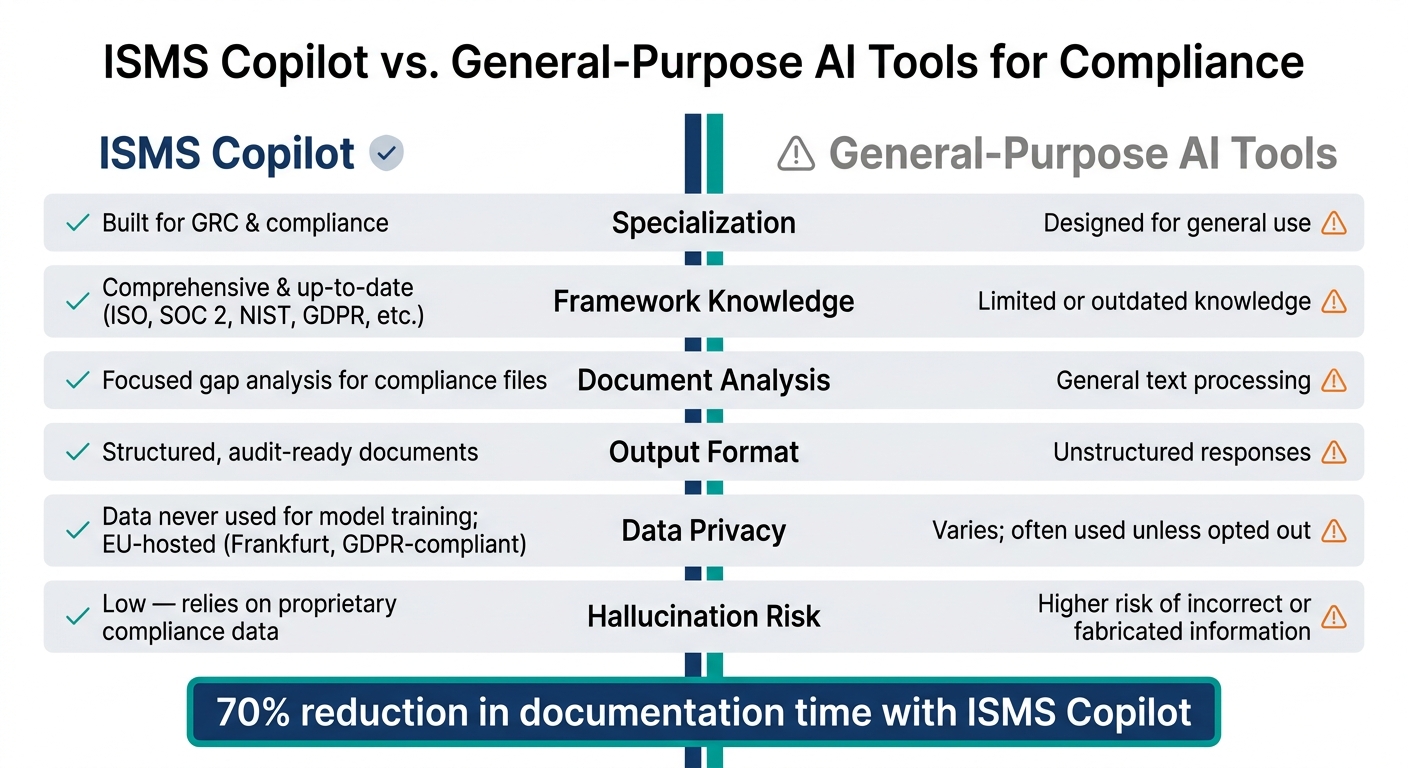 {ISMS Copilot vs. General-Purpose AI Tools for Compliance}
:::
{ISMS Copilot vs. General-Purpose AI Tools for Compliance}
:::
Most AI-powered GRC platforms aim to cover broad compliance management needs, but ISMS Copilot takes a more focused route. It’s a dedicated AI compliance assistant designed specifically for information security frameworks. Think of it as a ChatGPT-like tool, but tailored exclusively for compliance, with expertise grounded in ISO 27001 and related standards.
What Makes ISMS Copilot Different
ISMS Copilot uses Retrieval-Augmented Generation (RAG) technology alongside a proprietary compliance library to provide ISO 27001-specific guidance. Instead of pulling data from the general internet, it relies on a carefully curated database of proven compliance resources, ensuring the guidance it offers is both accurate and practical.
"When you ask a question, you get a straight, reliable answer." - ISMS Copilot [12]
This focus makes a real difference. If you need help with a specific ISO 27001 control or want to map it to NIST 800-53, ISMS Copilot delivers advice rooted in real-world audit scenarios - not just a surface-level summary. The platform supports 50+ frameworks, including SOC 2, GDPR, DORA, NIS 2, and ISO 42001. Its "Build Once, Comply Everywhere" methodology maps a single control across multiple standards, significantly reducing redundant work. This precision makes it an ideal tool for continuous testing, offering audit-ready guidance and keeping compliance efforts up to date.
How ISMS Copilot Enhances Continuous Testing
ISMS Copilot turns compliance from a one-off task into an ongoing process. It can analyze lengthy documents like PDFs, DOCX, and XLS files - no matter how large - to identify control gaps. Within minutes, it drafts audit-ready policies, cutting documentation time by 70%. This efficiency allows compliance teams to spend more time on strategic analysis rather than paperwork. The outputs are structured to meet strict compliance standards, so there’s no need for additional rewrites before submission.
The platform also ensures data organization through separate Workspaces for each client or audit project. This keeps policies, chat histories, and evidence files isolated, preventing any crossover between projects.
ISMS Copilot vs. General-Purpose AI Tools
The differences between ISMS Copilot and general-purpose AI tools become clear when addressing the specific needs of continuous testing in compliance. Here’s how they stack up:
| Feature | ISMS Copilot | General-purpose AI Tools |
|---|---|---|
| Specialization | Built for GRC and compliance | Designed for general use |
| Framework Knowledge | Comprehensive and up-to-date (ISO, SOC 2, NIST, GDPR, etc.) | Limited or outdated knowledge |
| Document Analysis | Focused gap analysis for compliance files | General text processing |
| Output Format | Structured, audit-ready documents | Unstructured responses |
| Data Privacy | Data never used for model training [12] | Varies; often used unless opted out |
| Hallucination Risk | Low; relies on proprietary compliance data | Higher risk of incorrect or fabricated information |
Data privacy is a critical factor for compliance teams. ISMS Copilot stores all data within the EU, specifically in Frankfurt, Germany, under GDPR-compliant controls. It also enforces mandatory MFA and end-to-end encryption [12].
"General AI is amazing tech. But for the detailed, high-stakes work of compliance, you need a specialist." - ISMS Copilot [12]
For teams conducting continuous control testing across multiple frameworks, this specialization isn’t just helpful - it’s the difference between delivering polished, auditor-ready outputs and spending hours fixing incomplete or inaccurate results.
Top AI-Powered GRC Tools for Continuous Testing
These platforms showcase advancements in continuous testing, offering tools and methods designed to simplify compliance processes. While some focus on specialized compliance assistance, others provide broader GRC functionalities with continuous testing features. Here's a closer look at some of the top options.
LogicGate Spark AI
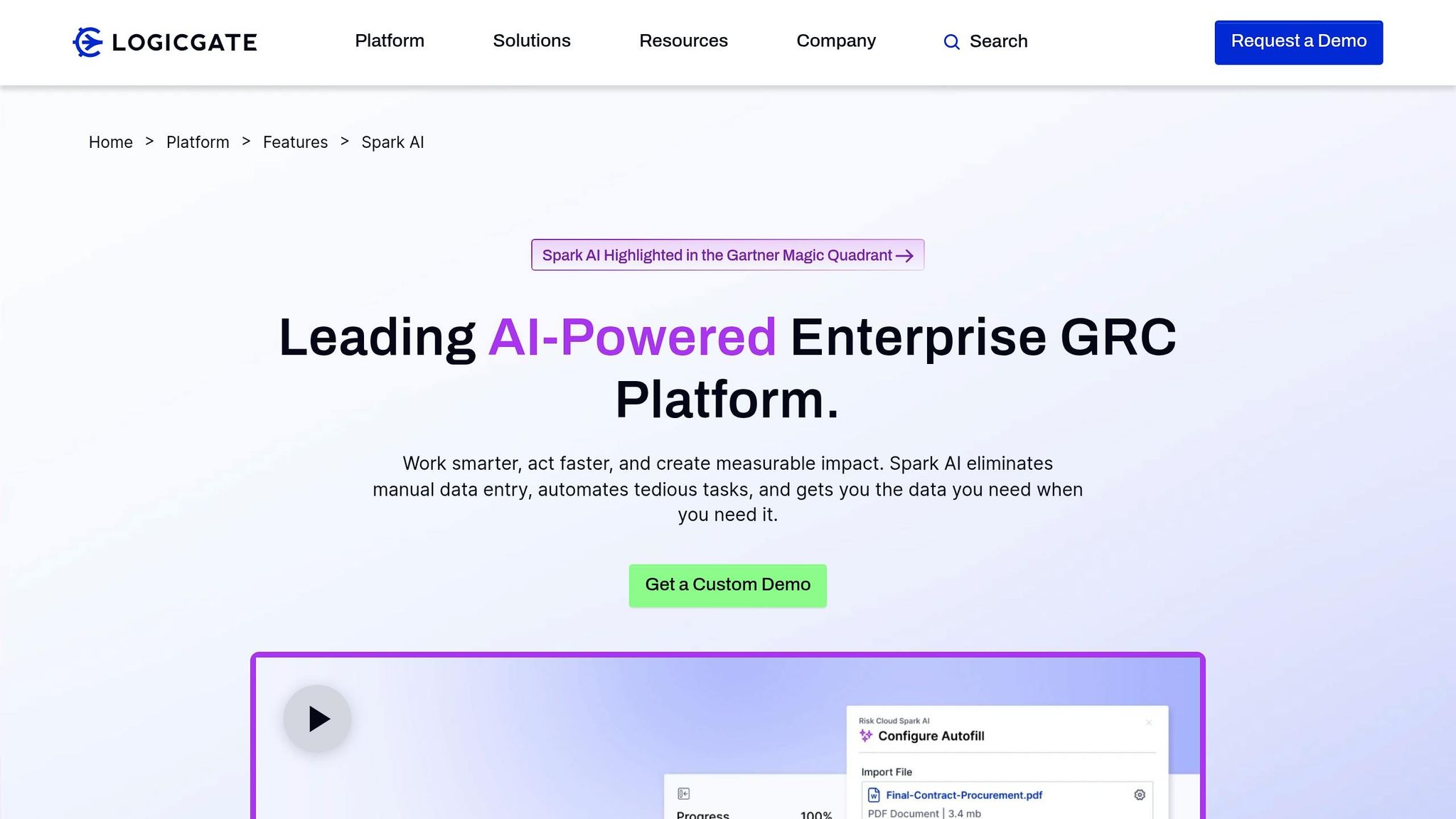
LogicGate's Spark AI integrates with over 30 frameworks, automating tasks like evidence collection and control mapping. It also handles gap analysis and corrective action planning, significantly reducing the manual effort needed to track evidence across compliance requirements. A full release of Spark AI is planned for January 2026, promising to streamline these processes even further.
While LogicGate emphasizes automated control mapping, TrustCloud focuses on continuous data monitoring to maintain audit readiness.
TrustCloud and Continuous Control Monitoring
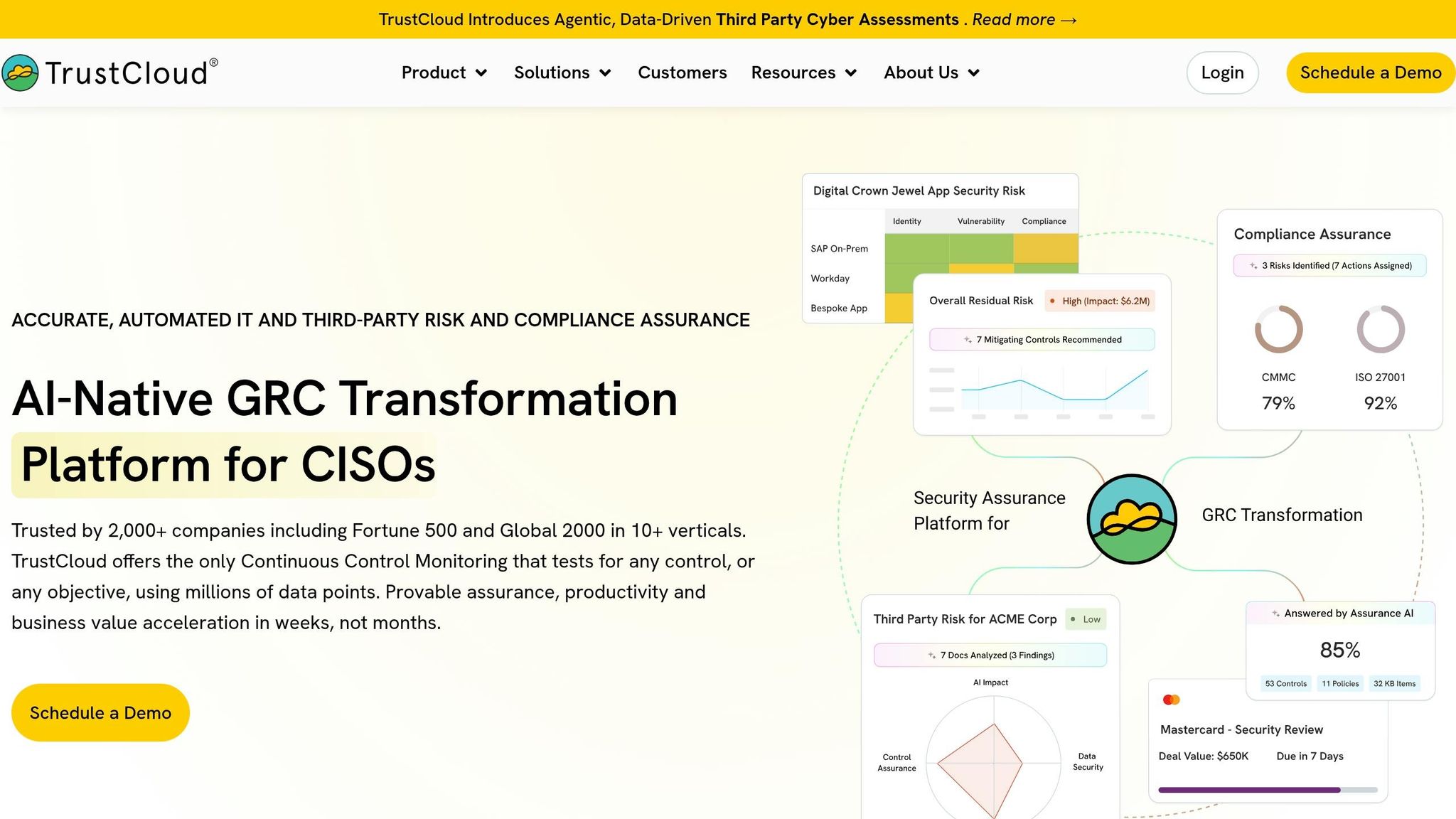
TrustCloud leverages vast amounts of data to support continuous testing. Its Continuous Control Monitoring (CCM) engine evaluates controls using millions of data points, prioritizing precise, programmatic accuracy over simple automation. The TrustOps module provides 24/7 audit readiness by detecting deviations in real-time, flagging any controls that fall out of compliance. For SaaS companies needing to demonstrate their security posture to enterprise clients, this level of live visibility is becoming essential [16][17].
Other Platforms Worth Exploring
Several other platforms bring unique approaches to continuous testing:
- Hyperproof: Offers a library of over 140 pre-built frameworks, reducing redundant work when different standards overlap [13][14].
- SAP: Utilizes Natural Language Processing within its GRC suite, making compliance data more accessible for non-technical users.
- Trustero: Simplifies test procedures by interpreting them in plain language, enabling accurate identification of true control failures while minimizing false positives. This saves audit teams both time and effort [15].
Choosing the right platform depends on factors like the frameworks you use, your team's size, and the level of customization your compliance program requires. As continuous testing evolves, these considerations will play a key role in selecting the most suitable tool for your needs.
Best Practices for Continuous Control Testing
How to Implement Continuous Testing
To get started with continuous testing, integrate your GRC (Governance, Risk, and Compliance) platform with your existing tools - like AWS, Azure, Okta, or Slack - using APIs or browser automation. Once connected, AI agents can automatically map your internal controls to frameworks such as SOC 2, ISO 27001, and GDPR [6][7][3]. From there, the system collects timestamped, tamper-proof evidence from sources like logs, access records, and configurations on an ongoing basis [6][7]. If a control drifts out of compliance, modern platforms can trigger automated remediation workflows to resolve issues, such as fixing misconfigurations or revoking excessive permissions. These workflows often include an option for human-led rollback if necessary [7].
Pro Tip: Start small. For example, pilot your system with a specific focus, like cloud misconfiguration testing or automated board reporting, before scaling it across the entire organization [18].
Governance and AI Oversight
Continuous testing can streamline operations, but it doesn’t replace the need for human oversight. Human judgment is still critical for tasks like regulatory reporting, risk acceptance, and enforcement actions - areas where situational awareness and legal expertise are indispensable [9][18].
Transparency is another must-have. Auditors need to see not just what was flagged but why. Choosing transparent AI systems over black-box models ensures that findings are clear, traceable, and defensible [10].
"XAI allows users to understand, trust, and validate the decisions made by AI systems. In a GRC context, this could mean providing a clear rationale for why a particular transaction was flagged as risky." - MetricStream [10]
Organizations should also establish clear escalation protocols to define when AI-detected anomalies require human review [9]. For regulated environments, maintaining a detailed audit trail is essential. This includes documenting how decisions were made, identifying the data sources used, and noting who validated the results [18]. Frameworks like ISO/IEC 42001 or the NIST AI Risk Management Framework can guide organizations in setting up these accountability measures [9].
Metrics for Measuring Success
To evaluate the effectiveness of continuous control testing, track specific metrics that demonstrate measurable outcomes. Here are the key ones to focus on:
| Metric | What to Measure |
|---|---|
| Audit preparation time | Time reduced from weeks to hours |
| Control coverage rate | Percentage of controls monitored continuously (aim for 98% or higher) |
| Time to remediate | Speed of resolving detected failures (target: minutes, not days) |
| Manual hours saved | Annual hours eliminated from evidence collection and testing |
| Audit findings per cycle | Fewer findings per cycle (e.g., reducing from 12–15 to 0–2) [7] |
| Cross-framework redundancy | Mapping controls across multiple frameworks to reduce duplicated work |
Before launching your system, document your baseline metrics. For example, organizations typically spend around 4,300 hours annually on manual compliance platform maintenance [19]. Having this baseline makes it easier to demonstrate ROI after implementation. When tracking remediation times, aim for resolutions in minutes rather than the days or weeks typical of manual processes [7].
"Trust is the number one thing. Once you have trust that the executive teams believe in the data, believe in the risk you are identifying, then you can have fulsome conversations, you can create change." - Tom Keaton, Vice President of Business & Product Strategy, Diligent [18]
Conclusion: Where AI-Powered GRC Tools Are Headed
The world of compliance is evolving fast. Companies are moving away from the traditional once-a-year audits and embracing 24/7 continuous control monitoring, where AI tools actively scan systems, gather evidence, and flag issues in real time [8][2]. And the benefits are clear: businesses using AI-driven GRC platforms have reported cutting internal compliance efforts by up to 83% [8], while integrated platforms can lower compliance operating costs by an average of 35% compared to pieced-together solutions [19].
But efficiency isn’t the only goal. The focus is shifting toward accountability. The future lies in governed AI - ensuring every AI-powered decision is fully traceable and defensible to meet regulatory demands. As SureCloud aptly notes:
"If you cannot explain to your regulator what the AI did, why it did it, and who approved it, you do not have AI governance - you have AI hope." [20]
This is where specialized tools become essential. While general-purpose AI tools like ChatGPT or Claude can handle broader tasks, they often deliver outdated or incomplete outputs that don’t meet the high standards of compliance work. Purpose-built solutions like ISMS Copilot step in to fill this gap. Designed specifically for information security compliance, ISMS Copilot provides expert-level, audit-ready guidance across over 50 frameworks, including ISO 27001, SOC 2, NIST 800-53, DORA, and the EU AI Act. Starting at just $20/month, it’s a practical option for teams of all sizes.
Compliance is no longer a periodic task - it’s becoming a continuous, real-time effort. Companies adopting AI-powered GRC tools now will gain a significant edge, enabling them to demonstrate their security posture instantly, meet regulatory demands, and streamline operations.
"The difference between a 'good' company and a 'trusted' company in 2026 is the ability to prove security in real-time." - Enactia [21]
FAQs
::: faq
How does continuous control monitoring actually work?
Continuous control monitoring (CCM) leverages technology to keep a close eye on the effectiveness of security, compliance, and risk controls - either in real-time or very close to it. By automating the collection and analysis of evidence across various systems, CCM can quickly identify issues like control failures or deviations from established policies. This means problems are caught and addressed much faster.
CCM also improves visibility into your systems, cuts down on manual work, and simplifies audits. By integrating directly with IT infrastructure, it continuously monitors things like system access, changes, and compliance, making the entire process more efficient. :::
::: faq
What should we automate first for continuous testing?
Automating repetitive, time-intensive tasks such as evidence collection and control testing is a smart first step. These activities are perfect candidates for automation because they simplify compliance workflows, cut down on manual work, and enhance precision. By focusing on these areas, organizations can move away from periodic evaluations and embrace real-time monitoring. This approach not only saves resources but also supports ongoing compliance in today's challenging regulatory landscapes. :::
::: faq
How do we prove AI findings to auditors?
Using AI-powered GRC tools, such as ISMS Copilot, can simplify the process of proving compliance to auditors. These tools are designed to automate tasks like evidence collection and continuous control monitoring.
By working in real-time, they gather, organize, and validate compliance evidence, ensuring that you always have audit-ready records at your fingertips. This approach not only reduces manual effort but also enhances transparency, traceability, and provides clear, verifiable proof of compliance. It also demonstrates that your controls are actively tested and maintained, making the entire audit process far more efficient. :::
Related Posts
The internal audit that never finds anything
ISO 19011 changed edition in May 2026. The failure mode it exists to prevent did not: the internal audit that has, by drift, stopped disagreeing with management.
Under NIS2, "important" is not a lighter security tier
Teams read the important label as NIS2-lite and scope their controls down. The security measures in Article 21 are the same either way; the tier changes supervision, some enforcement tools, and the floor on the national fine maximum.
Your ISO 27001 certificate does not start DORA's clocks
Financial entities keep mapping ISO 27001 controls onto DORA articles and calling the residue paperwork. DORA's real additions are duties that must be performed, to a specification and on a clock, that a certificate was never designed to test.