
Cross-Framework Mapping with Versioned Libraries
Map controls across ISO, SOC 2 and NIST using versioned libraries and automation to save time, reduce errors, and ensure audit traceability.

Cross-Framework Mapping with Versioned Libraries
Managing compliance across multiple frameworks like ISO 27001, SOC 2, and NIST can be overwhelming. The solution? Cross-framework mapping - a method that connects a single internal control to the requirements of several standards. This approach reduces duplicate work by leveraging overlaps (e.g., SOC 2 and ISO 27001 share 40–60% of controls) while ensuring accuracy through version-specific control libraries.
Key Takeaways:
- Version Control Matters: Frameworks evolve (e.g., ISO 27001:2022 vs. 2013), and outdated references can derail compliance efforts.
- AI Tools vs. Manual Methods: Tools like ISMS Copilot automate mapping, saving weeks of manual work, reducing errors, and improving audit readiness.
- Efficiency Gains: Automation cuts mapping time to 30–60 minutes, compared to weeks for manual approaches, and can save mid-sized companies $300K–$620K over five years.
For compliance teams juggling multiple frameworks, tools like ISMS Copilot simplify the process by maintaining version-specific references, automating evidence collection, and ensuring audit traceability. The result? Faster, more reliable compliance mapping with reduced costs and risks.
Mastering Control Cross-Mapping for Enhanced Compliance
::: @iframe https://www.youtube.com/embed/4RXJPdZ5L6o :::
For professionals managing multiple frameworks, you can streamline compliance for consulting clients to maintain consistency across ISO 27001 and SOC 2 audits.
1. ISMS Copilot
ISMS Copilot takes on the challenges of cross-framework mapping with a solution that's designed to be precise and version-specific. Unlike generic AI tools, it uses dynamic knowledge injection, a proprietary system that detects framework references during conversations and provides curated, framework-specific information like controls, clauses, and mappings [9]. Whether you're discussing ISO 27001:2022 or SOC 2, the tool relies on verified, versioned reference files instead of guesswork.
Automation of Mapping Processes
The mapping process is streamlined into six clear phases: selecting a framework, scanning workspaces for existing assessments, generating a matrix, conducting a gap analysis, drafting an executive summary, and performing programmatic validation [1]. The final step features a check_cross_compliance_coverage tool that ensures every row in the matrix is complete, flagging any gaps. This automation delivers a first draft matrix in just 30–60 minutes, a dramatic improvement compared to the weeks or months manual methods typically require [1]. This efficiency also supports precise version control and smooth handling of updates.
Version Control and Change Management
One of the standout features of ISMS Copilot is its ability to avoid common errors seen in generic AI tools, such as confusing ISO 27001:2013 (114 controls) with the updated 2022 version (93 controls). It achieves this by relying on version-pinned reference files, ensuring accuracy [1]. When a framework is updated, GRC engineers update the central knowledge base, automatically providing users with the latest information - no need for manual spreadsheet updates.
"Version tracking: Framework knowledge is versioned (e.g., ISO 27001:2022 vs. 2013) to ensure users get current standards." - ISMS Copilot Help Center [9]
Scalability for Multi-Framework Programs
Currently, ISMS Copilot supports 14+ compliance frameworks, including ISO 27001:2022, SOC 2, GDPR, NIST CSF, and DORA [9]. The overlap between frameworks is a major advantage; for example, around 80% of SOC 2 criteria align with ISO 27001 controls, which reduces duplication by 40–60%. This efficiency can save mid-sized companies between $300,000 and $620,000 over five years [10].
Auditability and Traceability
Audit readiness is another key focus. Every output - whether it's a mapping matrix, gap report, or executive summary - includes citations tied to the correct version of each standard [9]. This makes it easy for auditors to trace any control back to its specific clause, eliminating the need for additional cleanup. Below is an example of how a sample output might look [1]:
| ISO 27001:2022 ID | Title | SOC 2 TSC | GDPR |
|---|---|---|---|
| A.5.1 | Policies for info security | CC1.1, CC1.2, CC5.3 | Art. 24, Art. 32 |
| A.5.24 | Incident management | CC7.3, CC7.4 | Art. 33 |
| A.5.34 | Privacy and PII | P1.1, P2.1, P3.1 | Art. 5, 6, 7, 9 |
| A.8.10 | Information deletion | CC6.5, P4.2 | Art. 5, Art. 17 |
2. Manual Mapping Approaches
Unlike AI-driven, versioned mapping, manual cross-framework mapping relies heavily on spreadsheets or "controls-as-code" methods. These traditional approaches highlight why version control is such a persistent challenge. Without automation, organizations often face significant hurdles related to scalability, auditability, and maintaining up-to-date mappings.
Automation of Mapping Processes
Traditional manual mapping lacks any form of automation. Compliance analysts or consultants painstakingly align control IDs from different frameworks using spreadsheets. This process can take weeks - or even months - of detailed research. The result? A fragile system that heavily depends on specific individuals. This vulnerability is why many teams are transitioning to a specialized AI assistant to maintain continuity. If one of these key contributors leaves, maintaining the system becomes nearly impossible [1].
"A spreadsheet of framework codes cross-referenced to each other is not a mapping; it is a shopping list." - Vektor AI [7]
Version Control and Change Management
Some teams attempt to manage version control using YAML or JSON files, utilizing Git-style branching and tagging. When frameworks are updated, these teams revise mappings on version-controlled branches, merging changes only after approval from security and compliance leads. While this approach is effective for disciplined teams, many organizations struggle to maintain such rigor. Without consistent upkeep, outdated references can quickly erode the accuracy of mappings [5].
Scalability for Multi-Framework Programs
Scaling manual mapping across multiple frameworks is both time-consuming and expensive. For example, covering frameworks such as SOC 2, ISO 27001, and NIST can cost organizations over $100,000 on a global scale [8][11]. This makes manual methods increasingly impractical for large-scale compliance programs.
Beyond the financial burden, maintaining audit readiness adds another layer of complexity to manual mapping systems.
Auditability and Traceability
Auditability in manual mapping depends entirely on the rigor applied during its creation. To ensure reliability, every relationship must be classified explicitly - whether it's Identical, Equivalent, Overlapping, or Distinct. Misclassifications, such as labeling an "Overlapping" relationship as "Identical", are a common source of audit issues [7]. Additionally, each mapping should include a rationale and a version-specific reference (e.g., "ISO 27001:2022, Clause A.5.1") to allow auditors to verify the cited standard's exact edition [6].
"A mapping is not a one-time artifact; it is a relationship that needs maintenance." - Vektor AI [7]
Pros and Cons
::: @figure 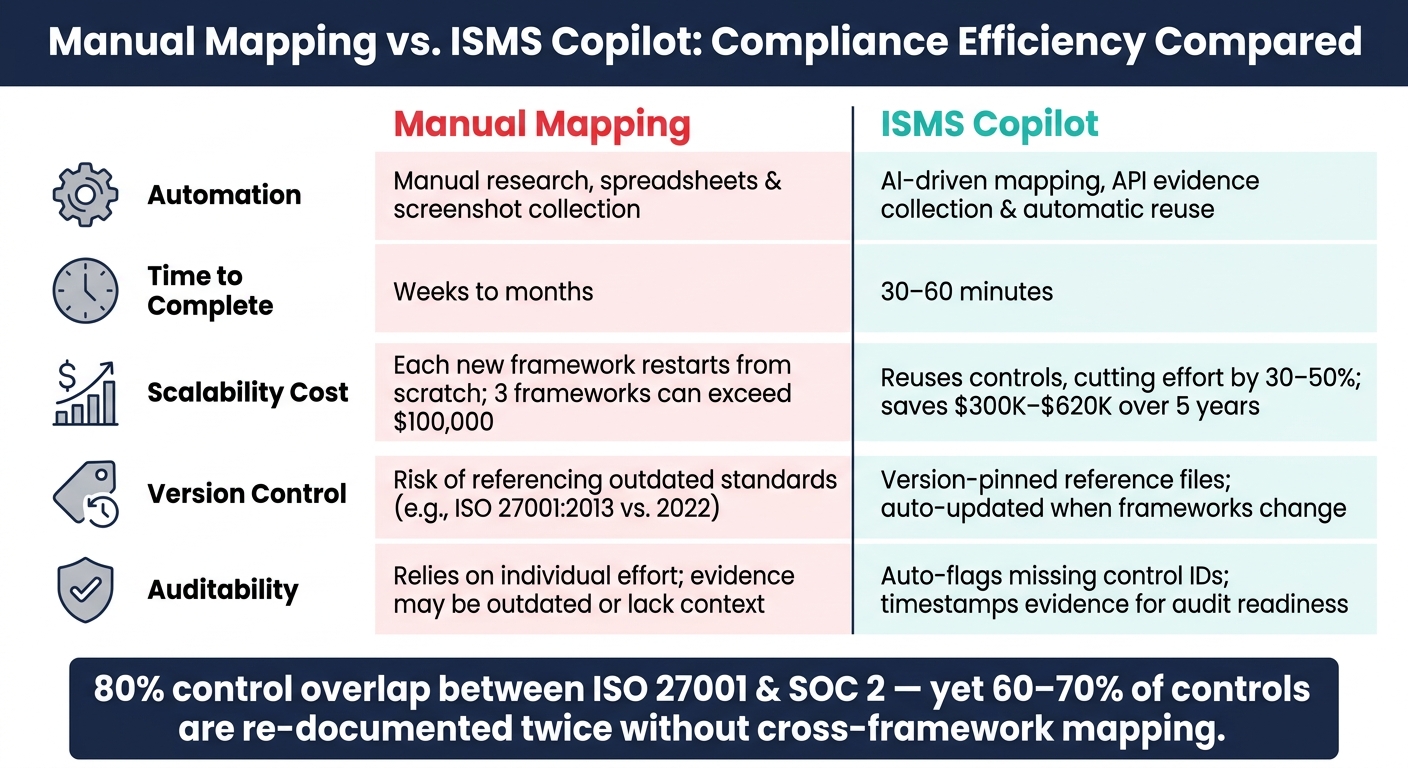 {Manual Mapping vs. ISMS Copilot: Compliance Efficiency Compared}
:::
{Manual Mapping vs. ISMS Copilot: Compliance Efficiency Compared}
:::
Both methods achieve compliance but differ in terms of time, cost, and risk, requiring multi-framework compliance best practices to manage effectively. Here's a side-by-side look at how manual mapping compares to ISMS Copilot across key criteria:
| Criterion | Manual Mapping | ISMS Copilot |
|---|---|---|
| Automation | Relies on manual research, spreadsheet updates, and screenshot collection [1][12] | Uses AI for mapping suggestions, API-based evidence collection, and automatic evidence reuse across frameworks [1][4] |
| Version Control | Risks "version hallucination", such as referencing outdated standards (e.g., ISO 27001:2013 vs. 2022) [1] | Maintains version-pinned files to keep references updated and track changes clearly [5][1] |
| Scalability | Each new framework adds a similar workload; mapping three frameworks could exceed $100,000 globally [8] | Reuses controls, cutting effort for additional frameworks by 30%–50% [12] |
| Auditability | Relies on individual effort; evidence may become outdated or lack necessary context [12] | Flags missing control IDs and timestamps evidence for audit readiness automatically [1][12] |
Key Differences in Detail
Scalability is one of the most striking contrasts. ISMS Copilot's versioned control system allows it to address 70%–80% of a new framework's requirements upfront, significantly reducing costs [12]. On the other hand, manual mapping starts from scratch with each additional framework, quickly driving up expenses and workload.
However, automation isn't without its challenges. Even the most advanced tools can generate errors, such as misinterpreting data or overlooking evidence in legacy systems [2]. These gaps often require manual intervention and human oversight to resolve.
Conclusion
Mapping ISO 27001 and SOC 2 reveals an 80% control overlap [13], yet many organizations still find themselves re-documenting 60–70% of controls twice [13]. That’s not an efficient compliance strategy - it’s just unnecessary duplication.
Versioned control libraries offer a smarter solution by treating compliance as a dynamic system. When frameworks like NIST CSF or PCI DSS 4.0 release updates, these libraries automatically re-evaluate affected mappings. This eliminates the need for teams to manually track down outdated references [7][5].
"Cross-framework mapping without a tool that understands temporal versioning of both frameworks and controls is extraordinarily painful." - Vektor AI [7]
For U.S.-based organizations juggling multiple frameworks - whether it’s SOC 2 for domestic customers, ISO 27001 for international markets, or FedRAMP for federal contracts - the strategy becomes clear: build a single master control library and map outward from it. If federal alignment is a priority, NIST 800-53 is a strong foundation, as both CMMC and FedRAMP closely align with it [5]. When frameworks have conflicting requirements, adopt the stricter standard to ensure one piece of evidence satisfies multiple audits [13].
Tools like ISMS Copilot make this process far more manageable. By combining version-pinned reference files with AI-driven gap analysis across more than 50 frameworks, ISMS Copilot can reduce the time needed to create a cross-framework matrix from weeks of manual work to just 30–60 minutes [1]. This is a game-changer for lean security teams under tight audit deadlines.
"If you're collecting the same evidence three times for three frameworks, you're doing it wrong." - Justin Leapline, episki [3]
FAQs
::: faq
What is a versioned control library?
A versioned control library is a structured system designed to track an organization's security controls as they evolve across various compliance frameworks. Unlike traditional static spreadsheets, this dynamic system automatically updates mappings whenever frameworks are revised, ensuring everything stays accurate and up to date. Tools like ISMS Copilot make this process even more efficient by helping you pinpoint gaps and reuse evidence across frameworks such as ISO 27001, SOC 2, and NIST. This approach not only saves time but also significantly cuts down on the manual effort involved in remapping. :::
::: faq
How do I choose a “master” framework to map from?
Selecting a master framework hinges on your specific business goals, regulatory obligations, and timelines. Begin by pinpointing any mandatory frameworks, such as SOC 2 or ISO 27001, and rank them based on their impact and how urgently they need to be addressed.
To simplify the process:
- Leverage a unified control library to manage overlapping requirements.
- When frameworks conflict, always default to the strictest rule to stay compliant.
- Keep track of framework versions (e.g., ISO 27001:2022) to ensure you're working with the most up-to-date standards.
For added efficiency, tools like ISMS Copilot can help streamline the mapping process and maintain consistency across multiple frameworks. :::
::: faq
How do I validate AI-generated mappings before an audit?
To ensure AI-generated mappings are reliable, focus on making them clear, supported by evidence, and version-controlled. Carefully assess whether the relationships they establish are equivalent, overlapping, or entirely separate - this helps prevent complications during audits.
Involve cross-functional teams, such as those from security, legal, and audit departments, to thoroughly review the accuracy of these mappings. Tools like ISMS Copilot can be particularly helpful, as they provide audit-level insights by tying mappings to versioned framework requirements. Lastly, bring in a second reviewer to double-check that the logic aligns well with your specific control environment. :::
Related Posts
NIS2 does not bind your company. Your national law does.
Directive (EU) 2022/2555 addresses Member States, not undertakings. The fines, the reporting clocks and the authority you answer to are written in national law, and those laws arrived on twenty-seven different calendars.
The internal audit that never finds anything
ISO 19011 changed edition in May 2026. The failure mode it exists to prevent did not: the internal audit that has, by drift, stopped disagreeing with management.
Under NIS2, "important" is not a lighter security tier
Teams read the important label as NIS2-lite and scope their controls down. The security measures in Article 21 are the same either way; the tier changes supervision, some enforcement tools, and the floor on the national fine maximum.