
How NLP Improves ISO 27001 Audit Accuracy
How NLP automates clause mapping, detects documentation gaps, and standardizes terminology to boost ISO 27001 audit accuracy.

How NLP Improves ISO 27001 Audit Accuracy
Natural Language Processing (NLP) transforms ISO 27001 audits by automating documentation tasks, reducing errors, and saving time. Here's how it works:
- Automates Repetitive Tasks: NLP maps controls, identifies documentation gaps, and standardizes terminology, eliminating manual errors.
- Saves Time: Tools like ISMS Copilot can analyze up to 1,500 pages of documentation in a single session, cutting down human review time by 65–85%.
- Improves Consistency: NLP ensures uniform language across policies, procedures, and evidence, addressing common audit failures like outdated or mismatched documentation.
- Enhances Gap Detection: It flags missing documents, outdated versions, and conflicts, helping organizations prepare for audits more effectively. This is a critical part of the essential steps to ISO 27001 certification.
Real-world example: In 2025, Talk Think Do used an AI-powered agent to save 65+ hours on an ISO 27001:2022 recertification project, achieving reaccreditation with zero non-conformances.
Documentation Challenges That Hurt ISO 27001 Audit Accuracy
Inconsistent Terminology and Control Mapping
When terminology varies across documents, it creates a major challenge during audits. If policies, procedures, and risk registers don't use consistent language, mapping them to specific Annex A controls becomes a tedious and error-prone process. For example, a policy might refer to an outdated ticketing system while the actual evidence reflects the use of a newer platform. This mismatch creates a conflicting paper trail, raising questions about the organization's control environment.
"A control that is working correctly but documented inaccurately creates the same audit risk as a control that isn't working at all." - Ali Aleali, Co-Founder & Principal Consultant, Truvo Cyber [6]
Another issue is incomplete approval details. When policies simply state "Approved by Policy Owner" without specifying a name or date, they fail to meet the formal accountability required by Clause 5.2 and A.5.1 of ISO 27001.
Missing Documents and Outdated Versions
Inconsistent terminology is just one piece of the puzzle; outdated or missing documents add another layer of complexity. Versioning issues, such as multiple copies of the same policy, can lead to "version drift." This forces auditors to spend extra time verifying which version of a document was active during a specific period, often delaying Stage 1 reviews.
"Evidence screenshots that were accurate in 2024 are still sitting in the platform in 2026, showing a tool that was retired, a process that changed, or a person who is no longer in the role." - Truvo Cyber [6]
While automated evidence, like MFA enforcement logs from platforms like Okta or AWS, stays up-to-date without manual intervention, manual records such as policy documents, approval logs, and screenshots require constant maintenance. Utilizing an ISO 27001 toolkit can help streamline this maintenance through standardized templates. These manual elements often become the source of discrepancies during audits.
Limits of Human Reviewers
ISO 27001:2022 introduces 93 controls across four themes, along with management system requirements outlined in Clauses 4 through 10 [7]. The sheer volume of these requirements makes manual tasks like clause mapping and gap analysis prone to human error.
As Akitra highlights, "NLP automates the extraction of data, classification, and analysis, reducing errors, ensuring compliance with regulations, and reducing pressure on employees." [4] By automating these repetitive tasks, NLP tools help ensure documentation accuracy and consistency, paving the way for smoother audits and better compliance outcomes.
How NLP Fixes Documentation Accuracy in ISO 27001 Audits
Automated Document Classification and Mapping
Natural Language Processing (NLP) simplifies the classification of policy documents, procedures, and evidence files by analyzing text, recognizing document structures, and aligning content with ISO 27001 Annex A controls and related frameworks. It works across structured, semi-structured, and unstructured documents - including scanned PDFs using OCR technology - cutting down on manual labor and reducing redundancy in compliance efforts [8][4][9]. Whether it’s a structured template, a semi-structured invoice, or an unstructured contract, NLP extracts and categorizes content effectively for each type.
The benefits are clear: organizations using an AI-driven ISO 27001 copilot for clause mapping and gap analysis report saving substantial time on manual tasks while improving the quality of their audit results [2].
"Using AI to strengthen ISO 27001 compliance means handing the repetitive work (clause mapping, gap analysis, register generation) to a private Azure OpenAI agent trained on your existing information security management system." - Louise Clayton, Talk Think Do [2]
Terminology Standardization and Coverage Analysis
In addition to classification, NLP ensures consistent terminology across all documentation. This is crucial because inconsistent language - where teams use different terms for the same control - can create confusion during audits. By using semantic techniques like BERT and word embeddings, NLP recognizes that terms such as "access revocation", "account deprovisioning", and "user offboarding" describe the same process. This consistency reassures auditors that controls are clearly and uniformly documented throughout the Information Security Management System (ISMS) [8][4].
Advanced NLP models can handle massive amounts of data, analyzing up to 1,500 pages of documentation in one go. In contrast, manual classification often results in error rates ranging from 1% to 5% [9][8].
Gap Detection and Conflict Resolution
NLP doesn’t stop at classification and standardization - it also identifies gaps and resolves conflicts in documentation. By comparing existing materials against ISO 27001:2022 requirements, it flags missing mandatory documents, detects inconsistencies between policies, and identifies evidence drift. This proactive approach helps organizations avoid audit discrepancies before they happen [5][10].
"AI can... compare a new artifact against a prior month's artifact and flag drift. It can identify the part of a CloudTrail, GitHub, IdP, ticketing, or scanning output that matters to a specific control owner." - Penligent [10]
Building an NLP-Powered ISO 27001 Audit Workflow
::: @figure 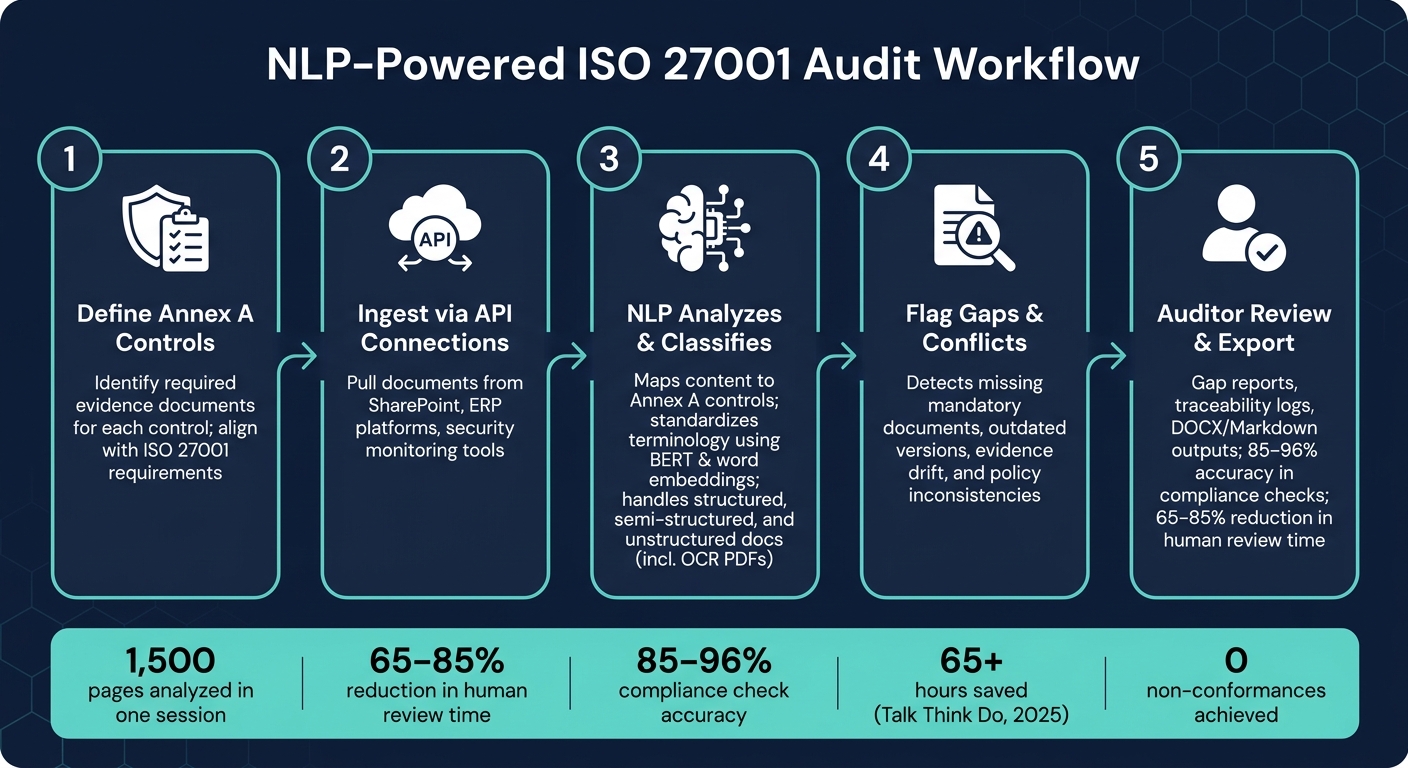 {NLP-Powered ISO 27001 Audit Workflow: Step-by-Step}
:::
{NLP-Powered ISO 27001 Audit Workflow: Step-by-Step}
:::
Step-by-Step Audit Workflow Overview
Incorporating NLP into your ISO 27001 audit process begins with a solid foundation: defining the Annex A controls you’ll be testing and identifying the evidence documents required for each. This initial step ensures that everything downstream aligns with ISO 27001 requirements, creating a process that is both accurate and repeatable [11].
From there, automated ingestion takes over. Documents are retrieved via API connections to your existing systems - like SharePoint, ERP platforms, or security monitoring tools. NLP models then analyze the content, checking if it meets the mapped requirements and flagging inconsistencies where necessary [11][12].
The final output includes gap reports, traceability logs, and flagged items for auditor review. This approach doesn’t just streamline the process; it delivers 85–96% accuracy in compliance checks and reduces the time spent on human review by 65–85% [11].
"AI supports evidence collection procedures within parameters practitioners establish in order to save managers hours of time." - Amanda Waldmann, Fieldguide [11]
To minimize risk and build confidence, start small. Focus on a specific use case - like password control tests or mapping policies to clauses using an AI ISO 27001 implementation assistant - before scaling up to a broader deployment [11].
Human Oversight and Explainability
Even with AI assistants for ISO 27001, human judgment is essential. Auditors must review the NLP outputs, conduct interviews, and observe operations to validate findings. This ensures the audit doesn’t fall into the trap of “paper-only” compliance [13].
Transparency is equally important. If the system flags an issue or links a document to a control, auditors need to understand the reasoning. Tools like SHAP (SHapley Additive exPlanations) and LIME (Local Interpretable Model-agnostic Explanations) help by connecting outputs to their inputs [12][14].
"If you can't explain the problem clearly enough for someone to fix it, you haven't done your job. Specific, actionable feedback transforms audit findings from frustrations into roadmaps for improvement." - Khawaja Faisal Javed, Senior Manager Operations & Digital Trust Lead Auditor, SGS Pakistan [13]
This isn’t just a best practice - it’s becoming a regulatory requirement. The EU AI Act’s Article 14, effective August 2, 2026, mandates that high-risk AI systems allow qualified personnel to intervene, override, or stop AI decisions [11].
Data Security and Governance Considerations
Handling sensitive security documentation securely is critical. When NLP is part of the workflow, it becomes part of your risk surface. Here are some key considerations:
- Prompt injection: Adversarial inputs can manipulate NLP models and compromise outputs. To counter this, every NLP tool should undergo adversarial testing and include prompt validation. A real-world example: in July 2025, a compromised version of Amazon Q Developer (CVE-2025-8217) impacted an estimated 1 million developers due to an overly permissive GitHub token [12].
Beyond securing the tool itself, governance over the entire model lifecycle is crucial. This includes protocols for data handling, secure model training, deployment controls, drift monitoring, retraining, and secure decommissioning to ensure no residual data remains [12]. For U.S. organizations, aligning with frameworks like NIST AI RMF and ISO/IEC 42001:2023 provides a strong governance structure [12][14].
"Explainability is critical. IS auditors should favor transparent AI models in which outcomes can be traced back to inputs." - ISACA [14]
Another challenge is semantic drift. As regulatory language evolves - whether through updated ISO controls, new NIST guidance, or changes in terminology - NLP models trained on outdated data can lose accuracy. Regular performance monitoring and retraining triggers are essential to keep the system reliable [12].
How ISMS Copilot Supports NLP-Powered ISO 27001 Audits
ISMS Copilot builds on the strengths of NLP to bring precision and depth to ISO 27001 audits, specifically by focusing on the unique demands of compliance.
Why Domain-Specific NLP Tools Outperform General-Purpose AI
While general-purpose AI tools like ChatGPT and Claude are designed for versatility, they often fall short when it comes to the detailed requirements of ISO 27001. ISMS Copilot, on the other hand, taps into a curated library of compliance expertise, making it a better fit for audit-specific tasks [3].
"Usually GPT makes stupid mistakes, Claude simplifies too much. ISMS Copilot offers detailed, audit-aware guidance." - Joe, ISO 27001 Professional [3]
This difference matters in practice. For example, asking a general AI to match a policy to ISO 27001:2022 Annex A.8 might produce a plausible response but miss critical details. In contrast, ISMS Copilot tailors its output to align with what auditors expect.
ISMS Copilot Features That Improve Audit Accuracy
ISMS Copilot’s Think Mode is a standout feature. With a 1-million-token context window powered by Claude Opus 4.6, the tool can process around 700,000–800,000 words in one session - equivalent to roughly 1,500 pages of documentation [9]. Given that most ISO 27001 policy documents are only 15–20 pages long (10,000–15,000 tokens), this capacity allows auditors to review entire ISMS documents without splitting them into smaller parts.
In addition to its capacity, ISMS Copilot addresses common challenges in manual reviews. It identifies inconsistencies between policy versions, flags outdated terms, and highlights gaps in compliance with Annex A controls. The platform also generates outputs in Markdown or DOCX formats, ready for audits [3][9]. For organizations juggling multiple frameworks - like SOC 2 and NIST CSF 2.0 - ISMS Copilot’s cross-mapping capabilities simplify compliance by aligning overlapping controls [1][15].
| Capability | What It Does |
|---|---|
| Think Mode (1M token context) | Analyzes up to 1,500 pages of documentation in one session |
| Gap Analysis | Maps uploaded policies against ISO 27001:2022 requirements |
| Ambiguity Detection | Flags conflicting statements and outdated terminology |
| Multi-Framework Mapping | Cross-maps ISO 27001 controls to SOC 2, NIST CSF, NIS2, and more |
| Audit-Ready Outputs | Generates structured DOCX/Markdown drafts and evidence request lists |
"ISMS Copilot saves time by identifying documentation gaps and streamlining the Risk Treatment Plan." - John Gilchrist, IT Audit Manager, Airline Industry [3]
These capabilities are designed to integrate smoothly into compliance processes in the U.S.
How U.S. Organizations Can Use ISMS Copilot
U.S. companies can use ISMS Copilot to simplify compliance tasks while ensuring accuracy and consistency in their documentation.
A good first step is to use workspace segregation. For example, creating separate workspaces for ISO 27001 certification and SOC 2 Type II audits ensures the NLP model stays focused on the specific requirements of each initiative [3][9].
For teams managing overlapping frameworks, ISMS Copilot’s harmonization features are invaluable. By identifying controls that meet both ISO 27001 and NIST CSF 2.0 requirements, organizations can minimize duplicate work. Additionally, the platform supports over 69 frameworks across 14 jurisdictions, making it a versatile tool for businesses that also need to address standards like HIPAA or the NIST AI Risk Management Framework [3].
The pricing is straightforward: the Plus plan starts at $20/month and includes Think Mode, and every paid plan includes 500 file uploads per month under a fair use policy. Larger teams can opt for the Business plan at $200/month, with plans scaling by AI usage and model quality [3].
Conclusion: What NLP Means for ISO 27001 Audit Accuracy
Manual ISO 27001 audits often struggle with common pitfalls: auditors grow fatigued, miss key connections across extensive document sets, and sometimes apply terminology inconsistently. NLP tackles these challenges head-on by automating tasks like clause mapping, gap detection, and terminology standardization. This shifts the auditor's focus from searching for errors to analyzing and resolving them.
The results speak for themselves. In July 2025, Talk Think Do implemented an AI Copilot agent for gap analysis and register generation during their ISO 27001:2022 recertification. The outcome? They saved over 65 hours on a 240-hour project and secured a three-year reaccreditation with zero non-conformances [2].
"AI can't replace governance, context or judgement, especially in a standard as nuanced as ISO 27001. But when trained appropriately, it can dramatically accelerate the process." - Louise Clayton, Talk Think Do [2]
This example highlights a critical takeaway: automated tools handle repetitive, high-volume tasks, allowing auditors to focus on interpretation and decision-making. For U.S.-based organizations juggling multiple frameworks like SOC 2, NIST CSF 2.0, or HIPAA alongside ISO 27001, this division of labor is especially beneficial.
NLP also proves to be an accessible investment for organizations of all sizes. For instance, ISMS Copilot's Plus plan starts at just $20/month, offering tools like Think Mode and 500 file uploads per month (fair use). This setup enables comprehensive ISMS gap analysis without the hassle of splitting files or losing context [9]. By addressing inconsistencies in documentation and streamlining audit workflows, NLP enhances accuracy and strengthens the foundation of effective information security management.
FAQs
::: faq
What documents should I prioritize for NLP review before an ISO 27001 audit?
When preparing for an ISO 27001 audit, it's essential to thoroughly review your Information Security Management System (ISMS) documentation. This includes policies, procedures, risk assessments, and control records. Auditors will carefully evaluate these documents to ensure they are clear, consistent, and fully aligned with ISO 27001 standards.
Pay attention to details like whether your risk assessments accurately reflect potential threats and if your controls are documented in a way that demonstrates compliance. Well-organized and precise documentation can make a significant difference during the audit process. :::
::: faq
How do I validate NLP audit findings so they hold up with auditors?
To make sure NLP audit findings stand strong during audits, it's crucial to ensure they're accurate, backed by evidence, and aligned with your ISMS controls and policies. Always cross-check AI-generated outputs against documented evidence to confirm consistency. Leveraging specialized AI tools designed for security compliance can minimize errors and enhance reliability. Additionally, continuous monitoring and automated evidence collection keep findings up-to-date and tamper-resistant, making them easier to validate during the audit process. :::
::: faq
What security controls should I require when using NLP on ISMS evidence?
When applying NLP to ISMS evidence, it's crucial to put security measures in place to protect authenticity, confidentiality, and integrity. Key steps include:
- Access Controls: Restrict access to authorized personnel only, ensuring sensitive data stays protected.
- Data Integrity Checks: Regularly verify that the information remains unaltered during processing.
- Audit Logging: Keep detailed logs of all access and modifications for accountability and traceability.
- Tamper-Proof Mechanisms: Implement systems to detect and prevent unauthorized changes to the data.
These measures not only safeguard sensitive information but also support compliance with ISO 27001 standards. :::
Related Posts
NIS2 does not bind your company. Your national law does.
Directive (EU) 2022/2555 addresses Member States, not undertakings. The fines, the reporting clocks and the authority you answer to are written in national law, and those laws arrived on twenty-seven different calendars.
The internal audit that never finds anything
ISO 19011 changed edition in May 2026. The failure mode it exists to prevent did not: the internal audit that has, by drift, stopped disagreeing with management.
Under NIS2, "important" is not a lighter security tier
Teams read the important label as NIS2-lite and scope their controls down. The security measures in Article 21 are the same either way; the tier changes supervision, some enforcement tools, and the floor on the national fine maximum.