 ISMS Copilot
ISO 27001 Costs for Startups: What to Expect
Estimated ISO 27001 first-year costs for startups with audit, labor, tooling breakdown and practical ways to reduce recurring expenses.

ISO 27001 Costs for Startups: What to Expect
ISO 27001 certification can cost startups between $25,000 and $40,000 in the first year, with ongoing expenses in subsequent years. Here's a quick breakdown of what to expect:
- Initial Costs: Includes implementation steps, external audits, and internal labor. Audit fees alone can range from $7,800 to $17,200, depending on company size.
- Internal Labor: Teams typically spend 200–400 hours, translating to $24,583–$39,333 in productivity losses.
- Tools and Training: SaaS platforms can cost $10,000–$15,000 annually, while training expenses vary from $50 per employee to $2,500 for a Lead Auditor course.
- Annual Costs: Surveillance audits cost $6,000–$7,500 per year, with recertification in year 3 costing $14,000–$16,000.
To manage costs, startups can choose between a DIY approach, SaaS platforms, or hiring consultants. SaaS platforms often save time and effort, while consultants handle most of the work but at a higher price.
Key Tip: Start small by limiting the scope of your ISMS to reduce audit days and fees. Tools like ISMS Copilot can also automate compliance tasks, cutting costs and saving time.
How Much Does ISO 27001 Certification Cost? 2026 Price Guide & Calculator
::: @iframe https://www.youtube.com/embed/eY27Xffotyg :::
Initial Certification Costs Breakdown
The first year of ISO 27001 certification comes with three main cost categories that startups should plan for carefully. These costs can range from $10,000 to $40,000 for organizations with 10–50 employees. The exact amount depends on factors like your implementation strategy, the complexity of your business, and whether you're already aligned with frameworks like SOC 2 or GDPR.
Gap Analysis and Preparation Costs
A gap analysis is your starting point. It pinpoints where your current security measures fall short of ISO 27001 standards. Depending on your organization's size and infrastructure, this process can cost anywhere from $5,000 to $25,000 [6]. For example, startups with cloud-native setups often spend less, while those with legacy systems or multiple locations may face higher costs.
You'll also need to purchase the official ISO 27001:2022 and ISO 27002:2022 standards, which cost about $350 [6]. Developing policies and documentation adds another $1,000 to $15,000 to your budget, though an AI implementation assistant can streamline this process. However, using pre-written templates can save you over 200 hours of work, significantly cutting these expenses.
Training is another key expense. Security awareness training costs around $50 per employee, while an internal Lead Auditor course runs about $2,500 [2]. If you're taking a do-it-yourself (DIY) approach, these training costs become even more critical since your team will handle the bulk of the implementation work.
These preparation costs set the stage for the next major expense: external audits.
Audit Fees: Stage 1 and Stage 2
Certification bodies charge fees based on the number of mandatory audit days, determined by your employee count under the ISO/IEC 27006-1:2024 standard. As of 2026, the average cost per audit day is $1,500, reflecting a 20% increase from 2025 due to a shortage of accredited auditors [2].
"As an active ISO 27001 Lead Auditor, I am seeing a 20% increase in fees this year due to auditor shortages." - Stuart Barker, ISO 27001 Lead Auditor, High Table [2]
Here’s a breakdown of what startups can expect to pay for their initial certification audit:
| Organization Size | Required Audit Days | 2026 Certification Fee |
|---|---|---|
| 1–10 employees | 5 days | $7,800 |
| 11–25 employees | 7 days | $10,900 |
| 26–45 employees | 8.5 days | $13,300 |
| 46–100 employees | 11+ days | $17,200+ |
The process involves two separate audits. Stage 1 reviews documentation to ensure your policies, procedures, and records are in order. Stage 2 assesses whether your Information Security Management System (ISMS) functions as documented. Both stages are typically conducted by the same certification body, and some offer discounted package rates for committing to both audits upfront.
Failing an audit can lead to costly re-assessment fees, which are usually 60% of the original audit fee [6]. Conducting a thorough internal audit before the official Stage 1 audit can help you avoid this expense by identifying and fixing issues early.
Internal Labor and Tooling Costs
Internal labor often becomes the most underestimated expense. Implementing ISO 27001 typically requires 200–400 hours of work from IT, HR, and DevOps teams in the first year. For senior-level employees, this translates to $24,583 to $39,333 in lost productivity [6].
"The biggest hidden cost you'll face is the cost of internal resources... the loss of productivity is often your highest expense." - Stuart Barker, ISO 27001 Lead Auditor [2]
This time is spent on tasks like risk assessments, evidence collection, policy implementation, control testing, and coordinating with auditors. Organizations using compliance automation tools can cut evidence collection time by up to 80% [6], while those handling everything manually often exceed the 400-hour estimate.
Tooling costs depend on your approach. A DIY toolkit with policy templates costs about $600 for one-time access [2]. SaaS compliance platforms range from $10,000 to $15,000 annually [2]. Alternatively, hiring a Virtual CISO (vCISO) for guidance costs $3,000 to $15,000 per month [6], which is more affordable than employing a full-time CISO at over $200,000 annually [6].
Additional expenses include penetration testing ($5,000 to $10,000) and upgrading security tools or infrastructure to meet ISO 27001 controls [2]. These costs vary widely depending on your current security setup and the scope of your certification.
This breakdown highlights how different implementation paths can impact your overall costs.
3 Implementation Options and Their Costs
::: @figure 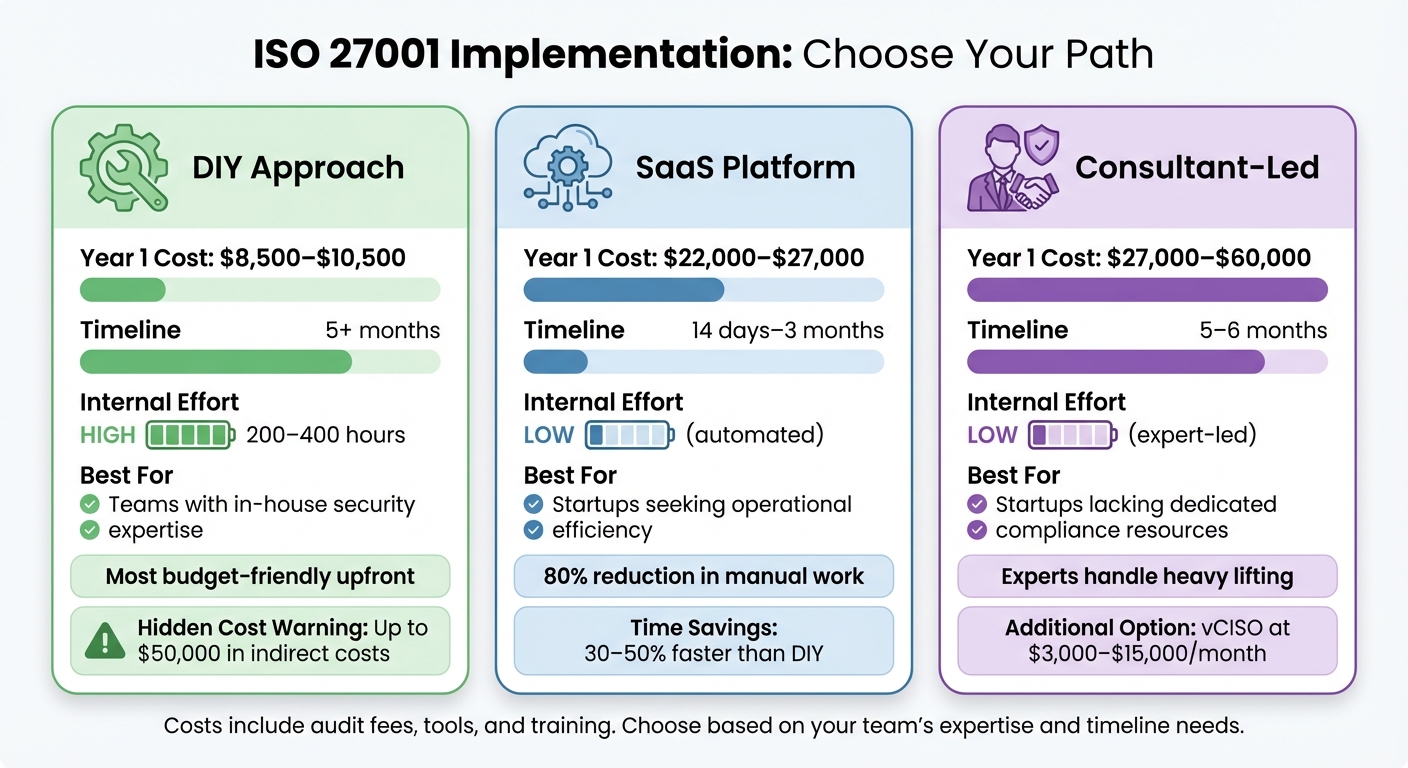 {ISO 27001 Implementation Costs: DIY vs SaaS vs Consultant Comparison for Startups}
:::
{ISO 27001 Implementation Costs: DIY vs SaaS vs Consultant Comparison for Startups}
:::
When it comes to ISO 27001 certification for startups, there are three main paths to consider. Each comes with its own cost structure, time requirements, and level of internal effort. The right choice depends on your team's expertise, budget, and how quickly you need to get certified.
DIY Approach
Taking the do-it-yourself route is the most budget-friendly in terms of direct costs, usually ranging from $8,500 to $10,500 in the first year. This includes the official ISO standards (about $350) and ISO 27001 policy templates. However, the hidden cost is the internal labor required - your team may spend 200–400 hours drafting policies, mapping controls, and preparing for audits.
"It is possible, but highly inefficient. Without a compliance platform to map controls and collect evidence, you will drown in spreadsheets."
– Travis Good, Architect of security and privacy programs [7]
This approach works best for startups with experienced security professionals on staff. But keep in mind, the process can take over five months and may lead to indirect costs of up to $50,000 due to diverted engineering time and other inefficiencies.
Using SaaS Platforms
SaaS compliance platforms, like ISMS Copilot, simplify ISO 27001 implementation by using AI and automation. These tools integrate with your existing cloud infrastructure, identity systems, and security tools to continuously monitor compliance. The first-year costs for this approach typically fall between $22,000 and $27,000, which includes the platform subscription and audit fees.
Automation can reduce manual evidence collection by up to 80%, cutting what might take months down to as little as 14 days (or up to three months). Many teams report saving 30–50% of the time they’d typically spend on compliance tasks.
A real-world example: In 2026, Officebeacon achieved ISO 27001 certification using ISMS Copilot. This tool helped them avoid over eight months of manual work by automating processes and providing AI-driven guidance for tasks like policy writing and risk assessments. Its AI capabilities have earned it the nickname "the ChatGPT of ISO 27001."
For startups looking for a middle ground between automation and expert guidance, the consultant-led approach may be worth exploring.
Consultant-Led Approach
In this option, external consultants take on most of the workload. They handle everything from drafting policies and defining the scope of your Information Security Management System (ISMS) to preparing the Statement of Applicability (SOA) and conducting risk assessments. First-year costs for this approach typically range from $27,000 to $60,000, depending on the size and complexity of your implementation.
"External consultants... do the bulk of heavy lifting in terms of helping with policy creation, defining the scope of your ISMS, preparing the SOA, risk assessments and risk treatment plans."
– Sprinto [9]
For additional support, virtual CISO (vCISO) services are available at $3,000 to $15,000 per month, a more affordable alternative to hiring a full-time CISO, which can cost over $200,000 annually. This approach usually takes five to six months but requires much less internal effort compared to the DIY route.
| Approach | Year 1 Cost | Timeline | Internal Effort | Best For |
|---|---|---|---|---|
| DIY | $8,500–$10,500 | 5+ months | High (200–400 hrs) | Teams with in-house security expertise |
| SaaS Platform | $22,000–$27,000 | 14 days–3 months | Low (automated) | Startups seeking operational efficiency |
| Consultant-Led | $27,000–$60,000 | 5–6 months | Low (expert-led) | Startups lacking dedicated compliance resources |
Ultimately, your choice should align with your startup’s expertise, resources, and the strategic cost considerations discussed earlier. Each path offers its own balance of time, effort, and expense.
Ongoing Costs: Surveillance and Recertification
Certification with ISO 27001 is not a one-time event - it’s just the beginning of a three-year cycle. Once certified, your company commits to regular audits to maintain compliance, which means planning for recurring costs. These expenses can catch startups off guard, so understanding the financial and operational requirements upfront is key.
Annual Surveillance Audits
In the first and second years after certification, you’ll need to complete surveillance audits. These audits are essentially check-ins to confirm that your Information Security Management System (ISMS) is functioning as intended. They’re less intensive than the initial certification audit, taking about one-third of the time [6].
For small startups, surveillance audits typically cost between $6,000 and $7,500 per year [6][11]. During these audits, the auditor will examine a portion of your controls, verify that you’re collecting the necessary evidence, and ensure your policies are being followed. These audits are generally straightforward as long as your ISMS is well-maintained.
"Auditors don't penalize honest gaps. They penalize opacity and slow evidence production. Your investment is in making certainty continuous."
– John Whiting, Head of Product Marketing, ISMS.online [3]
To keep costs manageable, it’s a good idea to stick with the same certification body for all your audits. Familiarity with your business can lead to better rates and a smoother audit process [6].
Recertification Audit in Year 3
At the end of the three-year cycle, a recertification audit is required. This process is as comprehensive as the initial certification audit, involving a full review of your ISMS [6][11]. The goal is to renew your certification for another three years.
The cost for recertification varies widely based on the size and complexity of your organization, ranging from $10,000 to $50,000. For most startups, the cost falls between $14,000 and $16,000 [11]. Essentially, this is similar to the expense of your initial certification, so it’s essential to budget for it.
Failing to maintain your ISMS can result in even higher costs. If you fail the audit, you’ll need to start over with a completely new certification process. Re-assessment fees are usually about 60% of the original audit cost [6].
Total 3-Year Investment
When you add up all the costs - audit fees, internal labor, security tools, and training - the total investment over three years can range from $70,000 to $112,000 [6][11]. This includes:
- Approximately 400 hours of annual labor for ISMS updates and monitoring.
- Security tool subscriptions, which cost between $6,000 and $25,000 per year.
- Staff training expenses, ranging from $500 to $1,500 per employee.
While these costs might seem high, consider the alternative: the average data breach costs $4.35 million [10]. From this perspective, ISO 27001 certification becomes a practical investment in reducing risk.
| Year | Audit Type | Estimated Cost |
|---|---|---|
| Year 1 | Surveillance Audit | $6,000–$7,500 |
| Year 2 | Surveillance Audit | $6,000–$7,500 |
| Year 3 | Recertification Audit | $14,000–$16,000 |
To make the process smoother, integrate ISMS reviews into your quarterly business planning. This proactive approach keeps you “audit-ready” year-round, avoiding last-minute stress or the need for emergency consultants, who can charge $100 to $300 per hour [6]. Continuous integration of ISMS tasks into your operations ensures you’re prepared for audits without unnecessary surprises or costs.
How to Manage ISO 27001 Costs
Keeping ISO 27001 costs under control requires smart planning and a step-by-step approach. These strategies can help reduce expenses while maintaining compliance.
Phased Scoping and Gradual Implementation
Start small by narrowing the scope of your Information Security Management System (ISMS) to just one team or unit instead of covering the entire organization right away [12]. Why? Audit costs are linked to the "effective headcount" within the scope. Fewer people mean fewer audit days and lower fees [12].
For example, a company with 50 employees might need 8 to 10 days of audit time [12]. However, limiting the scope to a 15-person product team could cut the audit time to just 3 to 4 days. With audit rates ranging from $1,500 to $2,200 per day, this could save you between $7,500 and $13,200 [12]. Once you’re certified, you can gradually expand the scope as your organization grows.
This phased approach also spreads out costs for tools and reduces "compliance fatigue" [12][4]. Instead of purchasing enterprise-level tools upfront, you can roll them out in stages as your ISMS expands.
Using AI-Powered Tools
AI-driven platforms can handle over 80% of the tasks involved in ISO 27001 compliance [1]. These tools automate time-consuming tasks like gathering evidence, drafting policies, and conducting risk assessments, freeing up your senior staff for other priorities.
Platforms like ISMS.online can significantly cut implementation time. For instance, using such tools can reduce the readiness stage from four months to just four weeks, slashing costs from around $40,000 to $2,500 [13]. Companies that use automated platforms often see a 30–50% reduction in manual work [3].
Taking it a step further, tools like ISMS Copilot (https://ismscopilot.com) act as an AI-powered assistant for ISO 27001 and other frameworks like SOC2 and NIST 800-53. Instead of hiring consultants for a costly gap analysis, you can use AI to instantly identify gaps in your ISMS and generate a checklist of actions [1]. These platforms also offer pre-built policy templates and automated risk assessments, reducing the time and effort required to create these from scratch.
Optimizing Internal Resources
Even with AI tools, your internal team plays a key role. To avoid inefficiencies, group compliance tasks into focused sprints. This prevents IT teams from wasting time reconciling fragmented audit trails, which can lead to hidden costs [3].
Timing is another way to save. Plan your certification process during slower business periods to minimize disruptions. If your company has seasonal lulls, schedule your Stage 2 audit during these quieter times. This ensures your team can focus on audit preparation without neglecting product development or customer support.
Lastly, conduct a 3- to 5-day internal audit as a "practice run" before the official audit [12]. Identifying and fixing gaps early can help you avoid the expense of re-audits later on.
Conclusion
ISO 27001 involves more than just an initial certification - it includes ongoing surveillance and a full recertification process in Year 3 [4][5]. By understanding these costs upfront, you can avoid unexpected fees and budget effectively for maintaining compliance [3]. The real cost, however, often depends on how you choose to implement your ISO 27001 program.
While self-serve templates might start as low as $299, they demand significant internal effort to execute. The cost and effort of implementation vary widely, with each option presenting trade-offs based on your team's resources and timeline.
One often-overlooked expense is hidden labor, such as IT staff spending hours reconciling audit trails, which can easily surpass direct costs [3]. This is where AI-powered tools can make a big impact. For example, platforms like ISMS Copilot remove the need for manual gap analyses - typically costing $5,000 to $6,000 - and automate evidence collection across more than 50 frameworks. This transforms compliance from a stressful, annual event into a continuous, streamlined process [8]. Beyond simplifying compliance, these tools also provide strategic business benefits.
"Auditors don't penalize honest gaps. They penalize opacity and slow evidence production. Your investment is in making certainty continuous." - ISMS.online [3]
Certification is more than just a cost-management tool - it’s also a way to reduce risks. It can cut breaches by up to 50% [3], protecting against data breaches that average $4.45 million per incident [3]. When you weigh this potential exposure against the investment in certification, the value becomes evident. By planning wisely, leveraging automation, and treating compliance as a scalable asset, you can turn ISO 27001 into a business advantage rather than a burden.
FAQs
::: faq
What’s the cheapest way to get ISO 27001 certified?
The most budget-friendly approach to achieving ISO 27001 certification involves simplifying your processes, using automated compliance tools, and minimizing dependence on external consultants. By doing this, you can cut costs effectively while still meeting all necessary compliance requirements. :::
::: faq
How can I reduce audit days without weakening my certification?
To reduce the time spent on audits while keeping your ISO 27001 certification intact, concentrate on conducting detailed internal audits. This helps you identify and fix issues early, making external audits smoother. Leverage automation tools to handle documentation and evidence collection more efficiently. Make sure your team is well-versed in ISO 27001 standards and audit processes. Address any findings from internal audits promptly and maintain organized, current documentation to boost efficiency without risking compliance. :::
::: faq
What costs should I budget for after I’m certified?
After getting certified, it's important to budget for ongoing expenses to maintain compliance. These include annual surveillance audits, which typically cost about $5,000 per year, as well as the upkeep of security tools and the work required from internal staff. Additionally, you might encounter costs for re-certification or expanding the scope of your certification down the line. Planning ahead financially can make it easier to handle these recurring obligations. :::
Related Posts
NIS2 does not bind your company. Your national law does.
Directive (EU) 2022/2555 addresses Member States, not undertakings. The fines, the reporting clocks and the authority you answer to are written in national law, and those laws arrived on twenty-seven different calendars.
The internal audit that never finds anything
ISO 19011 changed edition in May 2026. The failure mode it exists to prevent did not: the internal audit that has, by drift, stopped disagreeing with management.
Under NIS2, "important" is not a lighter security tier
Teams read the important label as NIS2-lite and scope their controls down. The security measures in Article 21 are the same either way; the tier changes supervision, some enforcement tools, and the floor on the national fine maximum.