 ISMS Copilot
Multi-Framework Compliance with AI Personalization
AI maps shared controls, auto-generates tailored policies, collects audit-ready evidence, and monitors ISO, SOC 2, and GDPR.

Multi-Framework Compliance with AI Personalization
Managing compliance for multiple frameworks like ISO 27001, SOC 2, and GDPR often feels overwhelming. Each framework has unique requirements, but many overlap - up to 60% in some cases. Organizations waste time duplicating efforts and manually tracking controls, especially with outdated tools like spreadsheets.
AI changes this by automating compliance workflows. It maps shared controls across frameworks, reduces redundancy, and keeps up with regulatory changes in real time. For example, a single policy can now address overlapping requirements, cutting manual effort by 80%. AI also ensures accuracy by grounding responses in verified standards, avoiding errors common in general-purpose tools.
Key benefits include:
- Automated mapping: AI identifies shared controls across frameworks, saving time and effort.
- Real-time updates: Adapts to regulatory changes, ensuring compliance stays current.
- Tailored policies: Creates framework-specific documentation aligned with your tools and processes.
- Continuous monitoring: Detects compliance gaps instantly and gathers audit-ready evidence.
Organizations using AI report faster certifications with 60% fewer resources. By simplifying compliance, AI lets teams focus on improving security rather than repetitive tasks.
::: @figure 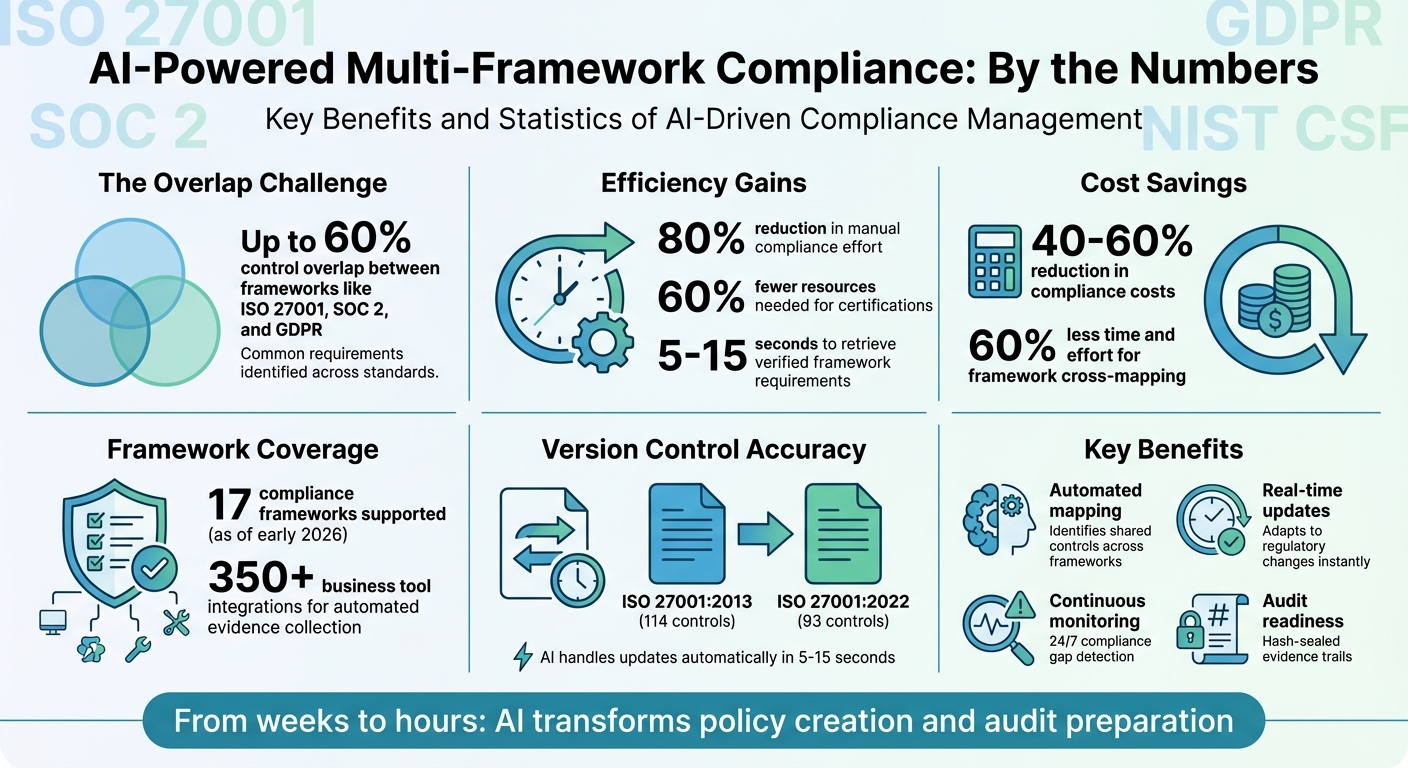 {AI-Driven Compliance: Key Benefits and Time Savings Across Multiple Frameworks}
:::
{AI-Driven Compliance: Key Benefits and Time Savings Across Multiple Frameworks}
:::
How AI Agents automate Common Control Frameworks and mappings #ai #cybersecurity #compliance
::: @iframe https://www.youtube.com/embed/K6h6XG4UReE :::
How AI Maps Controls Between Frameworks
Manually mapping controls between compliance frameworks can be a time-consuming task. To address this, AI now plays a crucial role in centralizing and streamlining the process. By identifying relationships between frameworks, AI creates a unified compliance matrix. This matrix serves as the backbone for automated compliance strategies.
Automated Control Mapping with AI
AI categorizes control mappings into four types: one-to-one, one-to-many, partial, and unmatched. This ensures that no compliance requirement is overlooked.
Modern AI systems have moved beyond traditional probabilistic semantic searches. Instead, tools like ISMS Copilot use regex-based matching to inject verified, structured framework data directly into the AI's context. This method avoids errors like "hallucinated" control numbers, a common issue with general-purpose AI systems.
"A single access control policy can satisfy NIST CSF PR.AC, ISO 27001 A.5.15-5.18, and SOC 2 CC6.1 - but only if you map the relationships." – ISMS Copilot [7]
Organizations leveraging unified compliance mapping report cutting compliance costs by 40–60% [7]. This approach also simplifies evidence submission for overlapping controls. By identifying shared requirements, teams can implement a single control to meet multiple frameworks simultaneously.
Adapting to Regulatory Changes in Real Time
AI doesn’t stop at the initial mapping - it adapts to changes in compliance standards as they happen. For example, when ISO 27001 updated from the 2013 version (114 controls) to the 2022 version (93 controls), organizations relying on spreadsheets faced the tedious task of manually updating every mapping. In contrast, AI-driven platforms handle this seamlessly. GRC engineers update a central knowledge base, and the system automatically applies those changes across all client workspaces.
AI also tracks framework versions to prevent errors like "version confusion." This ensures outdated controls aren’t mixed with current ones. Using structured markdown tables, the system defines each framework as a single object, processing updates in just 5–15 seconds [3]. This keeps teams working with the latest requirements at all times.
With continuous monitoring, compliance shifts from periodic checks to real-time oversight. AI keeps a constant eye on integrated business tools, spotting deviations between documented policies and actual implementations 24/7 [2]. These advancements make compliance not only more efficient but also more proactive, reducing the risk of surprises during audits.
AI-Powered Policy Creation and Documentation
AI has revolutionized policy creation, turning what once took weeks of research and drafting into a process that can now be completed in just hours. By aligning with specific frameworks and tailoring policies to reflect actual operations, AI delivers precision and efficiency.
Framework-Specific Policy Templates
Tools like ISMS Copilot leverage advanced framework knowledge to quickly generate policies that meet standards such as ISO 27001 or SOC 2. In just 5–15 seconds, they can retrieve verified, structured requirements from an authoritative database [3].
Accuracy is a standout benefit here. General-purpose tools like ChatGPT might mix outdated ISO 27001:2013 controls with the latest ISO 27001:2022 standards or even invent controls altogether. Purpose-built compliance AI avoids these pitfalls by grounding every response in official documentation [4].
AI also adapts policies to your specific environment. For instance, if your organization uses AWS for infrastructure, Okta for identity management, and GitHub for code repositories, the AI integrates these details into access control procedures, incident response plans, and backup policies. Instead of placeholders like "[Insert SIEM Tool]", you get actionable documentation customized to your tools and assigning responsibilities to roles such as the CISO or IT Manager.
"AI transforms policy creation from weeks of research and writing into hours of customization and review." – ISMS Copilot Help Center [9]
Another advantage is the ability to create unified policies that meet overlapping controls across multiple frameworks. For example, a single access control policy could address ISO 27001 controls A.5.15–5.18, SOC 2 CC6.1, and NIST CSF PR.AC. This reduces redundancy and saves time by consolidating documentation.
Once policies are tailored, AI further simplifies the compliance process by automating evidence collection for audits.
Automated Evidence Collection for Audits
Creating policies is only part of the compliance equation - auditors require evidence to confirm controls are actively implemented. AI simplifies this step by identifying the exact evidence needed for each control, such as SIEM logs for incident detection, IAM reports for access reviews, or backup restoration test results for business continuity [10].
A best practice for compliance is continuous evidence capture. Instead of scrambling to gather documents before an audit, organizations can document controls in real time as they are implemented. AI links policy requirements directly to their corresponding evidence types and storage locations. For example, an incident response procedure might automatically log that detection data is stored in your SIEM, containment actions are tracked in your ticketing system, and post-incident reviews are documented in meeting notes [4].
AI also simplifies audit reviews by transforming procedures into visual flowcharts, making decision points clear and easy to follow [10].
However, it’s essential to verify AI-generated outputs against official standards. Spot-checking 5–10 random control IDs can help ensure accuracy and prevent fabricated requirements - an issue more common with general-purpose models but rare in specialized tools that use zero data retention agreements [4][8].
Continuous Monitoring and Risk Prediction
Traditional compliance methods often rely on periodic audits, which can miss important changes that occur between reviews. AI transforms this approach by enabling continuous, around-the-clock monitoring. These systems integrate directly with your business tools - like cloud infrastructure and HR systems - to constantly gather evidence and verify that controls are in place and functioning as intended[2].
Detecting Compliance Gaps in Real Time
One of AI's standout features is its ability to detect compliance issues the moment they arise. By connecting with various business tools, AI platforms can instantly flag deviations from policies or unusual activities. For instance, if access reviews are overdue or backup jobs start failing, the system generates alerts well before these problems escalate or are discovered during an audit.
AI also uses intelligent framework detection to identify which compliance standards apply to your organization. By leveraging pattern matching, it ensures alignment with frameworks like ISO 27001, SOC 2, GDPR, and others - covering more than 14 frameworks supported by modern AI systems[3]. Unlike static tools that rely on outdated data, AI dynamically updates its monitoring workflows with the latest verified requirements. This eliminates confusion between older and newer versions of standards, such as ISO 27001:2013 versus ISO 27001:2022 controls[4][6].
Cross-framework mapping takes this a step further. With approximately 60% overlap in controls between frameworks like ISO 27001 and SOC 2[4], AI allows a single control to be monitored across multiple standards. For example, if there’s a gap in access control procedures, it will be flagged for all relevant frameworks. The system then generates detailed evidence checklists, showing whether controls are fully implemented, partially in place, or missing.
Beyond real-time detection, AI also helps you anticipate future compliance risks.
Forecasting Risks and Regulatory Changes
After identifying gaps, AI uses predictive analytics to evaluate potential risks and anticipate regulatory changes. Predictive risk analytics monitor key performance metrics, such as the time it takes to patch critical vulnerabilities (target: under 7 days) or the percentage of access reviews completed on time (target: 100%)[2]. If performance metrics begin to dip, the system triggers alerts, giving your team the opportunity to act before issues escalate.
"Continuous compliance monitoring is the crucial paradigm shift enabled by AI." – Vivek Thomas, CEO, Quantarra[2]
AI also performs change impact assessments automatically. For example, if you’re planning a cloud migration or adopting a new security tool, the system evaluates how these changes might affect your Information Security Management System (ISMS). It identifies which controls may need adjustment, ensuring smooth transitions without jeopardizing compliance[2]. This functionality complements earlier mapping processes by analyzing how any proposed changes might impact future audits. During surveillance audits - where typically 20–30% of controls are sampled annually over a three-year ISO 27001 cycle[11] - AI can predict likely areas of focus based on past audit findings, enabling more targeted preparation.
To manage multiple frameworks or clients, tools like ISMS Copilot maintain isolated workspaces, preventing data overlap while allowing users to seamlessly switch between regulatory contexts. With EU-based data residency in Frankfurt, Germany, and Zero Data Retention agreements, these systems also address GDPR-specific concerns that general-purpose AI tools might miss[6][8].
Measuring the Benefits of AI in Compliance
AI-driven automation can reduce manual compliance tasks by as much as 80%, allowing teams to shift their focus from repetitive administrative work to more strategic activities like managing risks. This highlights how AI can simplify the complexities of compliance across various requirements[2]. For instance, when working toward certifications like ISO 9001 or DORA, automated tools for framework cross-mapping can cut the time and effort needed by 60%[2].
Time Savings and Lower Costs
One of the standout features of AI in compliance is how it eliminates the most tedious parts of managing multiple frameworks. Tasks like taking screenshots, uploading documents, or duplicating evidence become unnecessary. Instead, AI platforms integrate with over 350 business tools - spanning cloud infrastructure, HR systems, and ticketing platforms - to automatically gather data such as configuration changes, access logs, and policies[2]. This approach ensures that a single piece of evidence can be applied across all relevant standards, whether it’s SOC 2, ISO 27001, HIPAA, or GDPR[2].
AI also alleviates the mental strain of juggling different frameworks, each with its own control numbering and terminology. This "framework fatigue" is tackled by AI acting as a quick-reference tool, delivering audit-ready answers to complex questions in just 5–15 seconds[3][8]. Additionally, specialized compliance AI uses far fewer tokens - around 1–2K - compared to sending entire framework documents, which can exceed 10K, making the process both faster and more cost-effective[3][8].
These improvements don’t just save time - they also cut costs significantly. With streamlined processes, organizations can achieve faster audit readiness and higher accuracy.
Faster Audit Preparation and Better Accuracy
Traditional audit preparation often involves weeks of scrambling to gather evidence and verify controls. AI changes this dynamic by continuously capturing evidence in real time, ensuring that organizations are always audit-ready. Through 24/7 system monitoring and hash-sealed evidence trails, AI platforms allow auditors secure, read-only access to up-to-date documentation portals[2]. This constant oversight prevents issues like control drift or policy deviations from slipping through the cracks between assessments.
"The success metrics speak for themselves: up to 80% reduction in manual effort and a significantly faster path to certification across core frameworks like SOC 2 compliance and ISO 27001." – Vivek Thomas, CEO, Quantarra[2]
Unlike general-purpose tools such as ChatGPT, which may mistakenly mix up framework versions or even fabricate controls - like confusing ISO 27001:2013's 114 controls with the 93 controls in the 2022 version - specialized platforms such as ISMS Copilot use verified regulatory texts to deliver accurate, grounded responses[3][8]. This precision is invaluable for organizations managing compliance across multiple frameworks, leading to quicker certifications, smoother audits, and a lower risk of non-compliance penalties.
Conclusion: Using AI to Simplify Multi-Framework Compliance
Managing compliance across multiple frameworks no longer has to feel like drowning in spreadsheets or duplicating efforts. AI-driven solutions simplify this process by automatically recognizing the standards you’re working with - whether it’s ISO 27001, SOC 2, or DORA - and aligning responses with verified requirements. This precision reduces the risk of errors, such as fabricated controls like the fictitious "ISO 27001 A.15.3" that can arise from general-purpose AI tools[4].
AI also enhances efficiency through automated control mapping. This feature highlights overlapping controls across frameworks, enabling organizations to address multiple standards using a single set of documentation. For example, tools like ISMS Copilot currently support 17 compliance frameworks (as of early 2026)[5] and can handle framework-specific queries in just 5–15 seconds[3]. These tools also use significantly fewer tokens - 1–2K compared to the 10K+ tokens required by older methods[8].
Precision is further improved with isolated workspaces and role-specific guidance. By creating dedicated workspaces for specific framework combinations and toggling between personas like "Implementer", "Auditor", or "Consultant", teams can customize AI responses for different compliance stages. This approach minimizes the risk of mixing client data or regulatory requirements, which can derail multi-framework projects[1]. This tailored setup ensures smoother certification processes and reinforces the time-saving benefits discussed earlier.
For organizations pursuing multiple certifications, there’s a clear roadmap. Specify the exact framework versions you’re working with (e.g., ISO 27001:2022) to ensure alignment with current standards[5]. Use mapping prompts to identify reusable documentation and verify outputs through spot-checks against official standards[4]. With Zero Data Retention agreements in place to protect sensitive compliance data[8], specialized AI tools offer a level of accuracy and security that general-purpose platforms often cannot match.
As regulatory requirements continue to grow, AI personalization has become a key resource for staying compliant without overwhelming your teams or budget.
FAQs
::: faq
How do I verify AI-generated control mappings are correct?
To ensure the accuracy of AI-generated control mappings, it's critical to cross-check the outputs against official standards like ISO 27001 or SOC 2. This involves manually reviewing each control and requirement to confirm everything is accurate and aligns with the framework's documentation.
While tools like ISMS Copilot leverage Dynamic Framework Knowledge Injection to base responses on verified data, manual validation remains a crucial step. This ensures that all mappings are consistent with the official framework guidelines. :::
::: faq
What does “continuous compliance monitoring” look like day to day?
Continuous compliance monitoring is an automated, ongoing process designed to help organizations remain audit-ready and maintain security in real time. It involves daily tasks like tracking compliance controls, verifying policies, and keeping an eye on security practices across frameworks such as ISO 27001 or SOC 2.
This method ensures that any gaps or risks are identified immediately, allowing for quick resolutions. With the help of automated tools, organizations gain real-time visibility, transforming compliance from a periodic chore into a proactive and seamless process. :::
::: faq
How can I prove controls are implemented without scrambling before an audit?
To avoid last-minute stress when proving controls are in place, focus on continuous monitoring and thorough documentation. Tools like ISMS Copilot can help by creating dashboards that track how well your controls are working. These dashboards also ensure your evidence matches the verified requirements. Keep detailed records of activities, monitoring results, and audit trails throughout the certification cycle. This approach not only shows you're prepared but also ensures transparency during audits. :::
Related Posts
NIS2 does not bind your company. Your national law does.
Directive (EU) 2022/2555 addresses Member States, not undertakings. The fines, the reporting clocks and the authority you answer to are written in national law, and those laws arrived on twenty-seven different calendars.
The internal audit that never finds anything
ISO 19011 changed edition in May 2026. The failure mode it exists to prevent did not: the internal audit that has, by drift, stopped disagreeing with management.
Under NIS2, "important" is not a lighter security tier
Teams read the important label as NIS2-lite and scope their controls down. The security measures in Article 21 are the same either way; the tier changes supervision, some enforcement tools, and the floor on the national fine maximum.